Nederlands
Triboelectric nanogenerator
A triboelectric nanogenerator turns small movements into electricity, just like a balloon you rub against your hair. It can thus act as a sensor that generates its own signal.
A triboelectric nanogenerator, TENG for short, converts movement into a small electrical voltage. It is a wafer-thin package of two different materials. When there is movement, they press briefly against each other and spring back apart. That produces electricity, without the need for a battery.
How does it work?
It works like a balloon you rub against your hair. Two different materials touch, separate again and exchange electrons in the process. This creates a small electrical voltage, in effect static electricity. 'Triboelectric' comes from the Greek word for rubbing. 'Nano' indicates that the layers are very thin.
The stronger the movement, the greater the voltage. As a result, each movement has its own recognisable pattern. A TENG yields very little current, too little to power a device. It is mainly handy as a sensor: the movement you want to measure generates the signal itself.
Why it matters
Wearable devices such as smart glasses and smartwatches suffer from their battery, which makes them heavier and has to be recharged constantly. Sensors that generate their own signal use far less power.
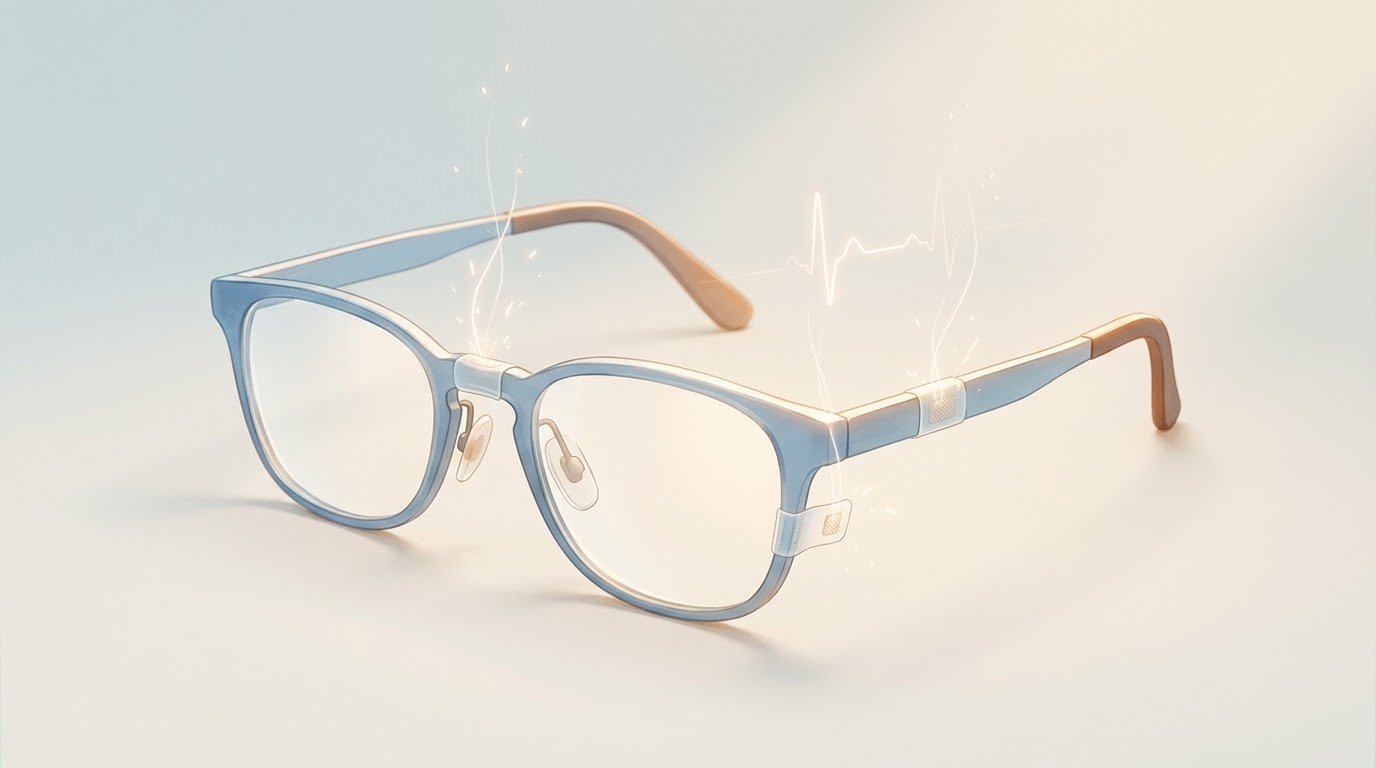
Researchers at Northwestern University built glasses with TENG sensors. These pick up pulse, firm blinking and jaw movements from the movements of the face (link). The readout electronics use only 4.1 microwatts in total. The next step is glasses that work entirely without a battery. In time, such glasses could help, for example, to monitor the health of the heart and blood vessels.
Articles about Triboelectric nanogenerator
-
Northwestern builds glasses whose sensors generate their signal from facial movements
Researchers at Northwestern University built GlassTENG: glasses with sensors that generate their signal from facial movements. They recognise the pulse, firm blinking and jaw movements, and the readout electronics use almost no power. A battery-free version is the next step.