Nederlands
Northwestern builds glasses whose sensors generate their signal from facial movements
Researchers at Northwestern University built GlassTENG: glasses with sensors that generate their signal from facial movements. They recognise the pulse, firm blinking and jaw movements, and the readout electronics use almost no power. A battery-free version is the next step.
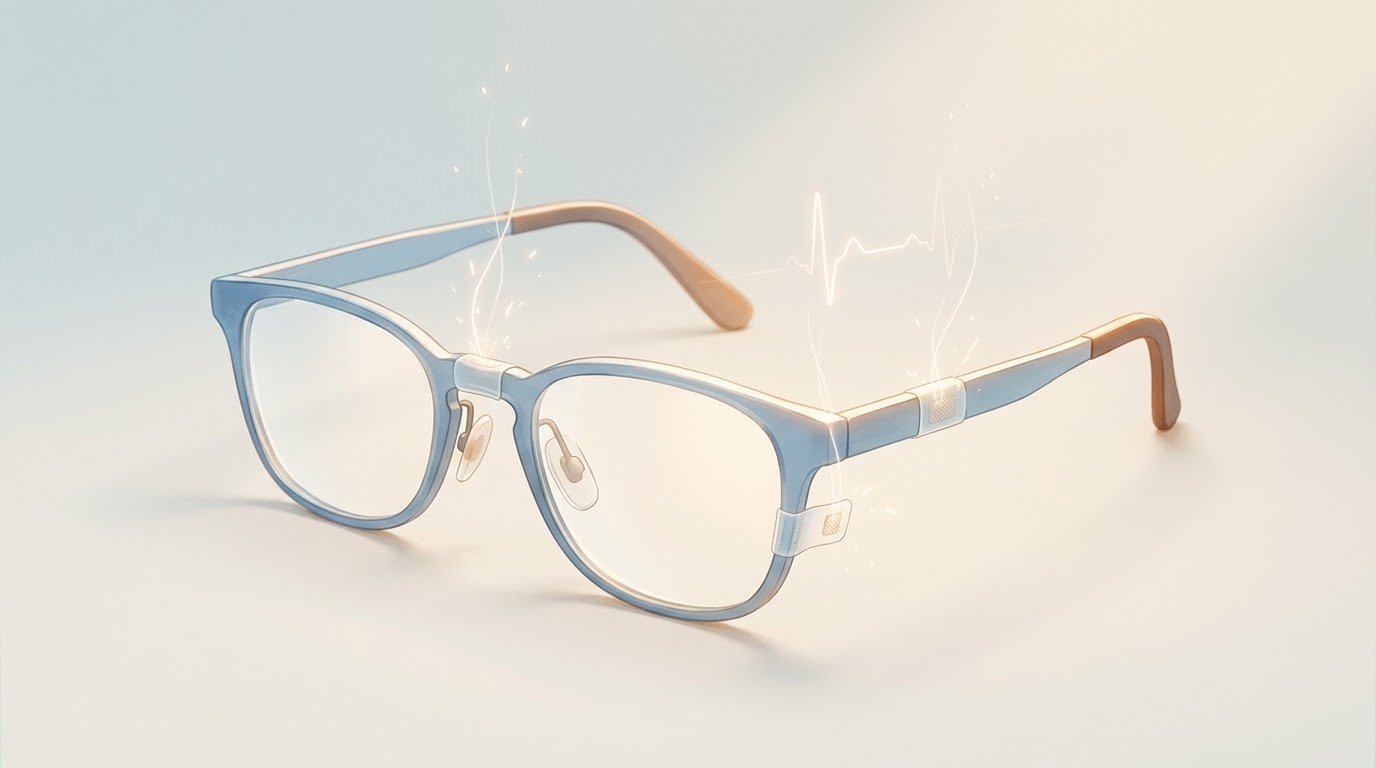
Smart glasses or a smartwatch that tracks your health have one big drawback: the battery. It makes the device heavier and has to be recharged all the time. Researchers at Northwestern University in Evanston, near Chicago, are working on a solution. They built a prototype of glasses with sensors that generate their signal from the movements of the face. The prototype is called GlassTENG. The research was led by Nivedita Arora, a lecturer in electrical engineering and computer science at Northwestern and a specialist in electronics that powers itself.
The glasses recognise firm blinking, raising the eyebrows, clenching the jaw, tapping the teeth, eating and talking. They also measure the pulse. On 15 October 2026 the researchers present their work in Shanghai at UbiComp/ISWC 2026, an important international conference on wearable technology.
Static electricity from every movement
Each sensor in the glasses is a triboelectric nanogenerator (TENG for short), a wafer-thin package of two materials: a flexible silicone rubber and a plastic similar to Teflon. Each has a very thin layer of silver on it. With a movement, the layers briefly press together and spring back again. This produces a small voltage spike. According to Arora, the movement being measured thus itself provides the energy to measure it: a blinking eye powers the sensor that notices the blink.
The stronger the movement, the greater the voltage. A pulse gives 0.05 to 0.1 volts. Blinking and raising the eyebrows give a few tenths of a volt. Firm chewing or clenching produces up to 1.5 volts. This way each movement has its own recognisable pattern.
Three places on the frame
The three sensors sit in places where there is a lot to feel. The first is at the nose pad, near an artery along the side of the nose. It picks up blinking and eyebrow movements. The second is at the temple, on a small extra arm on the frame, above the artery that you can feel beating there yourself. It mainly registers jaw movements. The third is in the arm of the glasses, just above the ear, on the temporal muscle. That is one of the muscles you chew with. All three sensors also pick up the pulse.
What the tests show
Twenty test subjects wore the glasses and carried out six actions. When blinking, they deliberately did so firmly. A machine learning model then had to say what someone was doing. Such a model is a calculation method that learns to recognise patterns from examples. Each time it was tested on a person it had not seen before. The model recognised 93.8 per cent of the actions correctly. Blinking and tapping the teeth were recognised in 99 per cent of cases, jaw clenching in 96 per cent.
The heart rate measurement also proved accurate. With ten participants sitting quietly for five minutes, the researchers compared the glasses with a chest strap that measures the heart rate accurately. On average the glasses were off by less than two beats per minute.
Talking was the most difficult. It was recognised correctly in 55 per cent of cases and was often mistaken for eating. In both, the jaw moves in a similar way. The researchers want to improve this by looking more closely at how a movement develops over time, and by testing the glasses on a large scale in daily life, outside the lab.
Almost no power needed
The sensors themselves need no power to turn movement into a signal. A small electronic circuit makes that signal readable. For the three sensors together it uses 4.1 microwatts: about four millionths of a watt. Common ways of measuring heart rate or muscles, such as the light and light sensor in many smartwatches, use hundreds to tens of thousands of times as much, according to the researchers. They illustrate this with smart glasses running on a small battery. An ordinary optical heart rate sensor would cost one and a half to almost ten hours of battery life there. Their three sensors together would cost less than half a minute.
To read out and process the signals, the prototype still uses ordinary electronics with a power source. In the research, the measurements were stored on a memory card and analysed afterwards. According to Northwestern, the glasses can also send the data to a phone or tablet via Bluetooth.
What comes next
The next step is glasses that work entirely without a battery. To do this, the researchers want to link the sensors to an extra-efficient chip and harvest the energy needed, for example from light or from the sensors themselves. Arora also wants the calculations to be done on the glasses themselves. Then the glasses can give a signal immediately, for example to relax the jaw when it is unconsciously tensed. Fellow researcher Nabil Alshurafa, who also works at Northwestern's medical school, envisions glasses that recognise unconscious behaviour, such as jaw clenching or snacking, and help the wearer deal with it consciously.
In the long term, the researchers hope that such glasses can help monitor the health of the heart and blood vessels, teeth grinding and jaw clenching (bruxism), fatigue and eating behaviour. Because the glasses measure the pulse in three places at once, they also see a possible route to measuring blood pressure without a cuff around the arm. These applications are the goal of follow-up research. The glasses in the study were still a test version with separate electronics; a more compact version is the next step. They also want to remove the small extra arm at the temple, so that the glasses look like ordinary glasses.
What does this mean for the road to the singularity?
AI only becomes truly personal when it knows how someone is doing, at that very moment. That requires sensors that can be worn all day without thinking about them. GlassTENG shows that the measuring itself need cost almost no energy, and that a learning model can get a lot out of these simple signals. If the computing and the connection also become efficient enough, ordinary glasses can become a quiet health assistant that never needs a charger. According to Arora, about half of all people already wear glasses, so such a step could reach a great many people. This research lays an important foundation for that.
What is the technological singularity? Read the explanation →