Nederlands
Tokens
Tokens are the pieces of text a language model reads and writes: often a short word or part of a word. The speed, cost and memory of AI are measured in tokens.
A language model does not read and write in whole words or letters, but in tokens, also called word pieces. A token is a piece of text: a short word, part of a long word, a punctuation mark or a space followed by a word. You can compare it to words being chopped into syllables before the model gets to work on them.
How does it work?
Before a model processes a text, the text is split into tokens. Each token gets a number, and the model calculates with those numbers. An answer usually emerges token by token: the model picks the next piece, adds it and then looks at what fits next.
That is why tokens are used as a measure everywhere. A model's speed is given in tokens per second. The amount of text a model can take in at once is the number of tokens that fit in its working memory. And the price of an AI service is often calculated per million tokens going in and per million coming out. Long texts and long chains of reasoning therefore cost more tokens, and with them more computing time and money.
Why it matters
Tokens make it easy to see what AI work costs. According to its maker, the American company Inception's AI model Mercury 3 writes more than a thousand word pieces per second, because it finishes a text in a few rounds all at once instead of token by token (link). That makes AI faster and cheaper.
For heavy work the numbers climb quickly. Anthropic has Claude supply a mathematical proof with software, which is then checked step by step, and a single such proof can cost hundreds of millions of tokens (link). When computing becomes more efficient, that number drops. For anyone reading news about AI, it is useful to know that a token is not a word, but a building block of a word.
Articles about Tokens
-
New AI memory condenses a whole stack of documents into 16 tokens for each question
Researchers from Stanford and other institutions built Memorilla, a memory that condenses a whole collection of documents into 16 tokens for each question. In their own tests, a language model usually scores better with it than with all the text, and answers much faster. Exact names are sometimes lost.
-
Thinking Machines Lab releases Inkling 2 Small, open version to follow after safety tests
The AI company of former OpenAI executive Mira Murati has started its second generation of models with Inkling 2 Small. The model is available through the company's own platform, Tinker. The company wants to release it next week, once the external safety tests are finished.
-
Unsloth shrinks a large open AI model from Alibaba and, by its own tests, makes it more accurate than other versions
Unsloth has released new, smaller versions of Qwen3.8-Flash-Next, a large open AI model from Alibaba. By its own tests, they score 15 per cent higher on average than other shrunken versions. This lets more people run the model on their own computers.
-
Tencent releases Hy4: an open AI model that understands images and operates a computer
China's Tencent has released Hy4, a large language model that understands images for the first time and can operate a computer on its own. According to Tencent, it makes things up far less often than the previous version. The model files will be freely available in the coming days.
-
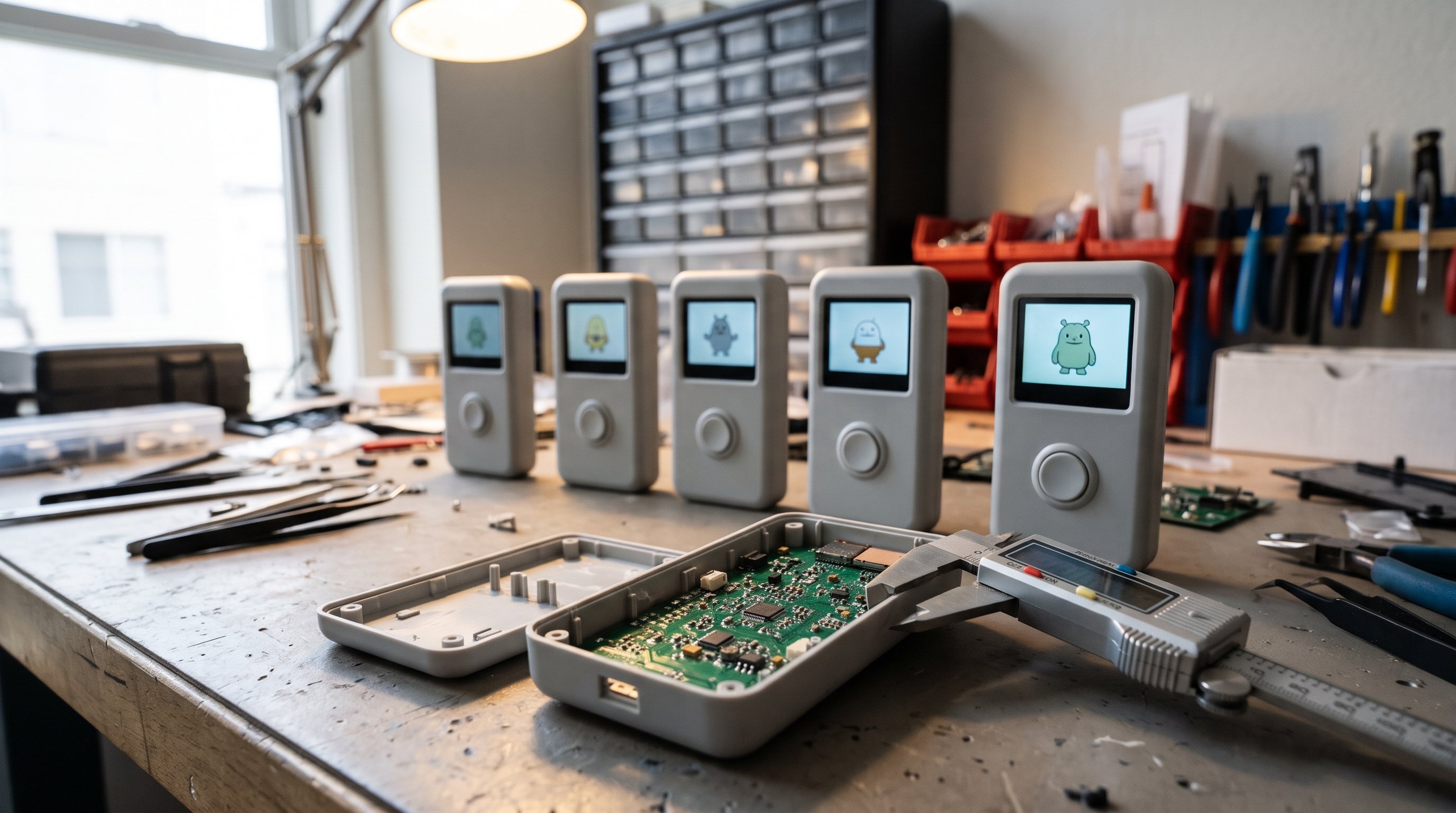
OpenAI uses its AI for hardware design: from 3D models to circuit boards
OpenAI shows how ChatGPT and Codex help engineers design physical products. Two employees had the GPT-6 Astra model design a working prototype in less than a week. Getting it made in a factory still took several rounds of checks by humans.
-
Anthropic builds FlashProve: cryptographic proof of which AI model produced an answer
Anthropic has released FlashProve, an open-source research prototype that uses zero-knowledge cryptography to show which model generated an answer, without revealing the model weights.
-
Chinese company releases free AI model for chemistry, trained on its own lab work
The Chinese company Deep Principle has released Hydrogen-1.0, an AI model for chemistry and materials research that anyone can download. It also learned from failed experiments in the company's own lab. The results have so far been measured by the company itself.
-
Meituan releases LongCat-2.5: a multimodal agent model with 1.6 trillion parameters, trained on Chinese chips
On 2 November the Chinese company Meituan released LongCat-2.5, a large AI model that handles text and images and can carry out long programming tasks on its own. According to Meituan, it was trained entirely on Chinese chips and comes close to Claude Opus 5 in tests.
-
Developer builds a complete processor inside the weights of an AI language model
Developer Divyansh Agrawal built a complete processor inside the weights of the language model Qwen 3.5. In his tests, the model now calculates almost without errors, with no outside tool. It is still a slow experiment, but everything is online for anyone to see.
-
Chinese hacking group used AI agents against more than 200 organisations
A Chinese hacking group used AI agents to attack more than 200 organisations in at least 14 countries in eleven days, security company CrowdStrike reports. They broke into nine of them. CrowdStrike shares how to recognise these attacks.
-
Google presents Gemini 4 Carbon: better at finding and fixing security flaws
Two weeks after Gemini 4 Argon, Google DeepMind has released Carbon, which Google calls its strongest AI model so far. It excels at computer security and long tasks. Security experts get access first.
-
AI agents turn old console games into PC versions, but the volunteer community is struggling with it
With smarter AI models and the free toolkit Reverse Engineer Anything, dozens of unofficial PC versions of console games are appearing in a short time. The site that tracked this work is closing its leaderboard: according to its creator, the fast AI work is hurting the community.
-
Anthropic: Claude also disproves a conjecture about computing time that is almost thirty years old
Anthropic says an internal Claude model found a faster way to solve a famous computing puzzle on its own. OpenAI reported the same result shortly before, as one of its three AI breakthroughs. A computer has already checked the proof; mathematicians are now looking at whether it holds.
-
New mid-sized OpenAI model operates the computer by itself, at half the price
OpenAI has released GPT-6.1 Terra, the second-smallest model in its range. It operates computer programs better than its predecessor, makes up answers far less often and costs less than a third per task. For now it is only available to paying users.
-
Chinese AI model Kimi K3.1 Pro ranks fourth in independent leaderboard
Kimi K3.1 Pro from the Chinese company Moonshot AI ranks fourth in the independent leaderboard of Artificial Analysis, ahead of the newest models from OpenAI and Google. It improved most in independent computer work. Moonshot plans to release the model by 4 November.