Nederlands
CRISPR
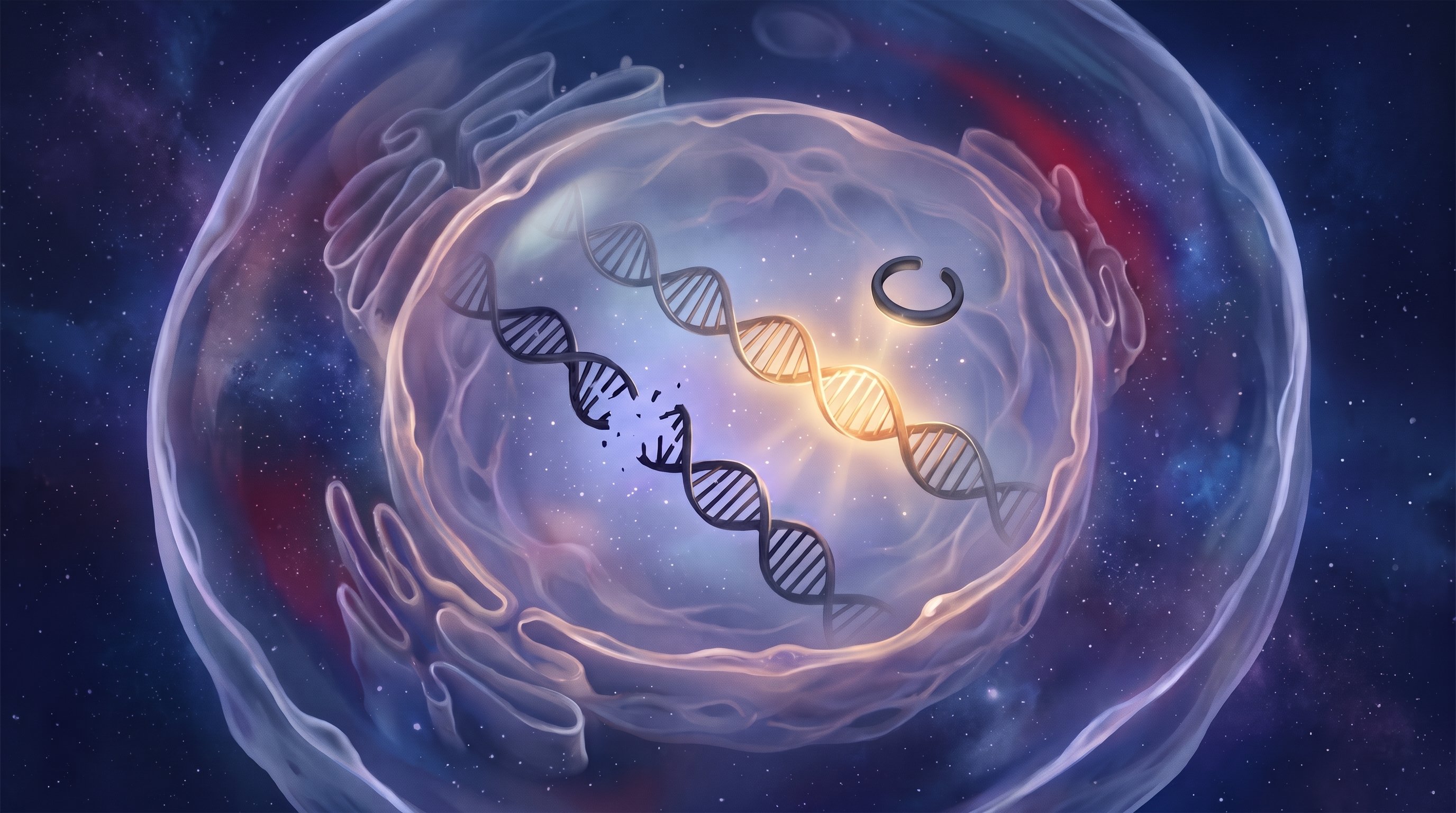
CRISPR is a technique that lets researchers cut at a chosen spot in DNA or edit genetic material very precisely. It was borrowed from a defence mechanism of bacteria.
CRISPR is a way of editing the DNA of a cell in a targeted manner. DNA is the blueprint of an organism, written down as a long series of letters. With CRISPR you can find a particular piece of that text and change something there, much as the search function in a word processor takes you to a word.
How does it work?
The technique comes from nature. Bacteria use a system called CRISPR to recognise viruses and make them harmless. Researchers discovered that they could use that system as a tool.
The tool has two parts. The first is a piece of RNA, a copy of a stretch of genetic code, which looks for the spot in the DNA that matches it. The second is a protein, for example Cas9, which cuts the DNA there. The cell repairs the break itself, and researchers can steer that repair to switch a gene off or change it.
Newer variants do not cut the DNA all the way through. With base editing, a single letter is replaced. With prime editing, a small piece of text is rewritten, like a find-and-replace function. Other variants only switch a gene on or off, without changing the code itself.
Why it matters
Many hereditary diseases are caused by a fault in a single gene. CRISPR techniques are therefore an important area of research for treatments that tackle the cause. The company Prime Medicine treated a patient for the first time with prime editing directly inside the body: a single infusion is meant to repair a DNA fault in the liver in Wilson's disease, a hereditary copper disorder. The study has only just begun, and first results follow in 2027 (link). In Melbourne, researchers switched a group of non-working genes back on in Prader-Willi syndrome, using the healthy spare copy that every cell has, in patients' cells and in mice (link).
It also plays a role in cell therapy, in which immune cells are used as a medicine. Researchers at WEHI in Melbourne edited those cells with prime editing so that doctors can steer them with two existing medicines: one helps the cells grow, the other slows them down again (link). The next step is a first study in people.
All of these applications are in research or at an early stage of treatment. A doctor assesses what suits a patient.
Articles about CRISPR
-
Researchers wake up silent, healthy genes in Prader-Willi syndrome
In Prader-Willi syndrome a group of genes does not work, even though every cell has a healthy back-up copy. Researchers in Melbourne switched that copy back on by removing one protein, in patient cells and in mice. Work on a medicine is now under way.
-
Precise DNA correction used inside a patient's body for the first time
Prime Medicine has for the first time treated a patient with prime editing directly inside the body. A single infusion is meant to repair a DNA error in the liver in Wilson's disease, an inherited copper disorder. The study has just begun; first results are expected in 2027.
-
Nearly 2,000 AI agents from OpenAI work through an atlas of 7.7 million brain cells in 32 minutes
OpenAI had nearly 2,000 AI agents work at the same time on one large dataset of mouse brains. In 32 minutes they came up with explanations and new research ideas, work that would take people months. The next step is to test the best ideas in the lab.
-
Australian researchers give doctors a 'switch' to control immune cells as medicine
Researchers at WEHI in Melbourne have modified immune cells so that doctors can control them using two existing medications: one helps the cells grow, while the other inhibits them. The next step is a first study in humans.