Nederlands
AI reaches gold-medal level at the International Mathematical Olympiad
An advanced version of Google Gemini solved five of the six problems at the Mathematical Olympiad and scored 35 out of 42 points. The organisers marked the answers themselves. Last year AI reached silver, and only after days of computing.
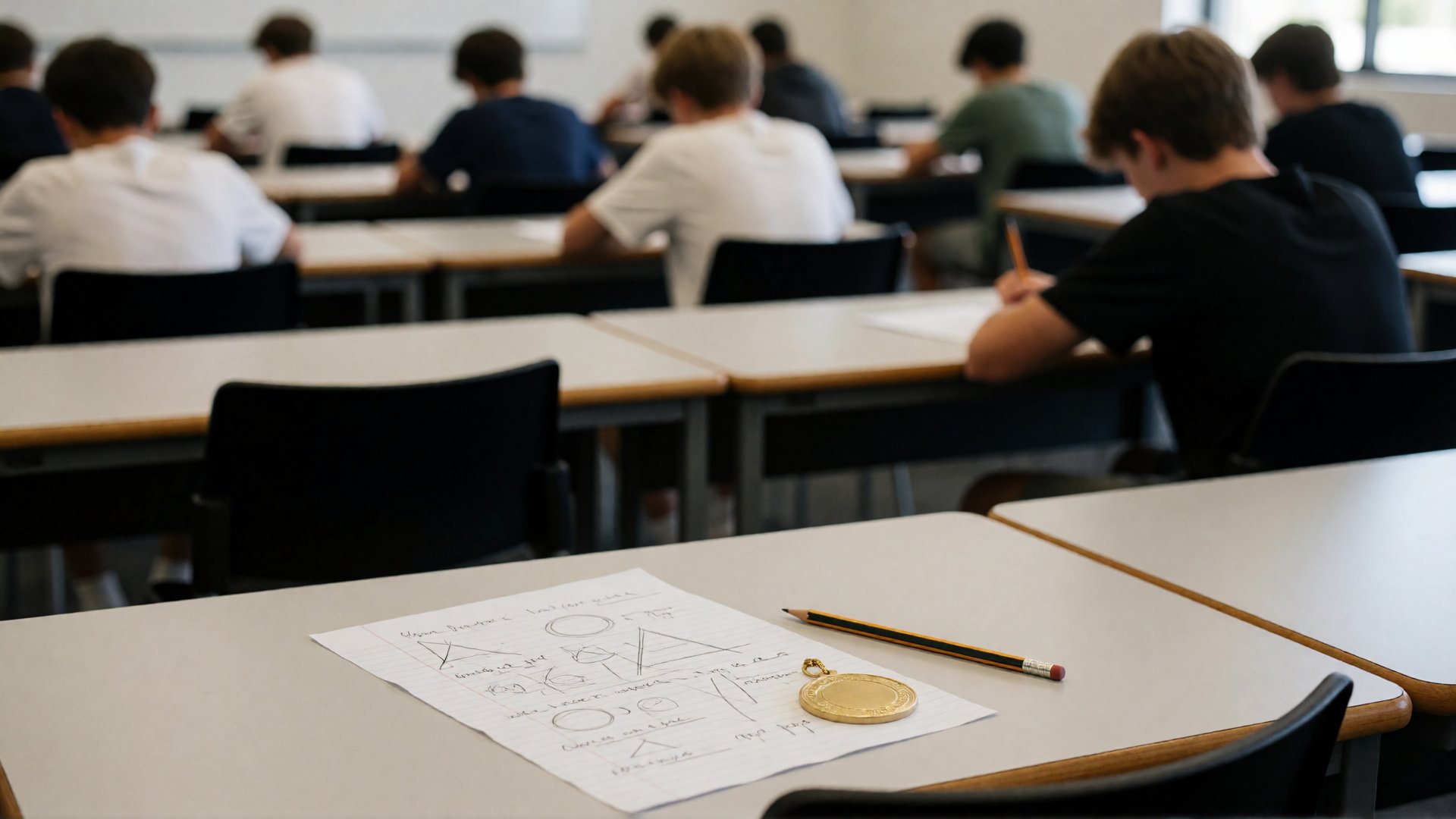
LONDON, JULY 2025 - An AI model has reached gold-medal level at the International Mathematical Olympiad, the best-known maths competition for school students. Google DeepMind reports that an advanced version of Gemini, in a mode called Deep Think, solved five of the six problems completely. That is worth 35 out of 42 points. The Olympiad organisers marked the answers under the same rules as for the human contestants. President Gregor Dolinar says: "We can confirm that Google DeepMind has reached the much-desired milestone."
What the Olympiad is
The Olympiad has existed since 1959. Each country sends six school students who have not yet started university. They get six very hard problems from algebra, combinatorics, geometry and number theory. These are not sums with one standard method: the contestants must come up with a proof themselves and write it down clearly. Half of the contestants receive a medal, and about 8 per cent receive gold.
How it went last year
In 2024, two DeepMind systems, AlphaProof and AlphaGeometry 2, reached the level of a silver medal. They solved four of the six problems and scored 28 points. They did need a lot of help from people. The systems could only work in a formal language, a strict computer language for mathematics. Experts first had to translate the problems and the proofs. The computing time was two to three days.
What was different this year
The new model read the problems as they appear on paper, in ordinary language. It also wrote the proofs in ordinary language, within the time limit of 4.5 hours. No translation was needed. The Olympiad's markers found the solutions clear and precise, and most of them easy to follow.
The model uses what DeepMind calls parallel thinking. An ordinary language model follows one line of thought. Deep Think looks at several possible solutions at the same time and combines them. The model was also trained with new forms of reinforcement learning, in which it receives a reward for good steps in a line of reasoning and in a proof. It was given a collection of good solutions to maths problems to learn from, and its instructions contained general tips for tackling Olympiad problems.
Caveats
The Olympiad has confirmed that the submitted answers are complete and correct. The review did not cover the system itself or the model underneath it. DeepMind reports that it is part of a first group whose results were checked this officially.
A version of the model will first go to testers, including mathematicians. After that, it will be rolled out to subscribers of Google AI Ultra.
Looking back from 2026
In September 2024, OpenAI's o1 was released. On a maths test for school students it scored 74 per cent of the points on average. Ten months later, an AI model reached gold level at the world's toughest competition for school students. That is a big leap in a short time. These problems have no fixed approach and call for creativity, a level that few young people reach.
Mathematics is a good testing ground, because a proof is either correct or it is not. A model that is strong here can also help with other reasoning tasks. DeepMind wants to keep developing AlphaProof and AlphaGeometry, and expects that systems that combine natural language with strict, checked reasoning will become useful for researchers. The next step is for such models not only to solve competition problems, but also to help find genuinely new mathematics.
Sources
In the glossary: Language model