Nederlands
AI agents run DNA experiments on their own in a robot lab
In AutoDNA, a lab at Shanghai Jiao Tong University, AI agents design DNA experiments and carry them out themselves, using more than twenty types of equipment. People only refill materials and maintain the machines. The research is published in Nature.
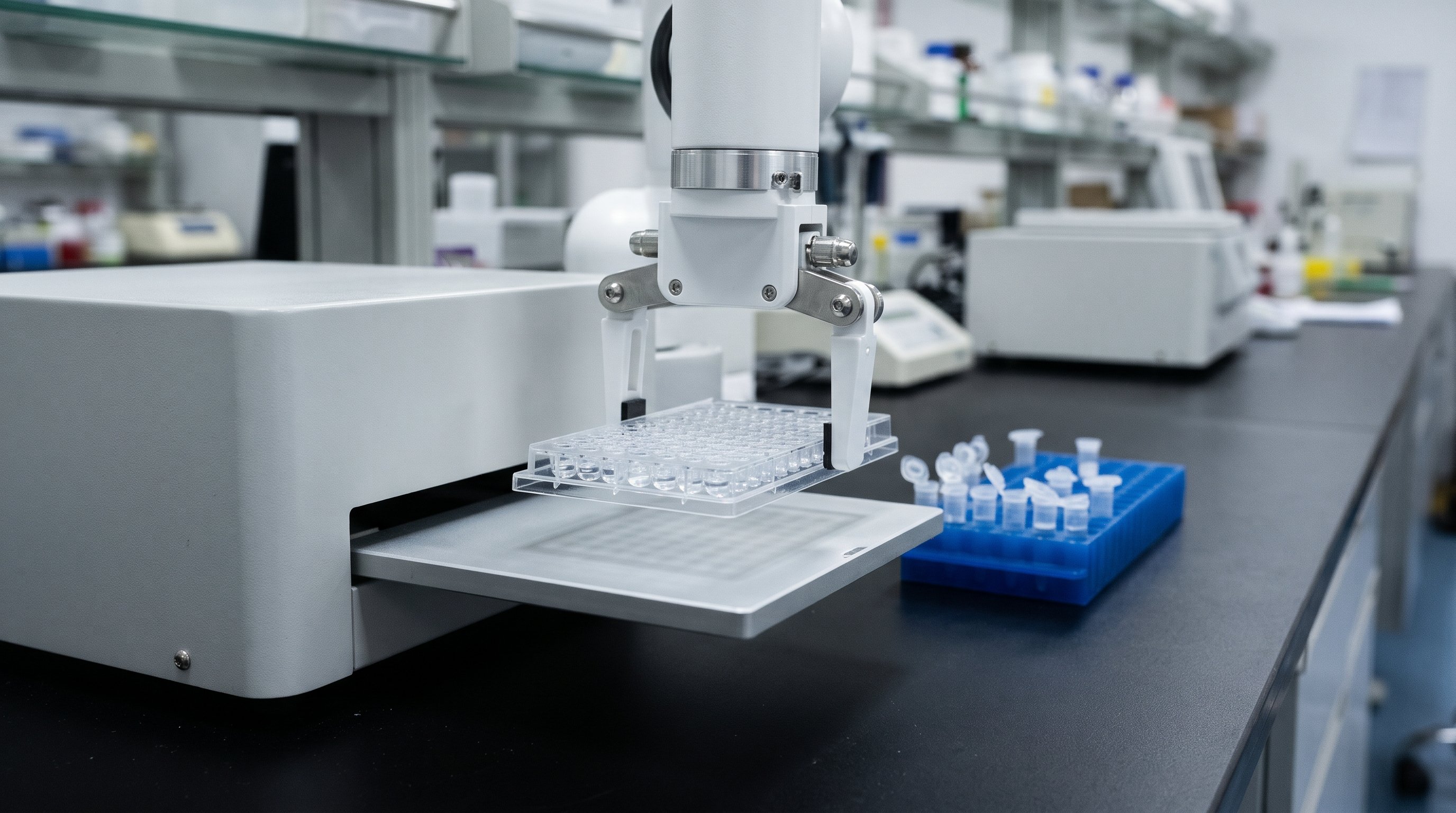
AI can come up with a promising molecule in a few minutes. But testing that idea in the lab often takes weeks or months of human work: pipetting, setting up machines, reading results. Researchers at Shanghai Jiao Tong University in China show that AI can increasingly do this second part by itself as well. Their lab, called AutoDNA, is described in the scientific journal Nature, in an article published on 4 November 2026.
The work itself is older. The researchers put a first version of their paper online as a preprint in July 2025. Scientists often share a preprint while fellow researchers are still checking the work before a journal publishes it. That checking usually goes back and forth several times and takes time: more than a year passed between the preprint and the article in Nature.
In AutoDNA, AI agents plan experiments with DNA and RNA and also carry them out. An AI agent is an AI program that takes steps on its own to reach a goal, instead of only answering a question. A person gives the task. After that, according to the researchers, human hands are only needed to refill materials, such as liquids and disposable tubes, and to maintain the equipment.
A team of AI agents
The system consisted of several AI agents, each with its own task. According to the project's public code, there was, among others, an agent that searched the scientific literature, one that wrote the step-by-step plan of an experiment, one that kept track of the substances needed and one that controlled the equipment. The agents worked with Gemini 2.5 Pro, the AI model that Google released in spring 2025. When the team ran the experiments, it was Google's most powerful model and probably one of the best AI models available. A separate planner divided the work across the machines, so that devices could work on different tasks at the same time.
Computer scientist Haibo Chen, one of the researchers, tells Nature why they took this approach. In many existing automated labs, people still have to set up the instruments themselves, and AI does only one part of the work. Biological lab work is hard to automate, because it consists of many steps that have to be done very precisely. So the team built the lab around AI from the start, instead of adding AI to an existing lab.
What the lab showed
The lab controlled more than twenty types of equipment and carried out more than 11,000 steps in total. It could do the basic tasks with genetic material: making DNA, copying it into RNA, multiplying it and reading the order of its building blocks.
The researchers tested the lab in four ways:
- It made DNA with an enzyme and reached the same yield as an experiment optimised by experts.
- By letting devices work at the same time, it carried out several step-by-step plans 3.2 times as fast.
- It stored a message in DNA and then read it back without errors. The message was a well-known saying about intelligence that is often wrongly attributed to Stephen Hawking.
- In patient material it found a known mutation in the KRAS gene, a gene often involved in cancer, and confirmed it with a second test.
Reactions from other researchers
Chemical engineer Milad Abolhasani of North Carolina State University tells Nature that AutoDNA is remarkable, because it works so independently and can combine so many different devices. According to him, the science of the future will have many autonomous labs. James Zou, a researcher at Stanford University, writes in an accompanying piece in Nature that AutoDNA shows that AI can start to close the gap between designing an experiment and carrying it out.
The lab did not yet work entirely without people: someone had to refill the supplies and maintain the machines. The researchers have made their code public, so that other teams can rebuild and test the system. That is also the next step: showing that such a lab works just as well in other laboratories and with other kinds of experiments.
What does this mean for the road to the singularity?
AI has been helping researchers with calculations for years: analysing data, making predictions, searching literature. The actual experimental work remained human work, and that is often the slowest link in science. AutoDNA is a step towards AI that does not only design experiments, but also carries them out itself and responds to the outcome.
That already worked with an AI model from spring 2025. Since then, AI models have become much better at planning and at solving unexpected problems. A lab with the same set-up can therefore probably do even more by itself with a newer model. If such labs work more widely and prove reliable, the pace of biological research could go up, for example when testing new diagnostics. AI could then more and more often complete the whole circle of idea, experiment and result by itself.
What is the technological singularity? Read the explanation →