Nederlands
Doomsday: Friday 13 November 2026. Why it is now about AI
In 1960, three researchers calculated in Science that the world's population would become infinitely large on Friday 13 November 2026. How did they get there, how did it turn out, and why is their calculation interesting right now for anyone who wants to know how fast AI is advancing?
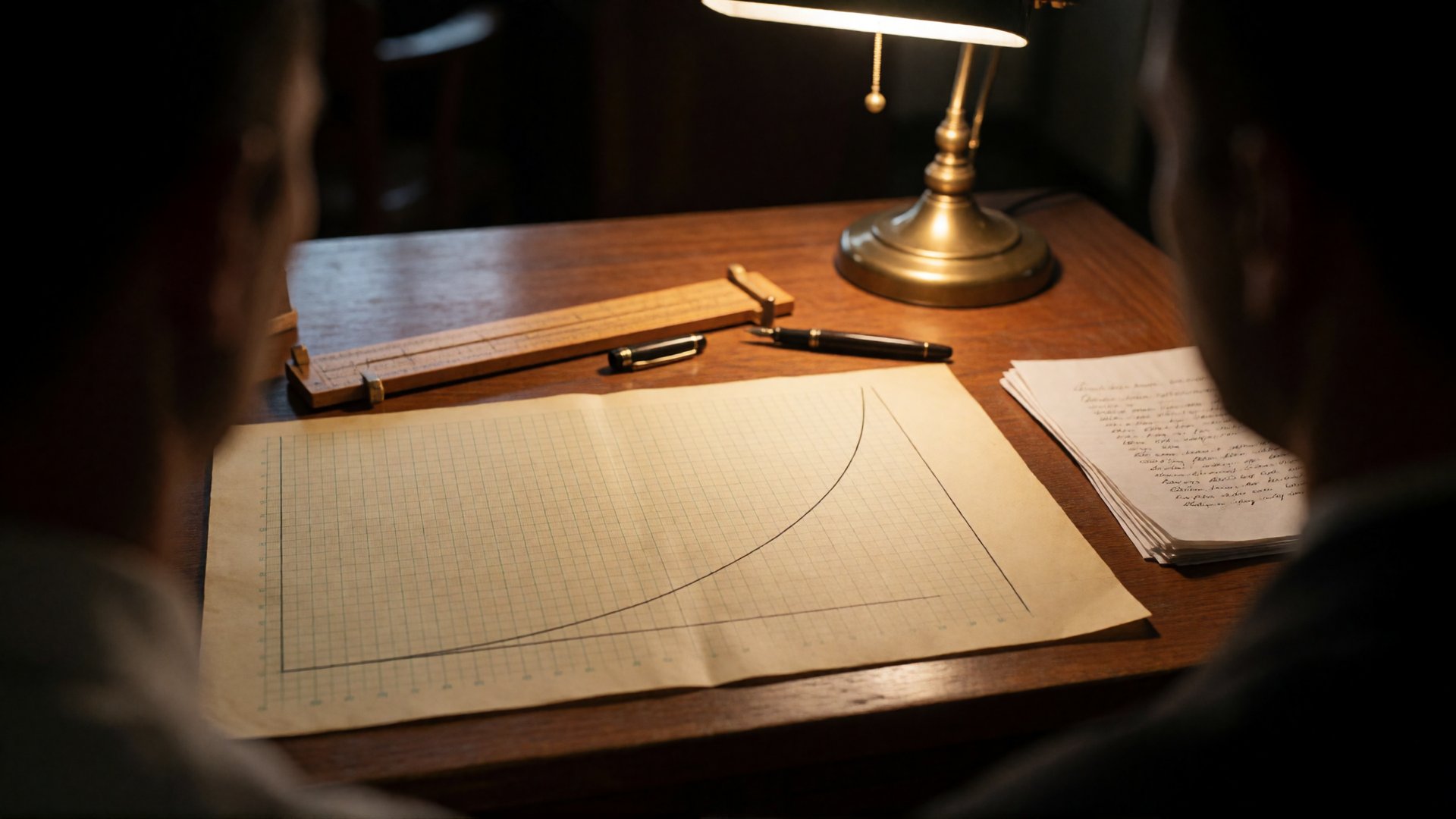
On 4 November 1960, the scientific journal Science published an article titled "Doomsday: Friday, 13 November, A.D. 2026". The Austrian-American physicist Heinz von Foerster and two of his students at the University of Illinois calculated in it that the world's population would become infinitely large on that day. That day is this coming Friday.
Over the past year, the article has been shared online more and more often as a prediction of the end of the world. That is not how it was meant. Their formula came out at the end of 2026, and making it exactly Friday 13 November was a wink: on that day, Von Foerster, who was born in Vienna on 13 November 1911, would turn 115. The mathematics behind it was serious, though. It shows how to measure whether something is not just growing fast, but growing faster and faster. That is exactly the question that AI raises today.
Growth that speeds itself up
With ordinary growth, which mathematicians call exponential, something doubles again and again in the same amount of time. A well-known example is a pond with water lilies that double in number every day. If the pond is full after 30 days, it is only half full on day 29. On day 25, the lilies still cover only about 3 per cent of the water. For a long time, little seems to happen, and then suddenly it goes fast. Yet the pace stays the same: one doubling every day.
For a long time, the world's population grew differently: each doubling went faster than the one before. How many people lived in the past can only be estimated. According to the series from Our World in Data, which combines estimates by historians, there were about 250 million people around the year 500 and about 500 million around 1500. That doubling therefore took about a thousand years. According to the United Nations, there were 1 billion people for the first time around 1800, about three hundred years later. After that, it took more than 120 years to reach 2 billion, in 1927. The next doubling, to 4 billion in 1974, took only 47 years. According to Von Foerster's formula, the doubling time would then become much shorter again. But the step to 8 billion, in 2022, took 48 years. Why that last doubling did not get shorter is explained further on.
Von Foerster and his students looked for a formula that fitted 24 estimates of the population over the last two thousand years. Their explanation was that the growth feeds itself. More people can work together better and come up with more, such as better farming and medicine. As a result, more people survive, and they come up with still more.
In their formula, each doubling takes about half as long as the one before. With the water lilies, that would mean: the first doubling takes one day, the next half a day, then a quarter of a day, and so on. However many doublings you add up, together they never take longer than two days. For the population, it is a matter of years, and in the formula the end point lay on 13 November 2026. At that end point, the result of the formula becomes infinitely large. In mathematics, such a point is called a singularity.
Why the population levelled off
For a long time, the formula fitted surprisingly well. According to the Canadian historian Alan MacEachern of Western University, who wrote about it this autumn for the news site The Conversation, the real population visibly fell behind the formula from about 1993, halfway between 1960 and 2026. According to the UN, more than 8 billion people live on Earth now, not 200 billion.
The turning point actually came in the 1960s. Around 1963, the world's population grew fastest, at more than 2 per cent a year, and then slower and slower. Families became smaller, partly because fewer children died young, contraception became easier to get, and more women went to school and went out to work. In the 1960s, a woman had five children on average, now just over two. Even so, many people were still added for years: there were so many young people having children of their own that even a smaller family per couple still meant many births in total. That is why the difference from the formula only became noticeable later.
The last doubling shows this clearly. According to the UN, there were 8 billion people on 15 November 2022. The step from 4 to 8 billion therefore took 48 years, one year longer than the doubling before it. According to the formula, that step should have taken about 23 years. For the first time in centuries, the doubling time did not get shorter, but even a little longer. The UN now expects the world's population to peak in the 2080s at about 10.3 billion people. A next doubling, to 16 billion, is probably not coming.
The same yardstick for AI
What remains of the 1960 article is the way of measuring. That a number goes up says little, because almost everything in technology is growing. The question is whether the doubling time itself is getting shorter. That is the difference between fast and faster and faster.
For AI, this is now being measured. The research institute Epoch AI keeps track of how much computing work computers had to do to train the most important AI models. Until about 2010, this doubled every 20 months, roughly at the pace of Moore's law: the rule of thumb that the number of switches on a chip doubles about every two years. When researchers then started training ever larger AI models and using ever more chips at the same time for it, this became every 6 months. For the largest language models, such as those behind ChatGPT and Claude, Epoch has measured a doubling every 5 months since 2020.
A second measurement is about what AI can do on its own. The non-profit organisation METR, which tests AI models, gives models jobs, mostly from programming and computer security, that an experienced human needs an hour for, for example. If a model completes half of such jobs successfully, METR says the model can handle tasks of one hour. According to METR, this task length doubled about every 7 months over the whole period from 2019 to 2025. A new calculation in January 2026 also looked only at the newer models. For the models from 2023 onwards, METR arrived at a doubling every little over 4 months, and for the models from 2024 onwards at about every 3 months. These are estimates with a wide margin: with a new set of tasks, the outcome turns out somewhat differently, according to METR, and tasks that take a human more than 16 hours cannot yet be measured reliably.
A third measurement is about price. The testing firm Artificial Analysis gives AI models from different years a score on the same scale and keeps track of what the cheapest model costs that reaches a certain score. An example: in November 2025, Google released Gemini 3 Pro, then one of the best models. Anyone who had that model write paid 12 dollars per million tokens, the word fragments into which a model divides text. At the end of April 2026, DeepSeek V4 Flash, from the Chinese company DeepSeek, reached almost the same score for under 30 US cents per million tokens: more than 40 times cheaper, five months later. That meant the price for that level halved about every month. At a higher score, it went just as fast. The programming model GPT-5.3 Codex from OpenAI, the company behind ChatGPT, cost 14 dollars per million tokens in February 2026. At the end of July, a newer version of DeepSeek V4 Flash reached that score for 28 US cents: 50 times cheaper, a little over five months later. Each new top level does start expensive again.
The mechanism that Von Foerster saw in the population, growth that feeds itself, is also being studied for AI. For AI, the question is whether better AI helps to make still better AI faster. METR estimated in early November that the AI company Anthropic, the maker of Claude, is now improving its models on clearly defined tasks about twice as fast as in the year and a half before. According to METR, the biggest part of this is probably because AI helps with its own research. That is an estimate for one company, with a large margin of error.
What the figures do not say
A doubling time that gets shorter for a few years is not yet proof that it goes to zero. That is exactly the lesson of 1960: the population grew faster and faster for centuries and still levelled off. The American economist Javier Birchenall of the University of California, Santa Barbara, looked back at Von Foerster's article in Science in early October. According to him, the mathematics was not wrong, but Von Foerster took a temporary pattern for a fixed law. According to Birchenall, the same caution applies to AI: the current pace can be real and have big consequences, without the growth therefore continuing to speed up endlessly.
There are also hard limits. The power needed to train the largest models doubles a little more than once a year, according to Epoch. The largest training runs already used more than 100 megawatts last year, and the largest AI data centres came close to a gigawatt at the start of this year, about the output of a large nuclear power station. Such a power figure says how much energy flows through at any moment, like the 10 watts on an LED lamp: the longer it runs, the more energy it costs in total. Models are becoming more efficient per task, but according to Epoch, companies mainly put that gain into larger models. That is why power use still grows.
If you start from a training run of a few hundred megawatts and keep doubling once a year, then around 2040 a single training run will use, at any moment, as much energy as all people on Earth now use together at that same moment: all factories, cars, heating and appliances combined. After about 30 doublings, around 2055, a single training run would use, at any moment, as much energy as all the sunlight reaching the Earth at that moment. After about 60 doublings from now, around 2085, a single training run would use, every second, as much energy as the Sun radiates in all directions in that second. The Earth catches only about half a billionth of that. Nuclear fusion offers no way out then either: all the deuterium in the oceans, the fuel for fusion, would yield at most as much energy as the Sun radiates in half a day. Such a training run would therefore use up that supply in half a day. If a training run takes a few months, as now, then after about 95 doublings, around 2120, a single training run costs as much energy as the Sun radiates in its whole lifetime of about 10 billion years. And long before that, the Earth gets too hot, because all the power that computers use ends up as heat. The water-lily effect works here too: the last steps are the biggest. Such a doubling therefore has to stop sooner or later, and long before that, power stations, chips or money become the limit.
In addition, Epoch counts only models that it considers important enough, and METR mainly measures programming jobs. How fast AI advances in other work can therefore turn out differently.
What does this mean for the road to the singularity?
For AI, singularity means something different than for Von Foerster: the moment when machines become smarter than humans and progress goes so fast that we can no longer keep up. The American mathematician and science fiction writer Vernor Vinge made the word known in that sense in 1993, and the American inventor Ray Kurzweil expects that moment around 2045. The idea underneath is similar to that of 1960: growth that feeds itself, until the doubling time becomes almost zero.
The prediction about the population did not come true, and that is good news: the world does not have to feed 200 billion people. The way of measuring does work. For the population, the doubling time stopped getting shorter after the 1960s and even became a little longer: from 47 to 48 years. For AI, it is still getting shorter for now in the measurements by Epoch and METR, and there are first signs that AI helps to improve AI. That gives no date, but it does give a question that you can answer again every year: is the doubling time still shrinking? Friday 13 November is therefore not Doomsday, but a good moment to watch for that.
What is the technological singularity? Read the explanation →
Sources
- Science (1960): Von Foerster, Mora en Amiot, Doomsday: Friday, 13 November, A.D. 2026
- The Conversation via ScienceDaily: Scientists predicted doomsday for November 13, 2026
- Verenigde Naties: World Population Prospects 2024
- Epoch AI: Trends
- Sevilla e.a. (2022): Compute Trends Across Three Eras of Machine Learning
- METR: Time horizons (Time Horizon 1.1, januari 2026)
- METR: Time Horizon 1.1 (29 januari 2026)
- Artificial Analysis: AI Progress (Progress Index en prijs per niveau)
- Our World in Data: Population (historische schattingen, o.a. HYDE)
- Science (8 oktober 2026): Birchenall, Demographic "doomsday" misses the mark
In the glossary: Benchmark, Self-improving AI, Chip, Data centre, Language model