Nederlands
Is AI just a remix machine? Mathematicians debate the rubber band around all knowledge
Now that AI finds mathematical proofs on its own, scientists are debating: is that truly new work, or clever combining of what was already known? An image of nails and a rubber band sharpens the question. According to an economist, that very combining holds the next big leap for all of science.
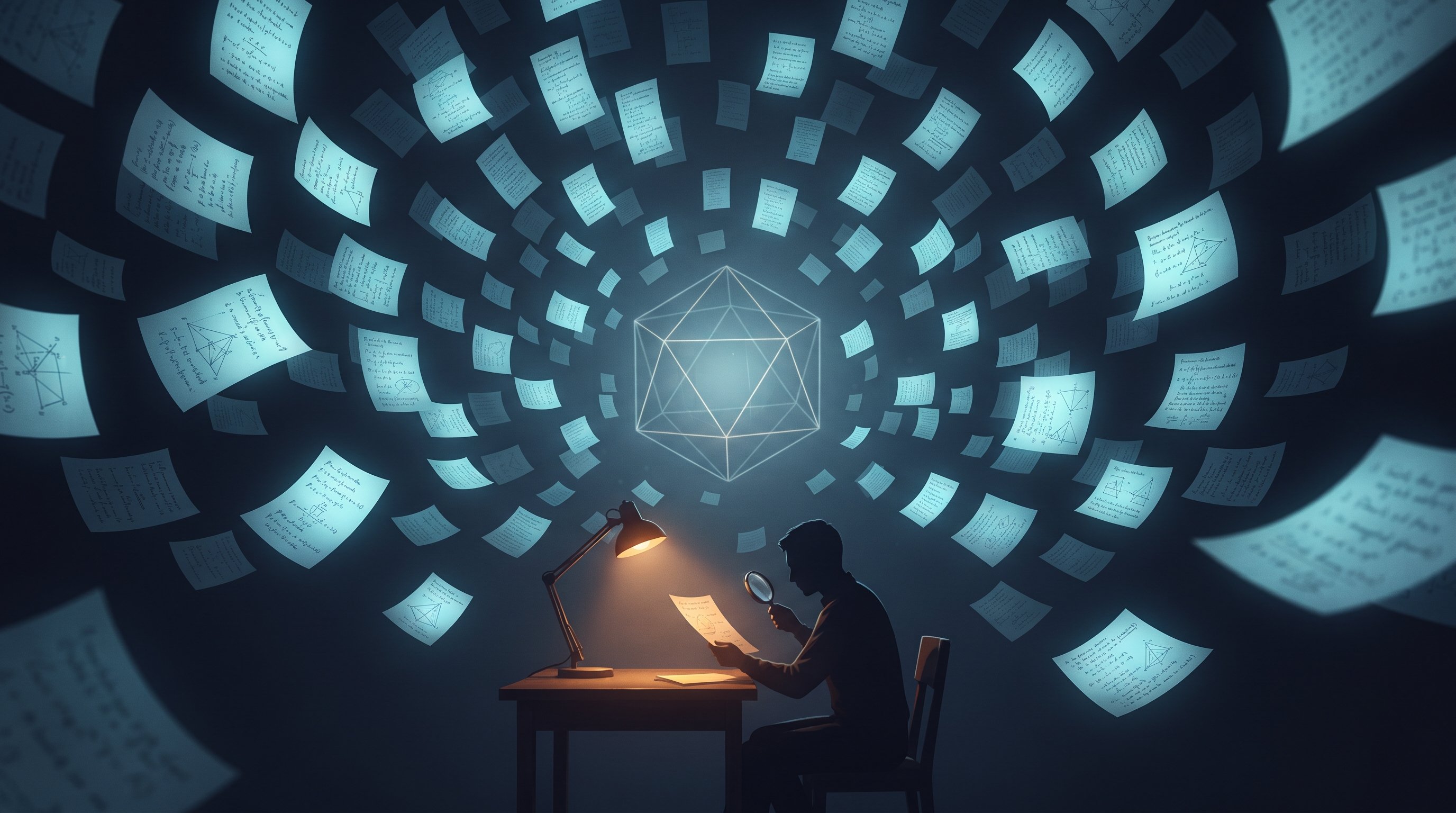
AI systems have recently been proving mathematical theorems that talented mathematicians were stuck on for years. In early October OpenAI put hundreds of mathematical manuscripts from a not-yet-released model online, and an AI agent solved 49 of 50 new research problems from theoretical physics. This raises an old question in a new form: does such an AI really come up with something new, or does it just cleverly combine what people already knew?
Nails in a board, a rubber band around them
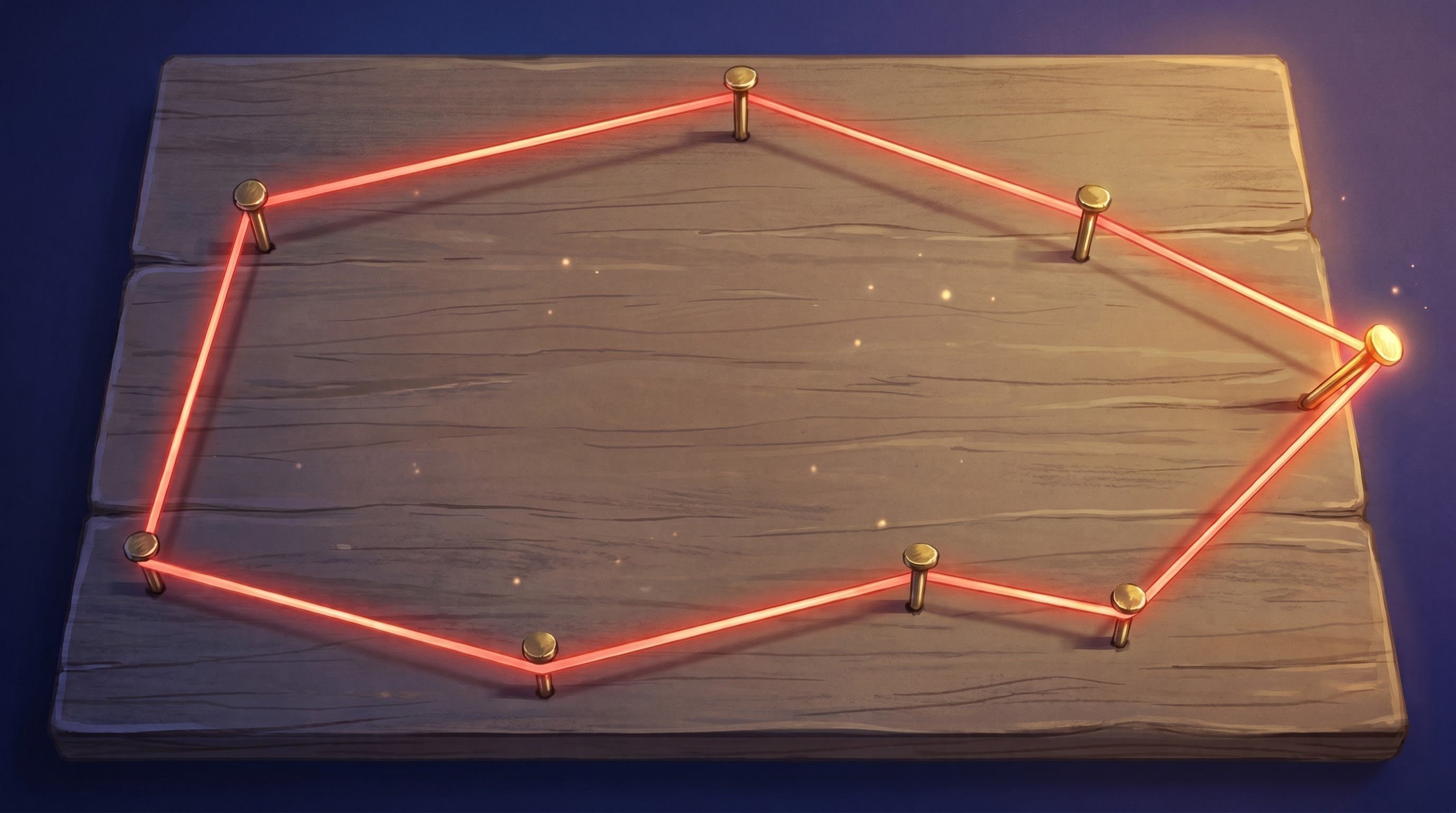
The mathematicians Nestor Guillen and Álvaro Lozano-Robledo used an image in blog posts that sums up the debate well. Imagine all the mathematics that people have proved so far as nails in a board. Stretch a rubber band around them. In mathematics, everything inside that rubber band is called the convex hull: the smallest shape without dents that encloses all the nails.
Many new proofs work by combining existing ideas: one person's trick with another person's method. In the image, that is a new nail somewhere between the old ones. This way you can fill a great many gaps, but you never get outside the rubber band. The question Guillen and Lozano-Robledo raise: do today's AI systems only do that, filling the space inside the rubber band?
Einstein and Bach built on others too
A writer on the forum LessWrong, who uses the name gjm there, took a serious look at the idea on 9 October. He finds it an interesting claim, but points to something that is often forgotten: almost all human creativity works this way too.
Einstein did not come up with the theory of relativity out of nothing. The idea of time as a fourth dimension had existed for decades, and the formulas describing what happens at high speed came from the physicists Lorentz and Poincaré. Einstein gave them a new meaning. Bach wrote beautiful fugues, but he was not the first to write fugues. Top mathematicians often have a handful of standard tricks that they keep applying to new problems. Anyone who calls that 'just combining' should, according to gjm, say the same of humans.
An experiment: the rubber band stretches by itself
The best part of his piece is a simple computer experiment. gjm took a handful of points in a space and kept making new points by mixing existing ones. Without anything more, those new points stay neatly inside the rubber band.
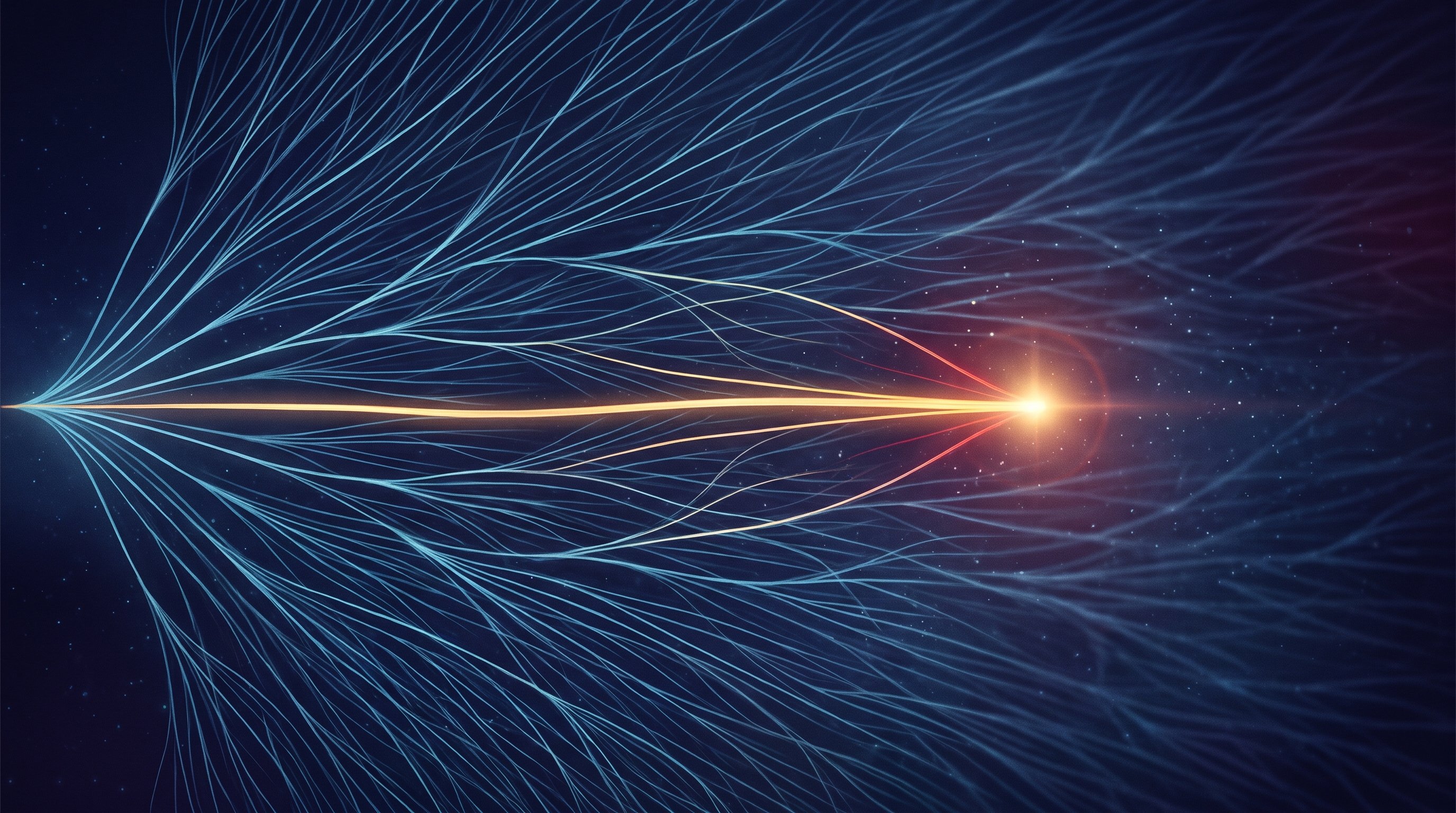
He then added a tiny bit of randomness to each combination, as if someone who merges two ideas also adds something of their own. Then the picture changes. The rubber band begins to stretch. Depending on the set-up, the space inside it ended up about 10 per cent to six times as large as at the start. It grew especially fast when the new combinations were made with the points on the outer edge. In the long run, according to gjm, such a process fills the whole space.
His cautious conclusion: if combining adds even a little that is new, it can certainly push back the boundaries of knowledge, perhaps even considerably. He suspects that human knowledge has largely grown this way.
'Just look at the new ideas yourself'
The American computer scientist Scott Aaronson responded sharply to the rubber band argument on his blog. According to him, Einstein, Gödel, Gauss and Shakespeare also filled in points inside the rubber band of everything that came before them, if you look at it broadly enough. He called the argument a way of reassuring yourself.
His wife, the computer scientist Dana Moshkovitz, has worked for twenty years in the field of one of the new AI proofs. According to Aaronson, she is amazed by the new ideas in it and wants to give lectures about them. gjm then wrote that this strongly suggests that the rubber band idea is wrong, and not just misleading.
Inside the rubber band lies a treasure
The economist Jason Abaluck of Yale looked at the rubber band from the other side on X on 8 October. For him, 'just combining' is not a weakness but an enormous opportunity. Mathematicians are now discovering how many insights lie hidden inside the rubber band of existing ideas. According to Abaluck, the rest of science will notice this on an even much larger scale.
The problem, he says, is that knowledge sits in separate boxes. Someone who does practical research in biology, chemistry or economics knows almost nothing of the mathematics that theoretical physicists use. And someone who works on abstract theory often does not know which practical problems others are trying to solve. That is understandable: most of that theory is useless to a biologist. But now and then an idea from one field fits a problem in another exactly.
Abaluck mentions two famous examples. The economist Paul Samuelson borrowed ideas from thermodynamics to describe equilibrium in the economy. The physicist Ed Witten used theory from particle physics to turn geometry upside down. Such leaps are rare, because for a human, searching for a useful idea in another field is like searching for one small item in a huge pile.
That is where AI can make the difference. If searching for connections between distant fields becomes cheap, then according to Abaluck even a low hit rate can produce an explosion of innovation. He expects a scientific revolution in the coming years from AI models that combine deep theory with practical knowledge and good judgement. Today's models still fall short on all three, he writes, but they are improving fast. Even without a single truly new idea, science could get far beyond its current level this way.
What does this mean for the road to the singularity?
The debate shows nicely how progress works, for humans and for AI. Big discoveries rarely arise out of nothing, but from new combinations of what was already there, each time with a little something extra. AI models have read the knowledge of a great many fields at once. As a result, they can make combinations that no single specialist would think of, simply because nobody knows all the nails in the board.
gjm also points to a concern: if AI takes over the filling in, people may practise it less, while it is exactly that practice that makes them creative. That is a reason to use AI as a partner and to stay curious. Together, gjm's experiment and Abaluck's argument give a hopeful message: inside the rubber band there is much more than we thought, and whoever keeps adding a little that is new pushes the boundary of what we know further and further. With AI on board, that can happen faster than ever.
What is the technological singularity? Read the explanation →