Nederlands
AI estimates biological age and cancer survival chances from a single face photo
Researchers at Mass General Brigham built AI that estimates, from a single ordinary face photo, how old someone's body is and how likely a cancer patient is to survive. This could help doctors better assess how much treatment a patient can take. Further research is needed first.
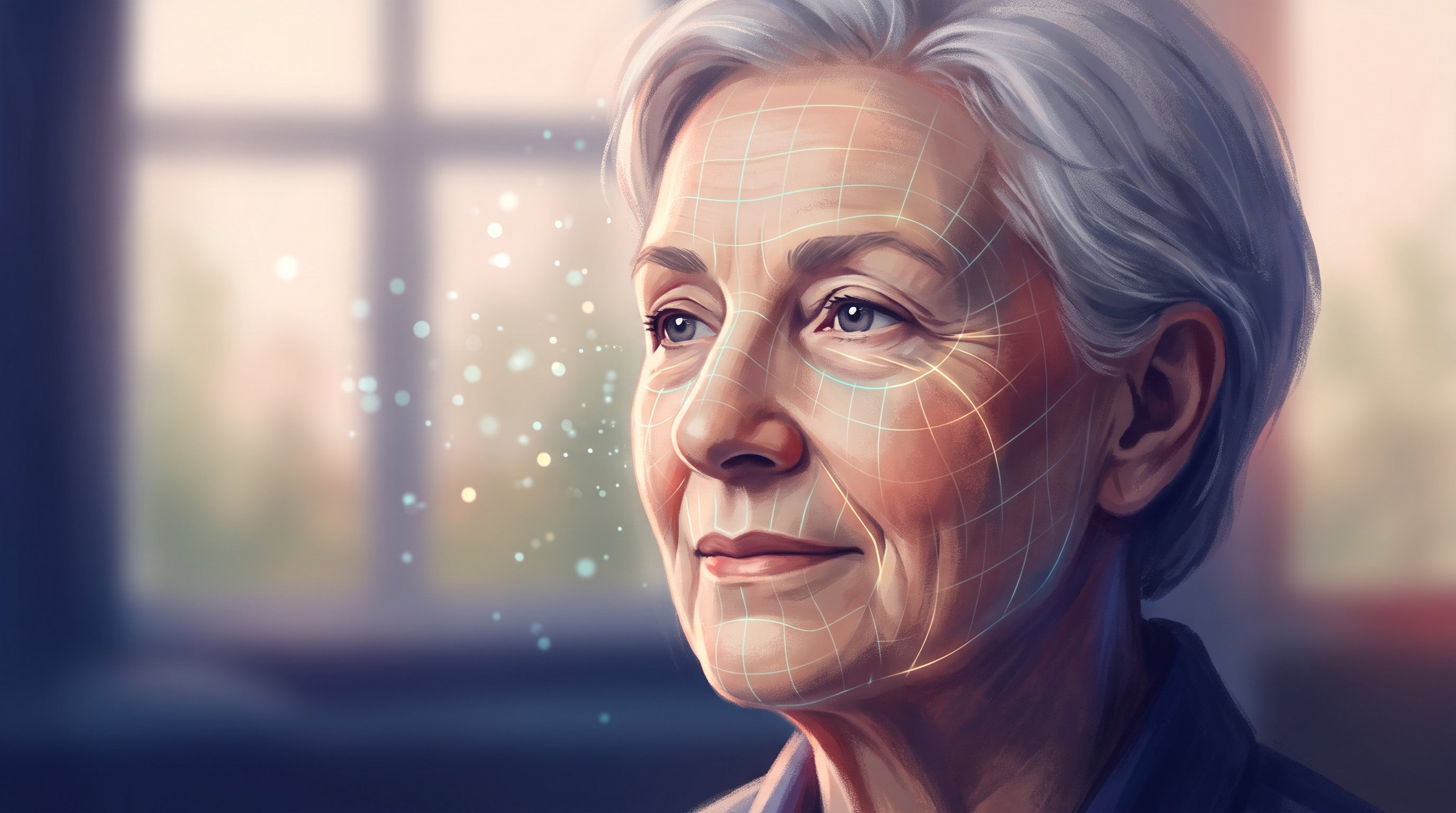
Before a cancer patient starts a heavy course of treatment, the doctor wants to know how much that person can take. Two people of 70 can be very different physically: one is fit, the other frail. Doctors therefore also look at how a patient looks, but such a judgement by eye is subjective and often inaccurate.
Researchers at the Mass General Brigham Cancer Institute in Boston want to help doctors with AI. Their new models extract two things from a single ordinary face photo: how old someone's body appears to be (the biological age) and how likely a cancer patient is to survive the coming period. The research appeared on 19 October 2026 in the journal The Lancet Digital Health.
First learn to look, then learn a task
The team first built a general foundation model, called FAHR-Face. That model was shown more than 40 million face photos, without anyone telling it what they contained. It repeatedly had to fill in a masked part of a photo itself. In this way it learned how faces are put together, a bit like someone who has done a great many jigsaw puzzles instinctively seeing which piece fits where.
The researchers then taught the model two specific tasks. FaceAge estimates biological age. FaceSurvival predicts the survival chances of cancer patients.
What the models can do
When estimating someone's real age, FaceAge was on average 5.1 years off. According to the researchers, that is more accurate than earlier models, which missed by nearly 7 years on average. More interesting is the difference between the estimated and the real age. Patients who looked at least five years older than they were had a 21 per cent higher chance of dying than patients who looked as old as they were. Smoking, heavy alcohol and drug use were associated with an older-looking face. The link was clearest for smoking: smokers looked older than those who had quit, and those in turn older than those who had never smoked.
FaceSurvival was trained with photos of more than 34,000 cancer patients receiving radiotherapy. The researchers then tested it on new groups of patients. In a test group of 3,820 patients, 122 people received the highest risk score. Of them, 64 died within 90 days of the photo, more than half. In the group with the lowest score, that was about 2 per cent.
Two models, two parts of the face
The two models pay attention to different places. FaceAge looks mainly at the folds between nose and mouth, the forehead and the temples. FaceSurvival looks mainly at the skin under the eyes and around the bridge of the nose. Why exactly those places say something about survival chances, the researchers do not yet know. Because the models pick up different information, they predict better together than either one alone, even alongside the data doctors already use.
FaceAge remained reliable with different lighting, a different facial expression, make-up and most cosmetic procedures. Only after a nose job did the model estimate people as slightly older.
The same team showed in 2025, with an earlier version of FaceAge, how such a tool can help doctors. Ten doctors and researchers then estimated the life expectancy of 100 seriously ill patients based on photos. They did hardly better than guessing, even when they knew the age and the illness. With FaceAge's estimate added, their predictions improved.
The next steps
It is not yet a tool for use in hospitals. The survival model was trained mainly with photos of patients from the Boston area, most of whom have a light skin tone. The team is therefore now testing the models on larger and more varied groups. Anyone can take part via an online study, in which a photo is uploaded and an estimated facial age is returned. According to lead researcher Raymond Mak, a radiation oncologist, the goal is to give doctors extra information, not to replace their judgement. Mass General Brigham has applied for a patent on the algorithms.
Bioethicist Matthew Liao of New York University, who was not involved in the research, calls the work interesting. It could help find people who need extra care. He also points out that a mistake by the model could lead to someone missing out on care, and that clear agreements are needed so that, for example, insurers or employers do not misuse such tools.
What does this mean for the road to the singularity?
A face photo is cheap and can be taken anywhere, with any phone. If such a photo can reliably show how frail someone is, doctors can better tailor a heavy treatment to what a patient can take, without extra tests at the hospital. That is a step towards care that fits the person better, and thus towards a longer healthy life. The approach is also striking: a single foundation model that has learned to understand faces can be deployed for ever new medical questions. After trials with more diverse groups of patients, it will become clear how quickly this technique can help doctors in practice.
What is the technological singularity? Read the explanation →