Nederlands
Oxford keeps a quantum link between atoms in two places alive for more than ten seconds
Physicists at the University of Oxford linked atoms of strontium and calcium in two places into a single quantum state. By passing the link on to calcium, it lasted more than ten seconds instead of milliseconds. A step towards networks of quantum computers.

Quantum computers calculate with particles that follow different rules from everything we are used to. One of those rules is entanglement: two particles can be linked in such a way that they form a single whole, even when they are in different places. What you do with one particle is directly connected with the other.
That link is the key to a network of quantum computers. A single quantum computer can only hold a limited number of computing units. If you link a few together, they can tackle much bigger problems together. But entanglement is fragile. A little disturbance from the surroundings, such as a fluctuating magnetic field, and the link is gone. Often within a fraction of a second.
Two kinds of atoms, each with its own task
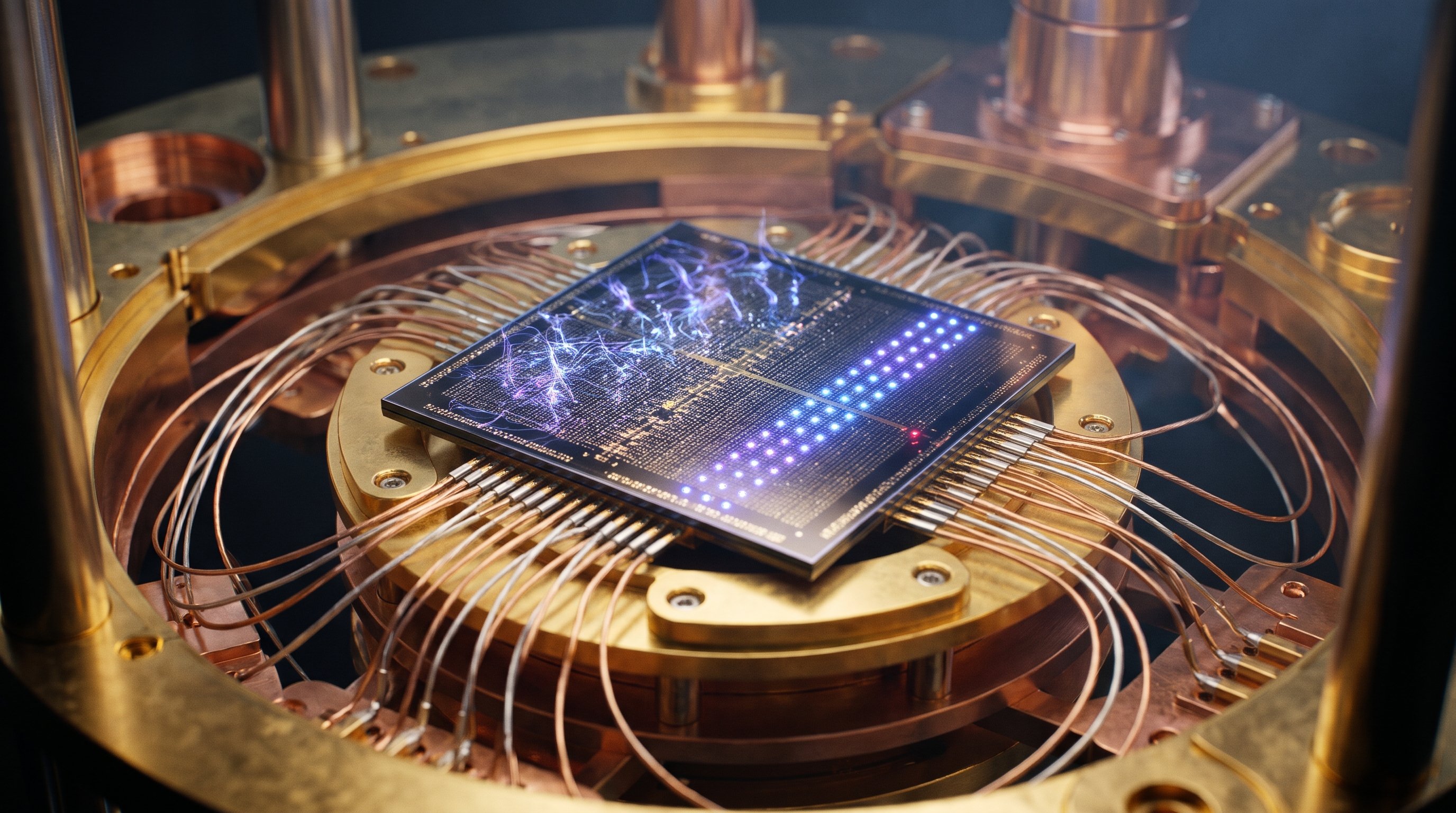
Physicists at the University of Oxford have found a clever solution. They worked with individual atoms held in place by electric fields, in two separate set-ups. In each place there was one atom of strontium and one atom of calcium.
The two kinds of atoms each get their own task. Strontium is good at making a link with the help of light. So the researchers first entangled the two strontium atoms in the two places. They then passed that link on, in each place, to the calcium atom next to it. This created a single shared quantum state with up to four atoms, spread over the two places.
From milliseconds to more than ten seconds
The advantage of that handover is big. Calcium is much less sensitive to disturbance from magnetic fields than strontium. Where the link via strontium lasted only milliseconds, in the calcium it held for more than ten seconds.
You can compare it with a conversation over a fast but crackly telephone line. As soon as the message has come through, you copy it into a notebook where it can no longer blow away. Strontium is the telephone line, calcium the notebook.
According to the researchers, this is the first time that entanglement between different kinds of atoms has been controlled in this way over a network. Lead author Dougal Main explains that each kind of atom has its own strengths and weaknesses. With more kinds in one quantum computer, you can use the best of each. The results appeared in the journal Physical Review Letters.
What still has to happen
The set-up now consists of two places with two atoms each. A usable network of quantum computers needs many more atoms and links, and the link also has to stay reliable enough to really calculate with. Co-author Gabriel Araneda sees the method as a building block for networks in which several atoms at a distance have to share and hold the same quantum state. Besides quantum computers, this can also help with very sensitive measurements at a distance and with comparing atomic clocks.
What does this mean for the road to the singularity?
Quantum computers may one day do calculations that are impossible for ordinary computers, such as precisely simulating molecules for new medicines and materials. For that, they need to become much larger, and that will probably be achieved by linking smaller machines together. A link that holds for ten seconds instead of a few milliseconds gives such a network much more time to work.
Here too, AI can raise the pace. Shielding quantum states from disturbance is a puzzle with a great many knobs: which atoms, which states, which order of steps. AI systems are good at searching such enormous spaces of choices and already help design quantum experiments. Conversely, large quantum computers may later help AI models with calculations that are out of reach today. In this way, the two technologies strengthen each other on the way to the future.
What is the technological singularity? Read the explanation →