Nederlands
AI agent solves 49 of 50 new research problems in theoretical physics
An AI agent based on GPT-6 Astra solved 49 of 50 unpublished physics problems, for less than 3 dollars each. These are heavy calculations that would take a top expert a day. The researchers mainly see a powerful calculation assistant.
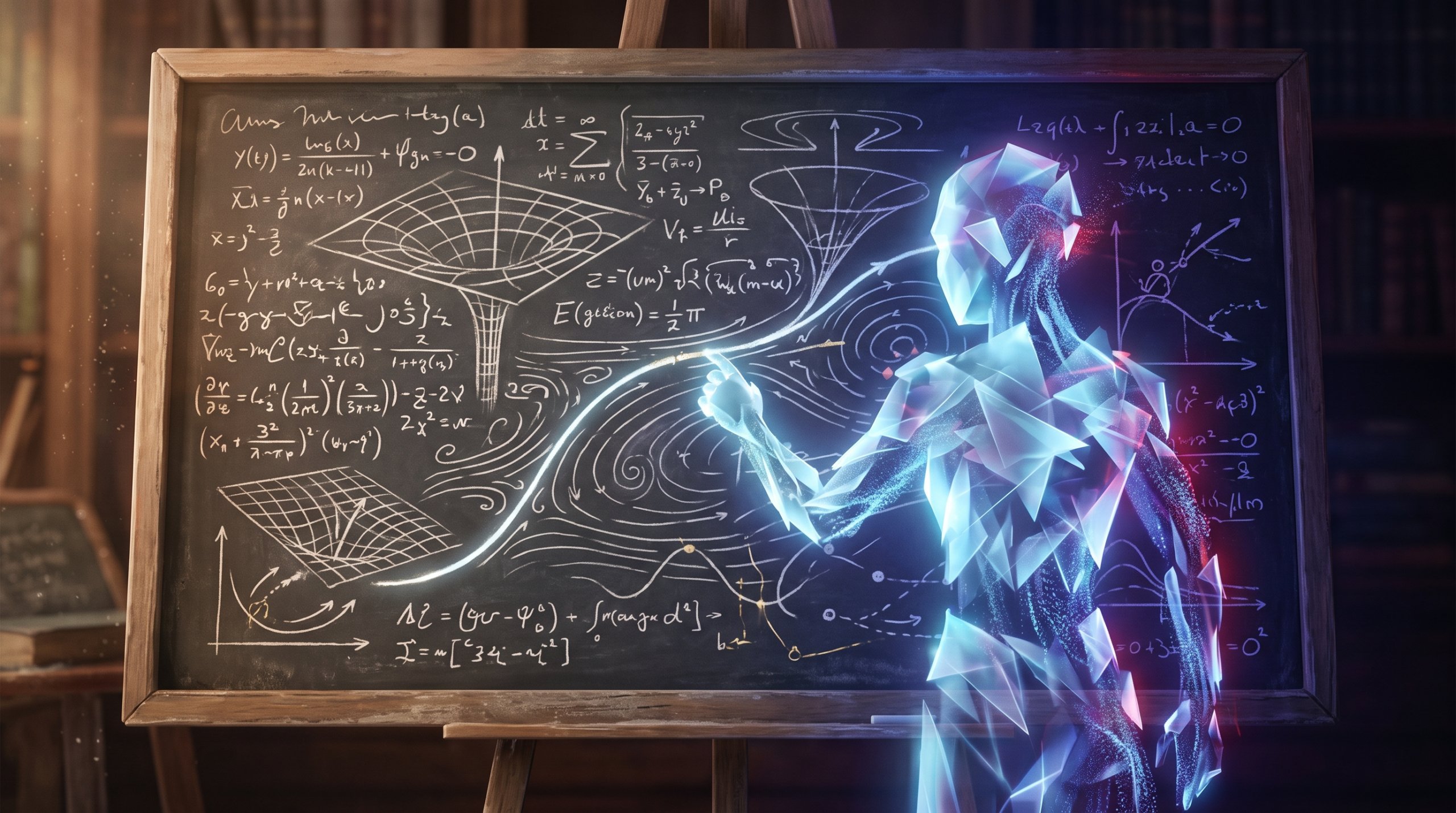
A team of more than thirty physicists gave AI agents a series of difficult calculation problems from theoretical physics. They were fifty problems that had not been published anywhere, so the AI could not look up the answers. The best agent, OpenAI's GPT-6 Astra in the programming environment Codex, solved 49 of them correctly. On average this cost less than 3 dollars (just over 2.5 euros) of computing time per problem.
The researchers come from, among others, the International Centre for Theoretical Sciences in India, the Tata Institute of Fundamental Research, Harvard, Duke, KU Leuven and Google DeepMind. They published their results on 9 October 2026 as TheoPhysEval, a so-called benchmark: a fixed set of tasks that allows AI systems to be compared fairly with each other.
What kind of problems were they?
Theoretical physicists work with pen, paper and computer on the mathematics behind nature. Think of black holes, flows in liquids, particle physics and the strange properties of quantum materials.
Each participant supplied a problem from their own field. Often they took a calculation from a recent article of their own and changed a few starting points. Compare it with a complicated recipe you know, but that now has to work for a different oven and a different number of guests. The method already exists, but you have to understand it exactly and adapt it without mistakes.
A specialist in that one subject needs about a day for it. A physicist from a neighbouring field takes much longer, because they first have to get to grips with the specialist literature. These are exactly the kind of jobs that professors used to give to beginning PhD students.
The researchers deliberately did not choose big open questions. Anyone who has such a breakthrough in hand would rather publish it themselves. The outcomes are new, but according to the authors they are not groundbreaking discoveries.
How did the AI models do?
Five AI agents received each problem without hints or human help. They were allowed to write and run programs themselves to do the calculations. This happened in two rounds: one with access to the internet and scientific articles, and one without.
With internet, the scores were:
- GPT-6 Astra (OpenAI): 49 of the 50
- Claude Opus 5.5 (Anthropic): 46
- Gemini 3.8 Flash (Google): 34
- DeepSeek-V4.1-Flash: 27
- GLM 5.3: 21
Without internet, Astra and Opus both scored 46 of the 50. Astra was also economical: it used much less computing than the other top models.
What happened during marking is striking. At first Astra seemed to have a number of problems wrong. On closer inspection, the experts themselves turned out to have made small mistakes in their own answers. After they had corrected them, Astra's answer was right in every case.
The one problem that Astra missed was not solved by any model. There, the AI had to reason backwards: work out from a drawn curve the formula that produces that curve. Such a task resembles a treasure hunt in which the maker knows more than the solver.
The specialist literature is already in memory
The difference between the round with and without internet was small. That surprised the researchers. Many problems rely on specific formulas from recent articles, which a human would always have to look up. The best models turn out to already know large parts of the physics literature.
Caveats and next steps
According to the authors, calculating is only one part of physics research. First, someone has to come up with a good theory and ask the right question. Only then does the calculation follow. According to the researchers, today's AI agents still have little feel for which questions are interesting. They also switch less easily to a better approach when a problem turns out to be too difficult. That is why human experts remain in charge for now.
Each model received the tasks once. In a repeat, a score could therefore come out a few points different. The tasks are public, so that other groups can repeat the test.
For truly unsolved problems the bar is a good deal higher. In another recent test with 82 open problems from mathematics and physics, Astra was also the best, with an average solution rate of about 14 per cent. So there is still a lot to gain there.
The authors are also thinking about the consequences for their field. Jobs that used to serve as a first research project for young physicists can now be done by an AI agent in a short time. Training programmes will have to respond to that. The researchers also want to prevent good AI help from becoming available mainly to wealthy institutes.
What does this mean for the road to the singularity?
AI agents now independently carry out calculations at the level of specialists, in fields that hardly any single person masters in full. They even catch mistakes in the work of experts. That is a big step.
According to the researchers, physicists with such assistants can handle much more and broader work, which can speed up science and eventually lead to breakthroughs. The next step is AI that not only does the calculations, but also learns to ask the right questions itself. But anyone who has a team of tireless calculation experts at their disposal for a few euros per task can already focus on the most beautiful part of physics: thinking about how the world works.
What is the technological singularity? Read the explanation →