Nederlands
Language model rewrites its own weights and gets better at maths
Researchers let an open language model adjust the numbers inside itself, without ordinary training. After the best adjustment, it gave the right answer 6.6 percentage points more often on 490 unseen maths problems. Smaller versions of the model could not do this.
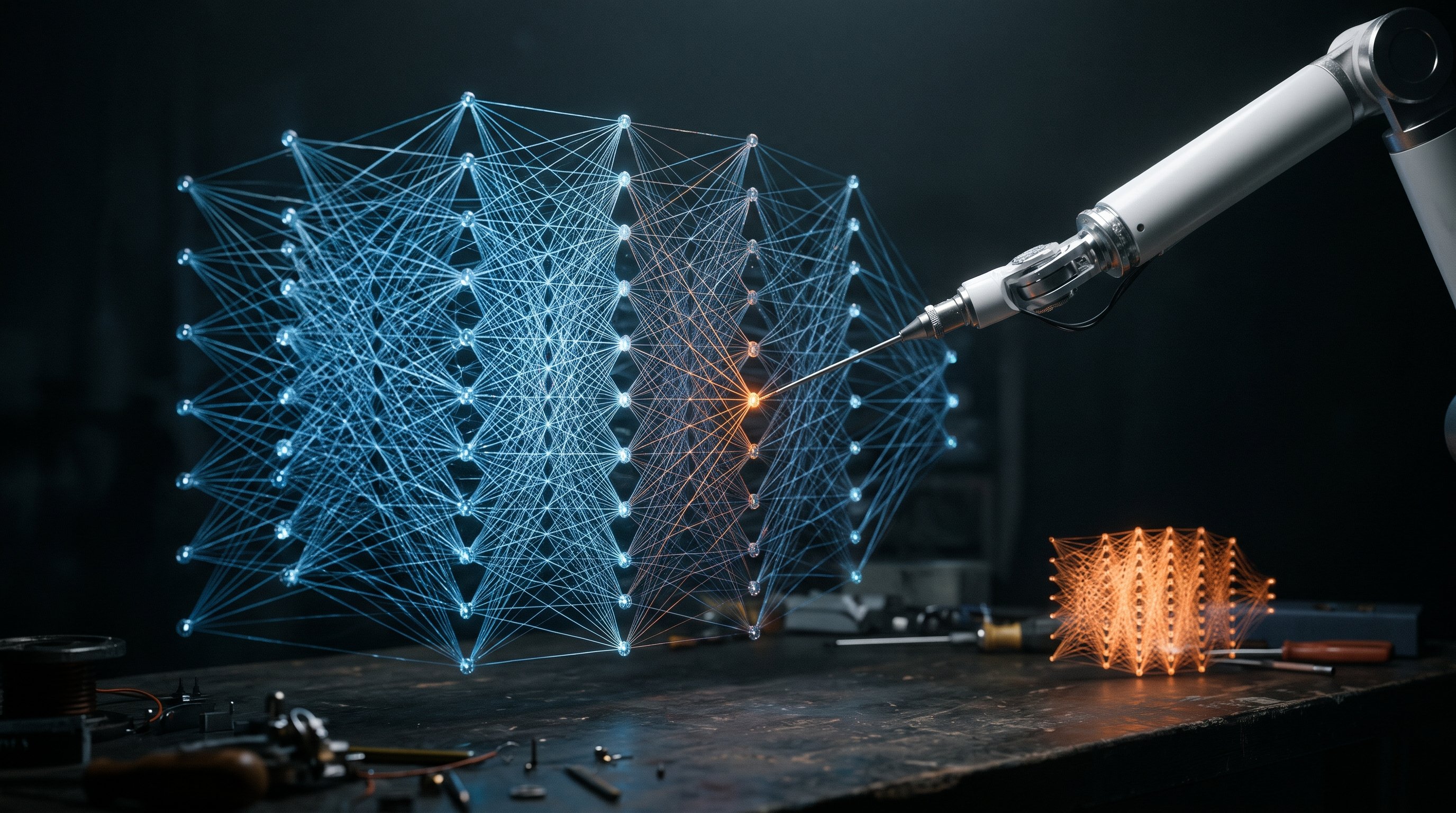
A language model normally gets better through training. A computer program makes very many small adjustments to the numbers inside the model, the weights, until the answers are more accurate. Researchers from the universities of Illinois, Princeton, Stanford and Yale, among others, let a model do that work itself, without such a training program. They call the approach self-rewriting.
The model was an open model with 27 billion parameters from the Qwen3.5 family made by the Chinese company Alibaba, a model that anyone can download. The researchers do not say when the experiments were carried out; their paper appeared on arXiv, a website where researchers share their work before other experts have reviewed it.
The model was given access to its own weights, an environment in which it could write and run its own computer code, and practice problems with feedback on its answers. The usual tools for training a model were blocked: every value that changed had been worked out by the model itself. It was allowed to run small experiments, by solving the same problems with and without an adjustment, or by looking at what happened inside itself. At the end of a session, it decided for itself whether to submit the adjustment or undo it.
Better at maths
Over eight sessions in a row, the model undid its adjustment five times and submitted three. The best adjustment made it give the right answer 6.6 percentage points more often on 490 maths problems it had never seen. According to the researchers, the model improved with every adjustment it submitted.
Repairing a damaged copy
In a second experiment, the researchers damaged a small part of a copy of the model with random numbers. After that, the copy could not solve a single maths problem. Without seeing the original weights, the model found the damaged spot and toned down the extreme values there and in several other parts. The copy then solved about 33 per cent of the unseen maths problems; the undamaged model managed 58.5 per cent.
The repair was made using only maths problems in text, but it also helped with pictures. On six tests with images the model had not seen before, the copy got back to 83 per cent of its original level. On a test in which the model has to point to the right button or spot on a screen, it went from 0 to 89 per cent correct, against 93 per cent for the undamaged model.
Smaller versions from the same family, with 2, 4 and 9 billion parameters, were given the same task. The smallest made no adjustment at all; the other two broke themselves in their attempts. Only the largest model could improve and repair itself. The researchers see it as a first step: the adjustments were small, the experiments limited, and other researchers still need to repeat the result. They believe people should keep watching when models adjust themselves. Every change is code that the model wrote itself, so a person can read it and undo it.
What does this mean for the road to the singularity?
For some time now, language models have been able to think longer before they answer, but they have to do that extra thinking again for every question. An improvement in the weights stays: the model benefits from it in every later answer, without extra computing. What is new is that the model found that improvement itself, by running experiments on itself. The researchers call this a necessary step towards a model that improves itself again and again.
If that line of work continues, a company will not have to start an expensive training round for every small improvement. The model then finds its own weak spot, repairs it, and a person checks the change before it is kept. That makes improving models cheaper, including for smaller organisations that work with an open model. It is striking that it only worked with the largest model. Such a skill seems to appear only above a certain size, so larger models can probably do more. The faster models improve themselves, the more important it becomes that every step can be checked and undone, as already happened here.
What is the technological singularity? Read the explanation →