Nederlands
Proof of the Riemann hypothesis passes independent computer checks
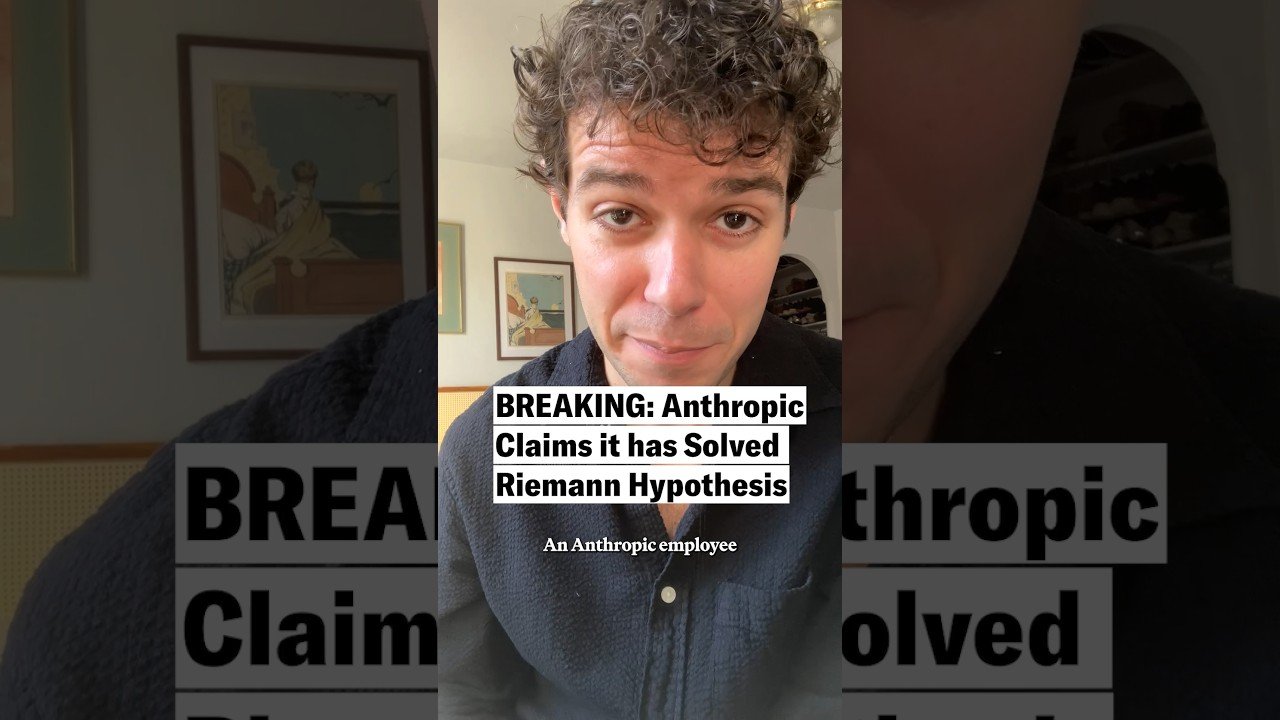
The proof of the famous Riemann hypothesis by Anthropic mathematician Levent Alpöge is correct, say the makers of the proof language Lean and the mathematics library Mathlib. Dozens of people and several checking programs reached the same conclusion.
The proof of the Riemann hypothesis that mathematician Levent Alpöge put online is correct. When the proof appeared, nobody had yet checked whether the code worked and whether the theorem it proved really was the famous hypothesis. Both questions have now been answered: the organisations behind the proof language Lean and the mathematics library Mathlib, the Lean FRO and the Mathlib Initiative, said that they have full confidence in both the theorem and the proof.
Alpöge works at Anthropic, the company behind the AI model Claude. He says he found the proof with Claude. He has not said which version of Claude he used. The proof is 17 million lines of code long.
The hypothesis was put forward in 1859 by the German mathematician Bernhard Riemann. It is about how prime numbers are spread along the number line. Prime numbers are numbers that can only be divided by 1 and by themselves, such as 2, 3, 5 and 7. For more than 160 years, nobody managed to prove it. It is on the list of seven Millennium Prize Problems of the American Clay Mathematics Institute, the best-known open problems in mathematics.
Playing loads YouTube, which may set cookies. More information
How was the proof checked?
Lean is a programming language in which a proof is written down step by step, so that a computer can check every logical step. Mathlib is a large shared collection of mathematics that has already been checked in this way. It contains an official statement of the Riemann hypothesis that experts had approved earlier.
Dozens of people built the code on their own computers, and all of them got exactly the same result. Two separate programs confirmed that the theorem Alpöge proved is literally the same as that statement in Mathlib. This rules out that an easier theorem was proved without anyone noticing.
After that, Lean's own checking program and several other checking programs, written in different programming languages, approved the proof. For two of those programs, it has been proved mathematically that they can never approve a wrong proof. The checks ran on a bare copy of the proof, so that any malicious code in the original files could not affect them.
Andrew Sutherland, a mathematician at the Massachusetts Institute of Technology (MIT), also had the proof checked himself. He told Scientific American that the chance that something is wrong is about zero. Kevin Buzzard, a mathematician at Imperial College London, had named exactly these two points beforehand as the real test: does the code build on other people's computers, and is the proved theorem the right one?
What still needs to happen
A computer can establish that every step is correct, but it cannot explain which new idea makes the proof work. Mathematicians now need to understand the 17 million lines and turn them into an explanation that people can follow. Only then can others use the new ideas for other problems as well.
What does this mean for the road to the singularity?
For some time, AI has been helping mathematicians to look for ideas and to work out steps. What is new is that an AI model helped to solve one of the best-known open problems, and that the result could be checked completely without a human reader. Trust then no longer depends on a handful of experts reading a proof for months, but on checking programs that anyone can run.
If that trend continues, AI could deliver proofs that are too long for a human, while checking them stays automatic. For other AI companies it would then be an obvious move to take on the remaining Millennium Prize Problems: whoever solves the next one shows that their model is the smartest. For mathematicians, the work shifts towards choosing the right questions and making what the machine found understandable. Because physics and engineering rest on mathematics, such a speed-up could eventually carry over to those fields too.
What is the technological singularity? Read the explanation →