Nederlands
AI researcher learns from its own work and comes up with better and better hypotheses
The young company PhAI Labs built a team of AI agents that comes up with research ideas, tests them and keeps track of what worked. The system learns from that record, and its hypotheses improved after two rounds. The code and model are publicly available online.
A good idea is the start of every piece of research. But the road from an idea to an experiment that really proves something is long. A researcher has to make a hunch sharp enough to be tested, work out which data are needed, and decide in advance when the idea will count as wrong. That takes a lot of time, and many ideas fall by the wayside.
The young AI company PhAI Labs, whose co-founders include Ling Yang of Princeton University in the United States, now presents a system that does this work by itself and gets better at it along the way. It is called DiscoveryRSI. The report on the research, with 24 authors, has been online since 16 October 2026.
A tree full of ideas
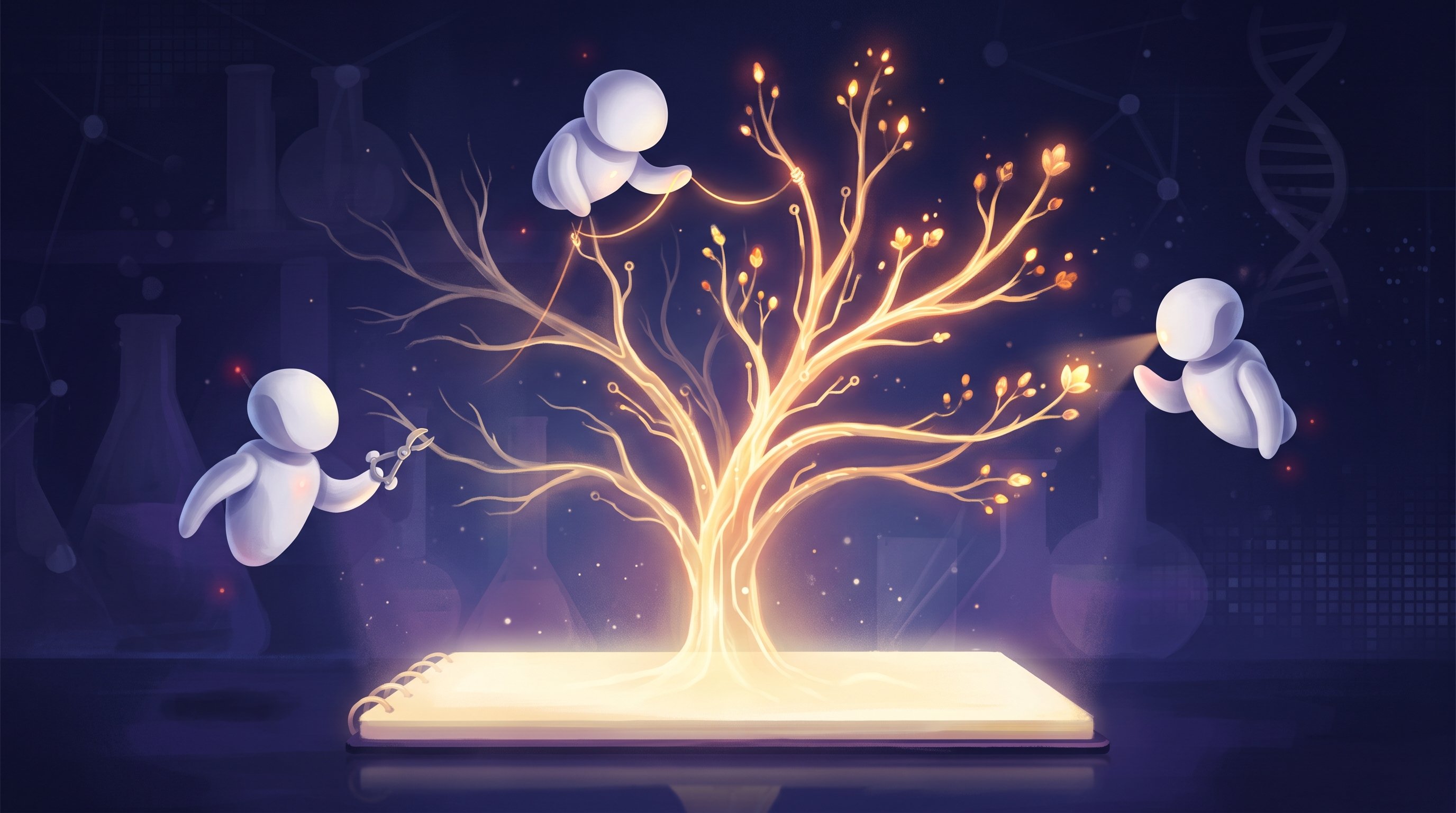
The system works with a team of AI agents: AI programs that carry out tasks on their own. A lead agent coordinates the rest. Together they let a hunch grow like a tree. An idea is adjusted, repaired, combined with another idea or started again from scratch. With every new version, another agent gives criticism. The best branches remain.
A chosen idea is then turned into a concrete task that a computer can carry out, with the data, the steps and the checks included. This way a hypothesis does not stay a loose idea, but becomes something you can really test.
Learning from its own logbook
The special part is what happens next. The system keeps a logbook: what evidence there was, which choices were made and which agent contributed what. It learns from that logbook in two ways.
First, it looks at which steps led to a good assessment, and uses them to train its own AI model, DiscoveryRSI-27B. Second, it replays earlier rounds to see which approach worked and where it kept going wrong. It uses this to adjust its way of working. With the improved model and the new way of working, it starts on new questions. In this way it learns from its own experience, just like a researcher who gets smarter after every project.
What it achieves
The researchers tested the system in four fields within biology and medicine. After two rounds of self-improvement, the hypotheses received a higher score from their own assessment system: from 4.86 to 5.39. The biggest gain was in testability: can the idea really be proved wrong, and can the data needed be found?
A second test was cleverly designed. The researchers checked whether the model came up with ideas that scientists later really studied, in articles that appeared after the model had been trained. For their own model this was true of 6.3 per cent of the ideas. For GPT-6 Luna from OpenAI it was 2.5 per cent, and for Claude Opus 5 from Anthropic 2.3 per cent.
In addition, 27 experts assessed 292 proposals without knowing which system had made them. In this first round, they found the ideas from DiscoveryRSI more important and better supported than those from GPT-6 Luna.
The system has not yet made a discovery that has been confirmed in the lab. The fact that an idea resembles later research shows that it is thinking in the right direction, but not that it helped the actual scientists. The next step is for researchers to really test the best ideas. The code, the model and examples are freely available online, so that others can check the system and build on it.
What does this mean for the road to the singularity?
An AI that learns from its own work and gets better as a result is exactly the kind of step the singularity is about. Here it is still on a small scale: two rounds, a limited gain, and the assessment comes largely from an AI system itself. But the principle works.
A large language model knows all fields at once. Combine that with a system that learns which ideas can be tested and which cannot, and it can suggest connections that a specialist in a single field would not easily see. If such AI researchers can soon also have experiments carried out themselves and learn from the results, science could speed up considerably.
What is the technological singularity? Read the explanation →