Nederlands
Chess computer Deep Blue wins its match against world champion Kasparov
In New York, IBM's Deep Blue beats Garry Kasparov, the reigning world chess champion, by 3.5 to 2.5. It is the first time a computer has defeated a world champion under normal tournament rules.
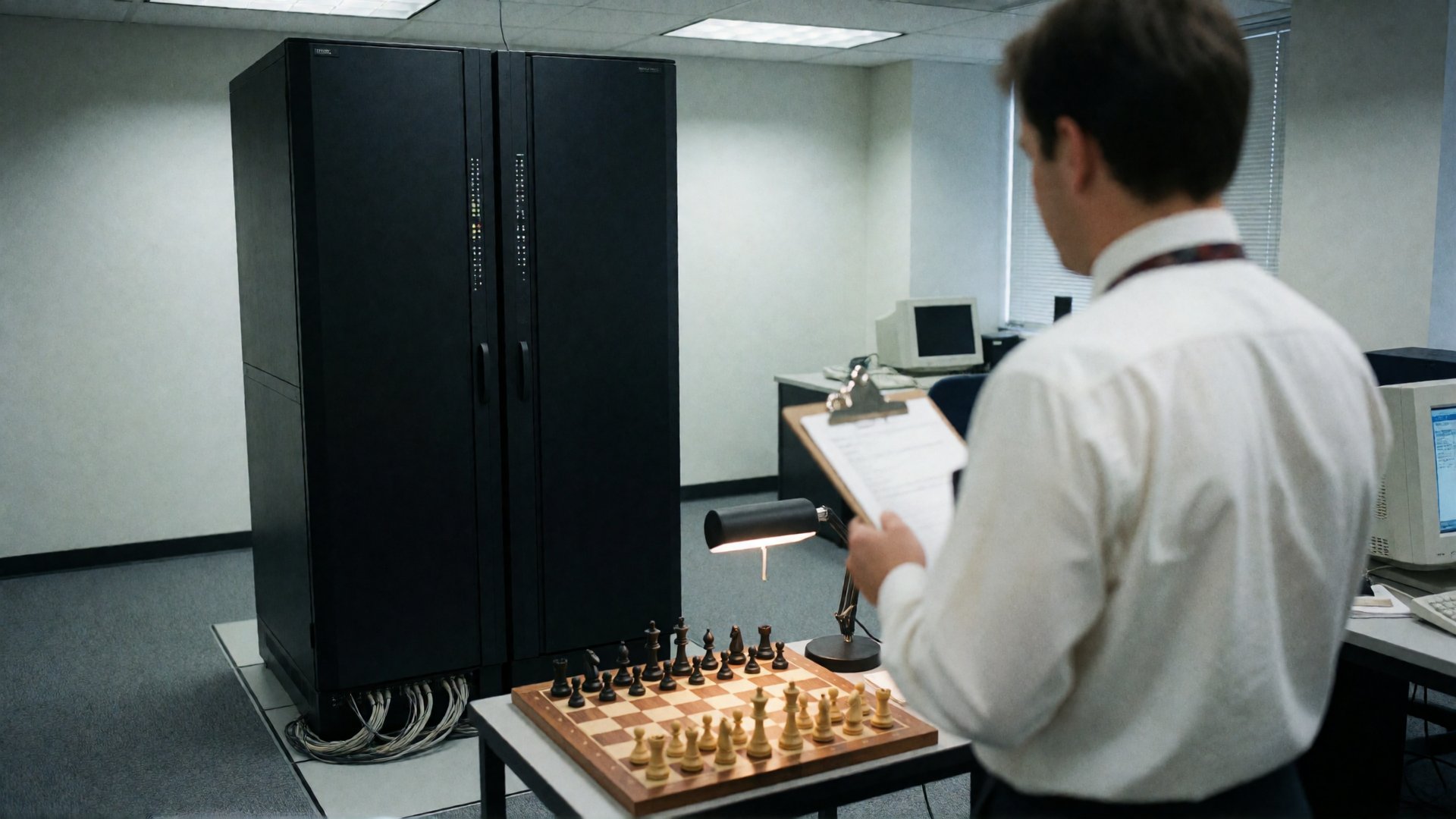
NEW YORK, MAY 1997 - IBM's chess computer Deep Blue has won its six-game match against Garry Kasparov, the reigning world champion. The final score is 3.5 to 2.5. Kasparov won the first game, Deep Blue won the second and the sixth, and games three to five ended in a draw. A year earlier, in Philadelphia, Kasparov still won the match 4 to 2, although Deep Blue did win the first game then. It is the first time a computer has beaten a reigning world champion in a match under normal tournament rules.
How does a chess computer play?
Deep Blue does not think like a human; it calculates. Starting from the position on the board, it looks at every possible move. For each move, it looks at every reply the opponent could make, then at its own next moves, and so on. This creates a tree of possibilities. Deep Blue usually looks six to eight moves ahead, and in some positions twenty or more.
At the end of each branch, it has to know whether the position is good or bad. For this it uses a scoring system: a calculation rule that gives a position a value. According to its makers, this scoring system is made up of thousands of parts, many of them for special positions. The values were set by analysing thousands of games played by grandmasters. Deep Blue then chooses the move whose best outcome scores highest, assuming that the opponent also plays the best replies.
Speed is the trick
Looking at so many positions takes a lot of calculation. Deep Blue uses several processors that work at the same time, together with chips built especially for chess. Together they assess 200 million positions per second.
Knowledge from the books
Besides calculating, the machine has been given knowledge. For the opening, it has a library of more than 4,000 positions and 700,000 grandmaster games, put together with the help of three grandmasters. For the end of the game, it has a table of all endgames with five or fewer pieces. The IBM team, including Feng-hsiung Hsu and Murray Campbell, improved the scoring system and the endgame knowledge for this match, and brought in grandmasters as advisers.
A tense match
After the second game, Kasparov was visibly thrown off balance. He said he saw unusual creativity in some moves and asked whether people had stepped in. IBM denies this: changes were made only between games. Kasparov wants a rematch, but IBM refuses.
Looking back from 2026
It later turned out that in the second game, a bug in the program made Deep Blue play a random but legal move at move 44. Kasparov had not expected that this could happen and saw superhuman insight in it. IBM published the machine's logs in later years, and Kasparov eventually said that Deep Blue was as intelligent as an alarm clock.
Deep Blue did not learn from its games: it calculated very fast and had a lot of stored knowledge. IBM took the machine apart, and two cabinets are now in the National Museum of American History and the Computer History Museum. Chess had long been seen as a sign of intelligence, and with this match that barrier fell. The next step came in 2016, when the program AlphaGo won the much harder game of Go against a top player, partly by playing against itself.