Nederlands
Computer beats Go champion Lee Sedol, in a game that seemed too big for calculating machines
In Seoul, the program AlphaGo has won the five-game match against Lee Sedol, one of the best Go players in the world, after three games. It learned the game from example games and by playing against itself.
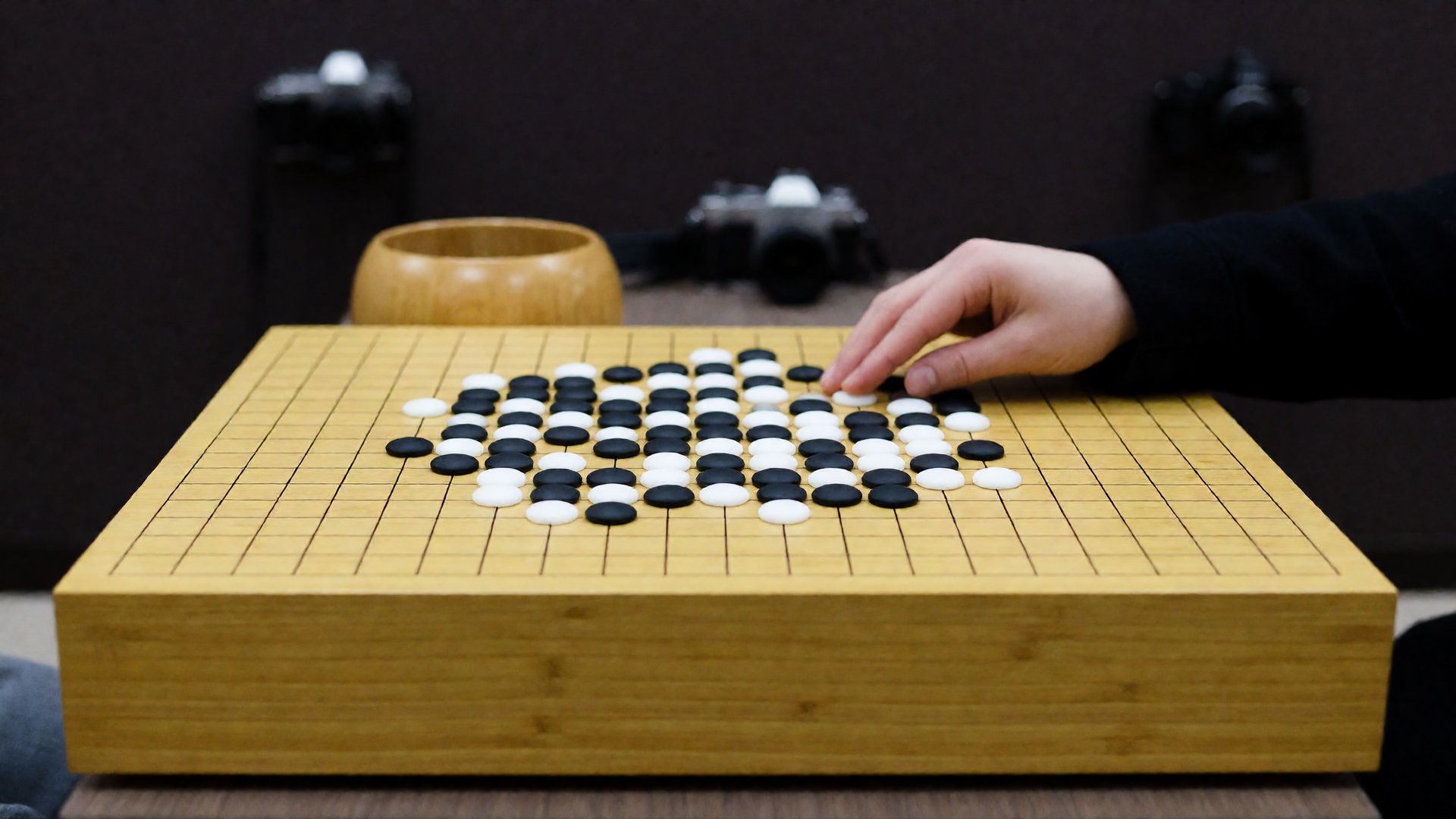
SEOUL, MARCH 2016 - In a hotel in Seoul, a computer program has beaten one of the best Go players in the world. AlphaGo, made by the company Google DeepMind, won the third game against the South Korean Lee Sedol, winner of 18 world titles, on 12 March. The match consists of five games, so AlphaGo has already won it. The last two games are still to be played. More than 99,000 people watched an earlier game online at the same time.
Why Go is different from chess
In Go, two players take turns placing black and white stones on a board of 19 by 19 lines. Whoever surrounds the most space wins. The rules fit on a small card, but the game is enormous: there are about 10^170 possible positions, a 1 followed by 170 zeros.
Chess programs win by calculating a great many moves ahead. That is how IBM's program Deep Blue beat chess champion Garry Kasparov in 1997. In Go this does not work: at any moment hundreds of moves are possible, and calculating them all would never end. It is also hard to see on the board who is ahead. That is why AlphaGo is built differently.
First learning from examples
AlphaGo consists of neural networks. These are computer programs that adjust themselves based on examples, a bit like a pupil who, after thousands of exercises, gets a feel for what works.
The first step was imitation. The program was shown about 30 million moves from some 160,000 games by strong amateur players. From these it trained a network that predicts, for every position, which move a good player would choose. The makers call this the policy network.
Then playing against itself
Next, DeepMind had the program play large numbers of games against copies of itself. After each game it knew who had won. Moves that led to a win became slightly more likely, moves that led to a loss slightly less. This is called reinforcement learning: there is no teacher saying what is right, only the result.
From all those games, a second network, the value network, learned to estimate for a given position how likely it is that white or black will win. For this, programmers do not need to write down rules about what a good position is.
Looking ahead, but only where it pays off
The last step is searching. AlphaGo looks ahead like a chess computer, but not along every move. The policy network points out the few promising moves, and the value network judges where they lead. This way it only has to calculate a small part of the board.
The program also aims for the highest chance of winning, not the biggest lead. As a result, a move can look strange to a human, even when it safely wins the game. In the second game AlphaGo played such a move, the 37th. According to DeepMind, there was only a 1 in 10,000 chance that a player would choose it. It turned out to decide the game.
Looking back from 2026
Lee Sedol won the fourth game on 13 March with an unexpected move of his own, the 78th. AlphaGo won the fifth, making the final score 4-1. The Korea Baduk Association gave the program an honorary rank as a professional of the highest level, 9 dan. According to DeepMind, more than 200 million people watched. Lee Sedol retired as a professional in November 2019, because in his view computers had become too strong for a human.
The most important thing was the approach. Learning from examples, then practising against yourself and adjusting based on the result: the same building blocks return in later AI. Modern language models, too, are refined after their first training with feedback, in the form of reinforcement learning. DeepMind later used the same branch of research to predict the shape of proteins. Go turned out to be a first proof that such programs can tackle a problem nobody had a manual for.