Nederlands
Four-legged robot solves a giant Rubik's Cube using only its legs
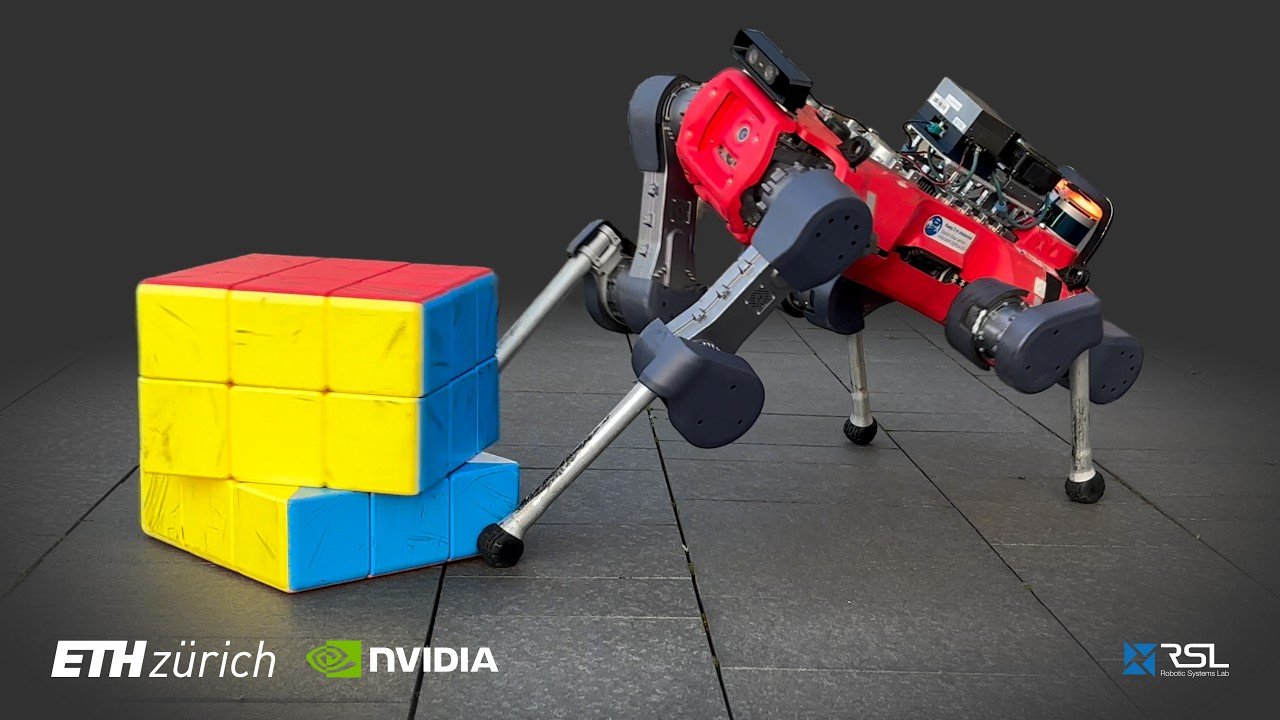
Researchers at ETH Zürich and Nvidia taught a four-legged inspection robot to solve a giant Rubik's Cube using only its legs. It tips the cube over and turns the layers, without human help. All three attempts succeeded, each in eight to nine minutes.

Robots on four legs, such as the Swiss inspection robot ANYmal, now walk easily over stairs, stones and building sites. But as soon as they have to grab or move something, they usually need an extra robot arm. Such an arm makes the robot heavier, more expensive and more complicated. For a few years, researchers have therefore been trying to find out whether a robot can use its own legs as hands. This is called pedipulation: moving things with your feet.
A team from the Robotic Systems Lab at ETH Zürich, together with a researcher from chipmaker Nvidia, now shows how far this can go. Their ANYmal solves a giant version of the Rubik's Cube entirely on its own, and touches the puzzle only with its feet. The team put the research online on 17 October 2026 and showed a video of the experiment two days later.
Playing loads YouTube, which may set cookies. More information
Why this is so difficult
Solving a Rubik's Cube takes three steps: looking at where the colours are, working out which turns are needed, and carrying out those turns. The calculation is easy for a computer; good programs for it have existed for a long time. The hard part is carrying it out.
Sometimes the robot has to tip the cube over to bring another side to the front. While doing so, not a single layer may shift. If that happens anyway, the plan is no longer right and the rest of the solution gets stuck. To turn a layer, the robot puts one front leg on the cube to hold it still. With the other front leg, it pushes the top two layers a quarter turn round. Meanwhile it has to keep its own balance. And it has to do that about thirty times in a row, without a mistake.
First look around, then calculate
The robot starts by walking once around the cube. With a camera that also measures distance, it looks at the sides. If it cannot see a side, it tips the cube over. Step by step, it builds up the full pattern of colours this way. In tests, the system recognised every square correctly indoors, and 98.7 per cent outdoors.
Next, an existing solving program works out which turns are needed. A second program converts them into a series of actions the robot has mastered: walking to the right spot, tipping the cube forwards or backwards, or turning a layer to the left or to the right. After each action, the robot looks again at exactly where the cube is, so that it can position itself well for the next step.
Practising in the computer
Nobody programmed the movements themselves in advance. The robot learned them through reinforcement learning: in a computer simulation, it tries a movement very many times and gets a reward when it goes well. For example, when its foot lands in the right place, the cube tips over and no layer shifts.
This happened in two rounds. First a virtual "teacher" learned the movement. In the simulation, the teacher was allowed to know everything, such as the exact position of the cube. Then a "student" learned to copy the teacher, using only what the real robot also has: the images from its two front cameras and the position of its joints. Compare it with a cook who first learns a recipe with scales and a thermometer, and can then make it by eye and by feel. That student now controls the real robot.
To make the step to the real world succeed, the researchers kept varying the weight of the robot and the cube in the simulation, how slippery the floor was and how stiffly the layers turned. They also gave the virtual robot a push now and then. This way it learned not to count on one exact situation.
In South Korea, too, researchers are working on robots that apply force while keeping their balance. There, a humanoid robot pushes up to 35 kilograms in front of it while walking, and that robot also practised endlessly in a simulation first. The difference lies in the body: the Korean robot has arms, while ANYmal shows that you do not necessarily need arms for precise work.
Three out of three
On the real robot, all three attempts succeeded, without a human having to step in. Each solution took about thirty steps and lasted eight to nine minutes. The robot corrected small errors along the way by itself, such as a layer that was not quite straight.
The team also tested how robust the skills are. The robot tipped and turned the cube on a smooth floor, on cobblestones and on mossy stones. It simply carried on when someone pulled on its leg with a rope or pushed the cube away with a stick. Tipping over even worked with a small box and a round tin.
What still has to happen
The robot practised specially for this one cube, and the test on the real robot consisted of three solutions. To make skills like these useful outside the lab, a robot must also be able to handle objects it has not trained for separately. The tests with the box and the tin show that tipping things over already reaches a little further than this one puzzle.
What does this mean for the road to the singularity?
Robots only become truly useful when they can not only walk around, but also do something with the things around them. This experiment shows that an ordinary walking robot, with the right training, can use its legs for precise work that lasts a long time: thirty actions in a row, without a mistake and without help. An inspection robot could then push open a door, flip a lever or shove an obstacle aside by itself, without needing an arm. Lighter and simpler robots could then do more of the work in inspection and maintenance in factories, and in search and rescue. And the approach that worked here, first practising endlessly in the computer and then going out into the real world, is more and more becoming the way to teach robots new skills.
What is the technological singularity? Read the explanation →