Nederlands
Proved with a lot of AI help: a flow without friction can break down on its own
Three mathematicians have proved, with a lot of help from AI, that an ideal flow without friction can break down on its own. A computer program checked every step. Terence Tao also reports a similar, less worked-out proof for real fluids.
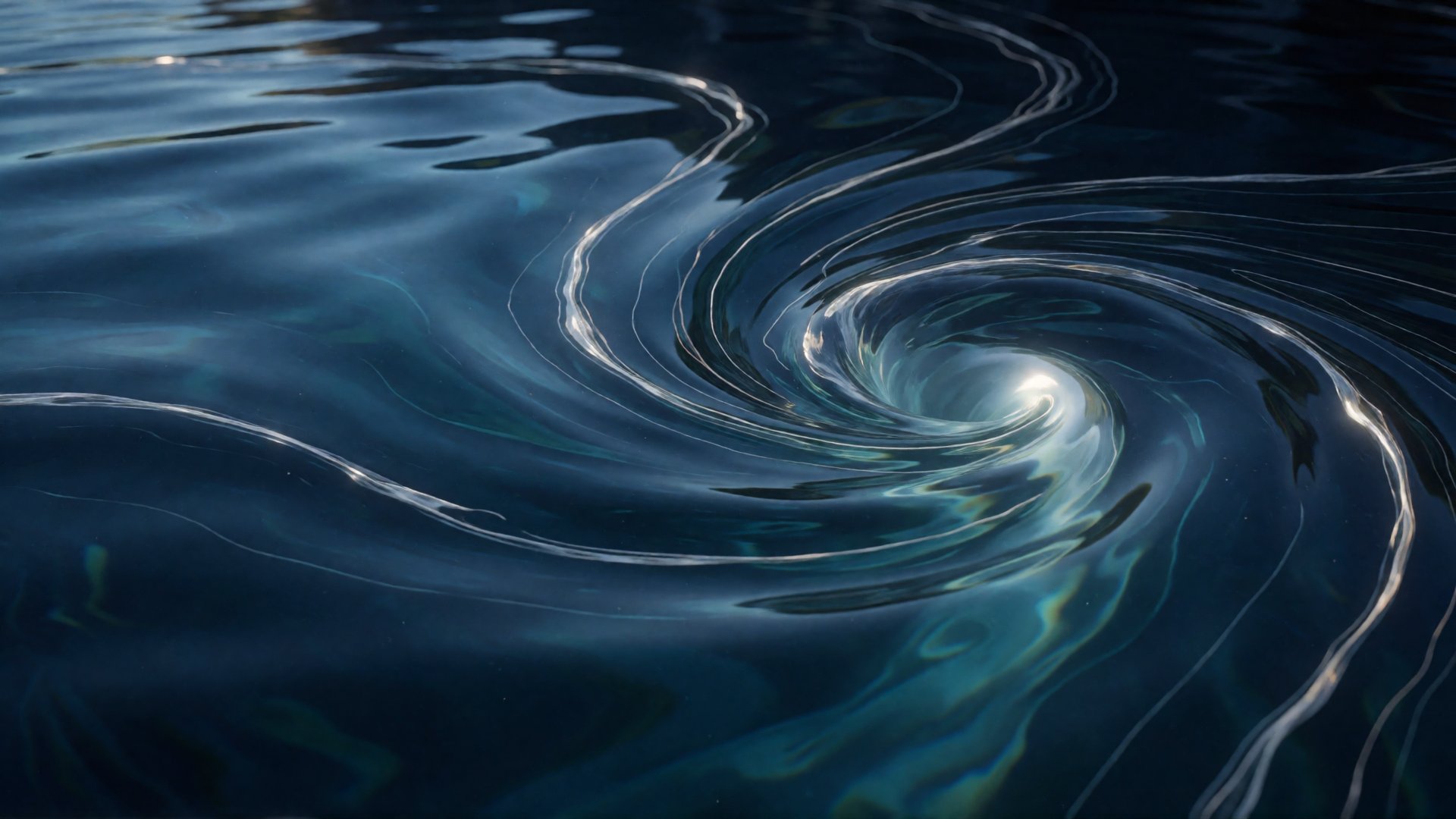
The Euler equations describe how an ideal fluid flows: without friction, and in a way that it cannot be compressed. Mathematicians have long wondered whether such a flow, which starts out smooth and calm, can break down on its own. In that case the swirling of the fluid at one point grows without limit within a finite time, and the equations no longer give a meaningful answer there. Mathematicians call such a point a singularity. That is something different from the technological singularity that WATTBA writes about.
Levent Alpöge, Tristan Buckmaster and Matei P. Coiculescu now show that it can happen. Their proof applies to a three-dimensional flow in a periodic space: whatever flows out of the region on one side comes back in on the other side. They choose a smooth starting flow, with no outside force driving the fluid. Their manuscript is dated 20 November 2026 and is a preprint: other experts have not yet reviewed it.
Every step checked
The authors also translated the proof into Lean, a program that checks every step of a mathematical proof. Every numbered result in the manuscript has a checked counterpart in Lean. No proof steps are missing, and the code relies only on Lean's three usual basic assumptions. One well-known supporting result from the literature has not itself been worked out in Lean; at that point the Lean version reaches the same conclusion by a different route.
According to the mathematician Terence Tao, who wrote about it , the proof came about with a lot of help from AI. The researchers have not said which AI model they used, or when. In September 2026 Tao had already described an earlier version, in which the flow still needed a push from outside. The approach builds on work by Diego Córdoba and Luis Martínez-Zoroa. The idea is to keep adding small, rapidly changing corrections to the flow and so exploit an instability, until the flow breaks down.
Real fluids too
In the same post, Tao reports that Alpöge and Buckmaster, again with heavy use of AI, also have a proof for the Navier-Stokes equations. These describe real fluids such as water and air, with friction. There too, a smooth flow in three dimensions with no outside force could break down. This proof is also in Lean, but part of it relies on a precise computer calculation that falls outside Lean, and its data have not yet been released. Tao calls the strategy clear in broad terms, but in his view more work is needed for a properly written-out proof.
What does this mean for the road to the singularity?
AI has been helping mathematicians search for proofs for some time, and programs such as Lean have been checking proofs for some time. What is new is that the two together answer a question that specialists in fluid dynamics had long been stuck on. That changes who checks the work. A human cannot quickly read through a long proof made largely with AI, but Lean can. If every new result comes with such a check, other experts no longer need to spend months verifying that everything is correct. They can then focus on what the ideas mean and where else they could be useful.
How fast things can then move was already shown by a preprint published one day later: another researcher had an AI system extend the construction further. If that line continues, mathematical results will build on each other faster than people can read them. The mathematician then becomes mainly the person who chooses the right questions and makes the answers understandable, so that others can build on them.
What is the technological singularity? Read the explanation →