Nederlands
Robot dog uses AI to hike through the Swiss Alps largely on its own
A robot dog has completed a 10.1-kilometre mountain route near Zermatt, largely under its own control. A navigation system from researchers at ETH Zürich and Apple let the robot decide for itself where it could walk safely.
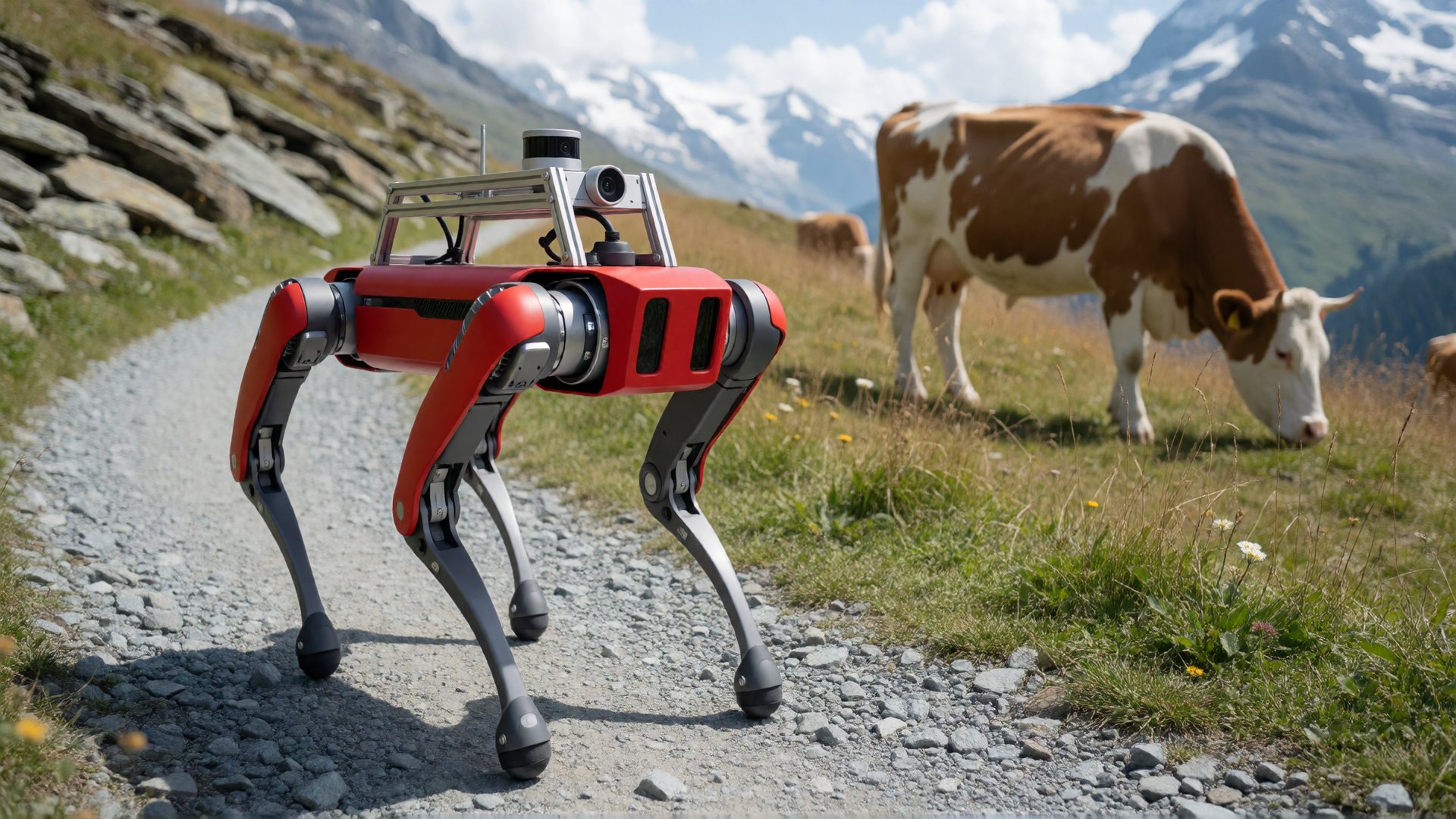
The four-legged robot ANYmal D walked a 10.1-kilometre hiking route near Zermatt in August 2024. The route starts above 3,000 metres on the Gornergrat and runs downhill. The robot operated on its own 96.7 per cent of the time. Twice, people had to make a major intervention for safety reasons.
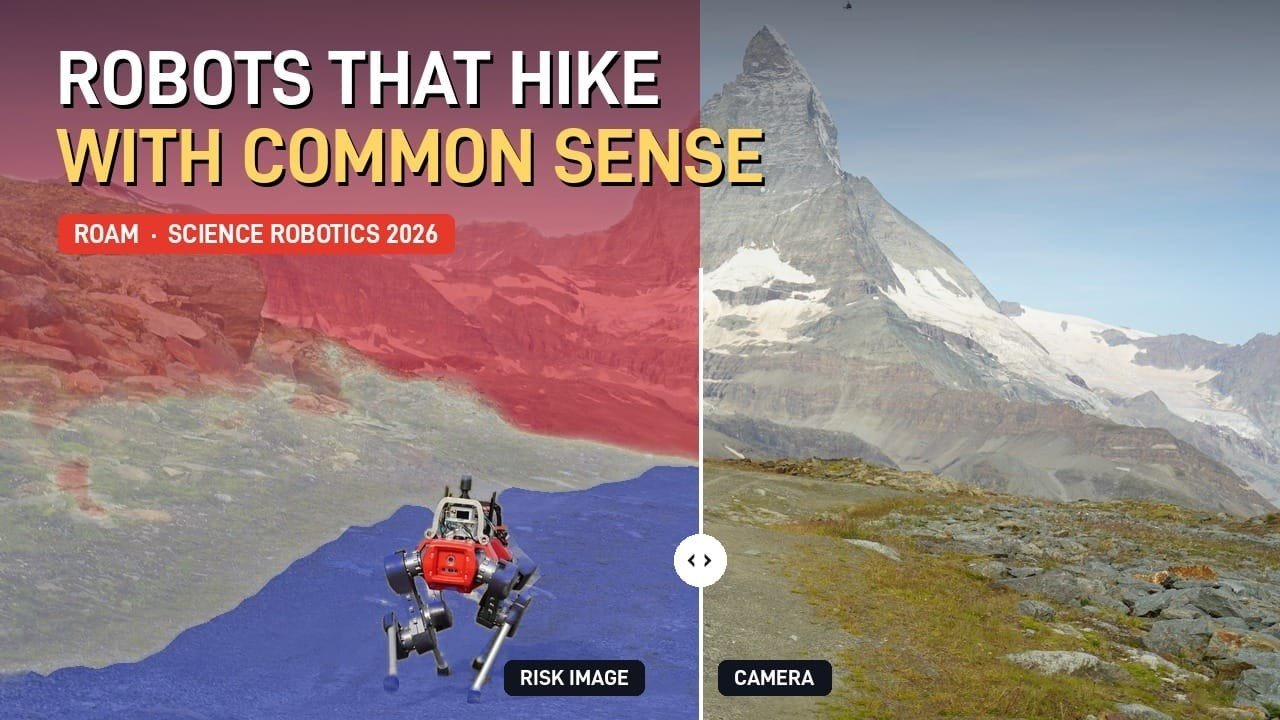
The system behind the hike is called ROAM, short for Robust Open-world Autonomous Mobility. Researchers at the Swiss technical university ETH Zürich and a researcher from Apple describe it in the scientific journal Science Robotics in November 2026. The routes and the robot's camera footage can be viewed on the project page. The lab also posted a video about the research on YouTube.
Playing loads YouTube, which may set cookies. More information
Not the walking, but the choosing
Four-legged robots can already walk well over difficult terrain. According to the researchers, the bottleneck lies elsewhere: the robot has to decide where to walk. A path, a meadow and a cow can all look passable to the sensors, but only the path is a good choice.
ROAM therefore links a vision-language model to two smaller AI programs that control the robot. A vision-language model is an AI model that understands both images and text. One program chooses the route over the next few metres; the other controls the movements of the legs. Both were trained in computer simulations with reinforcement learning, a method in which a system learns from rewards and penalties.
The vision-language model names what the camera sees and gives each part a risk score between 0 (safe) and 1 (avoid). In one example, a gravel path scored 0, grass 0.5 and a cow 1. A separate module turns those scores into a risk map of the surroundings. Using that map, the two control programs choose the route and the spot for each foot. The model itself never sets a direction or speed. It answers about once every ten seconds, while the movements are adjusted dozens of times per second.
During the trials in 2024, ROAM worked with a version of GPT-4 from OpenAI, at that time one of the strongest models that could also read images. Much stronger models have appeared since then. The code the team has made public now also works with newer models from Google and OpenAI.
Mountain lake, cows and roadworks
ANYmal D carried cameras, satellite navigation and lidar, a technique that measures distances with laser pulses. In June 2024, the robot also walked 2.38 kilometres around the Seealpsee, a mountain lake in the Appenzell Alps. There it operated on its own 97.5 per cent of the time. People stepped in when the robot came too close to the shore and when it could not get through a turnstile.
On a test site at ETH Zürich, the robot read signs at roadworks and followed what they said. It also recognised a shop mannequin on the path as a person and walked around it.
There are still limits. For long trips, ROAM needs a route planned in advance, and the vision-language model works over the internet. The researchers say the reliability and spatial understanding of such models still need to improve.
What does this mean for the road to the singularity?
Robots that walk steadily over rocks and gravel already exist. What is new is the division of tasks: a large AI model takes its time to work out what the robot sees, and fast small programs handle every step. That way, nobody has to program every situation in advance. A robot that can read a "keep out" sign can find its way in an environment built for people, without special markings for robots.
The trials still ran on a model from 2024. If that trend continues, newer and faster models will probably let the robot make the right choice by itself more often. Once such a model runs on the robot itself, the internet connection will no longer be needed either. That brings work within reach in places that are hard or dangerous for people to get to, such as checking pipelines in the mountains or searching for missing hikers. The robot will then have to recognise for itself when it does not understand its surroundings and needs to ask for help.
What is the technological singularity? Read the explanation →