Nederlands
Saline injection gives longer relief from carpal tunnel syndrome than an anti-inflammatory
In carpal tunnel syndrome, a nerve in the wrist is trapped. Indian doctors freed that nerve with an injection of salt water, guided by ultrasound. After six months it was still helping, while the complaints came back after an anti-inflammatory. Larger studies now need to confirm this.
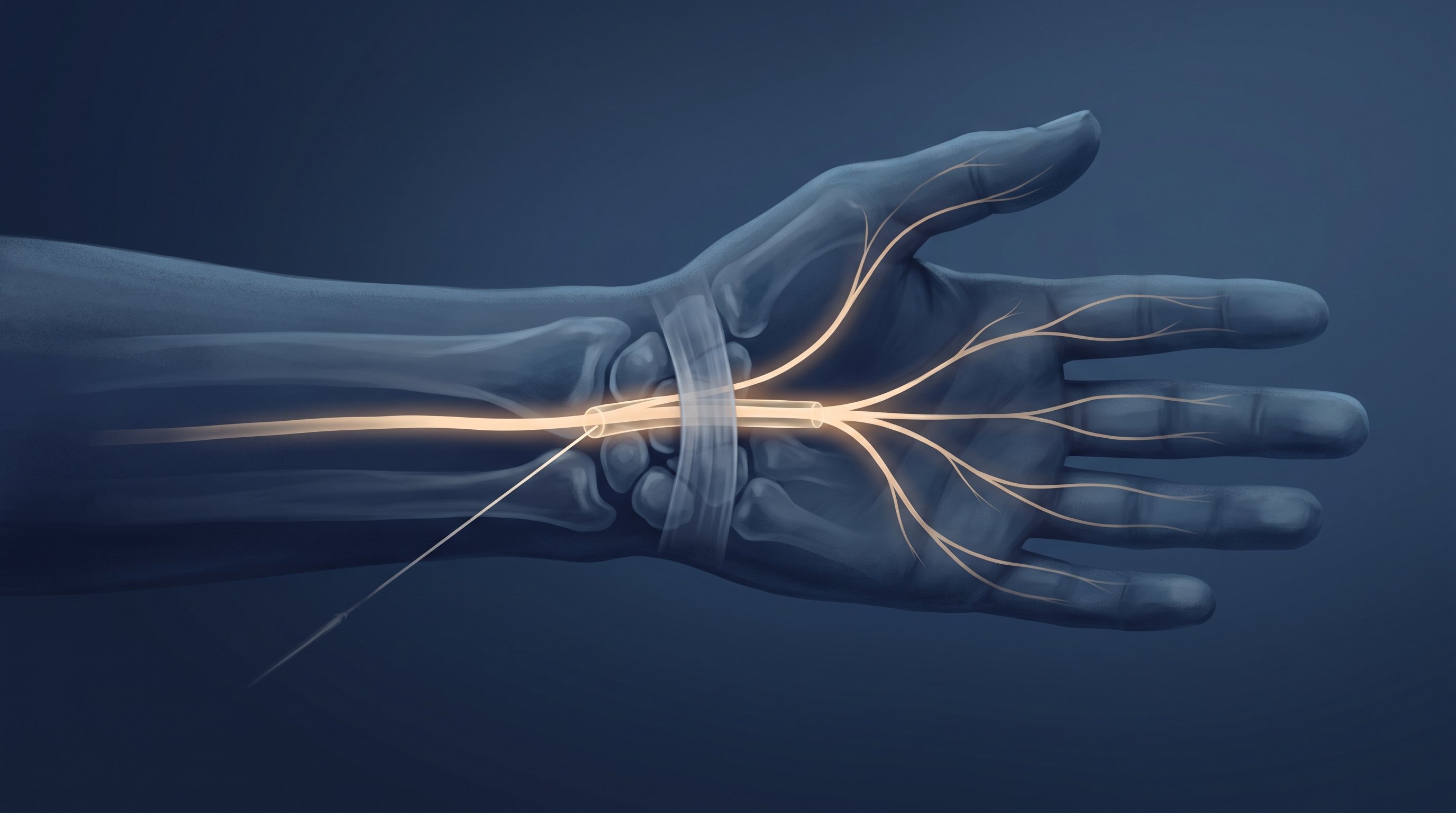
Tingling fingers, a numb feeling and pain in the hand, especially at night: those are the familiar complaints of carpal tunnel syndrome. In the wrist, a nerve runs through a narrow tunnel between the small wrist bones and a tough band of tissue. If the tissue there becomes swollen, the nerve gets trapped. According to the American radiology society RSNA, 5 to 10 per cent of people suffer from it at some point.
If a wrist splint and painkillers do not help enough, patients often get an injection of a corticosteroid, a strong anti-inflammatory. It usually works quickly, but the effect often does not last long. After that, sometimes only an operation remains.
Doctors in India have now tested another approach, using ordinary salt water. Their results appeared in October 2026 in the journal Radiology.
Freeing the nerve with fluid
The technique is called hydrodissection, literally: separating with fluid. The doctor watches the wrist on an ultrasound scan and uses a thin needle to inject fluid around the nerve. That fluid pushes the surrounding tissue away, so that the nerve gets room again and can move more freely. Compare it to a ring that is stuck on your finger: with a bit of soap around it, it slides loose again.
Doctors usually add an anti-inflammatory to that fluid. The researchers wanted to know whether the salt water on its own also helps.
Three groups compared
The team of radiologist Anindita Bose of Mahatma Gandhi Medical College in Jaipur studied 39 adults with carpal tunnel syndrome. Their complaints had persisted despite earlier treatments. Because some of them had problems in both wrists, 63 wrists were involved. These were divided at random over three treatments:
- hydrodissection with salt water only;
- an injection with an anti-inflammatory only;
- hydrodissection with salt water and an anti-inflammatory.
After four weeks, the complaints were clearly reduced in all three groups. After that, the difference became visible. In both groups with hydrodissection, the improvement was still there after three and after six months, and became somewhat larger. In the group that only received the anti-inflammatory, the complaints came back. Adding the anti-inflammatory to the salt water gave no clear extra benefit in the long term.
The difference could also be seen on the ultrasound. The thickness of the swollen nerve decreased by 43 to 45 per cent after hydrodissection, against about 15 per cent after the anti-inflammatory alone.
Short and without a hospital stay
The treatment took a quarter of an hour on average. No general anaesthetic or hospital admission was needed, and according to the researchers, patients could go back to work within an hour. They saw no serious complications.
Co-researcher Anupama Tandon of Guru Teg Bahadur Hospital in Delhi points out that anti-inflammatories can cause side effects with repeated use, such as thinner skin or weaker tendons. She was surprised that the salt water alone helped for so long, even in people who had already tried many other treatments. According to the researchers, the technique is mainly an option for mild to moderate complaints. It might allow an operation to be postponed or sometimes avoided. For severe complaints, an operation remains the right route.
What still needs to happen
The research was done in one hospital, with a small group of patients. There was no group that received a dummy treatment, so the part of the effect that comes from people expecting a treatment cannot yet be separated out. The researchers therefore want larger studies in several hospitals, following the patients for longer. They have already started a new study comparing salt water with a sugar solution, to see which fluid helps longest.
What does this mean for the road to the singularity?
Sometimes progress lies not in a new medicine, but in smarter use of something simple. Here the ultrasound did the work: because the doctor sees exactly where the needle is, ordinary salt water can free the nerve.
It is precisely with treatments like this that AI can mean a lot in the coming years. Programs that read ultrasound images can help doctors find the nerve faster and more accurately, even when they have little experience. And AI models that oversee the medical literature of different fields at the same time can notice more quickly which simple, cheap treatments deserve a fair comparison with standard care. In this way, a simple injection of salt water could help more people without an operation, if larger studies confirm it.
What is the technological singularity? Read the explanation →