Nederlands
Wafer-thin mesh draws electricity from beating human heart cells
Researchers in the US grew beating human heart tissue around a wafer-thin mesh that generates a little electricity with every heartbeat. The work has so far been done in the lab. The goal: implants such as pacemakers that no longer need a battery.
Pacemakers and brain stimulators run on a battery inside the body. When it is empty, a new operation is needed to replace it. A smaller battery only helps in part, because it also holds less energy.
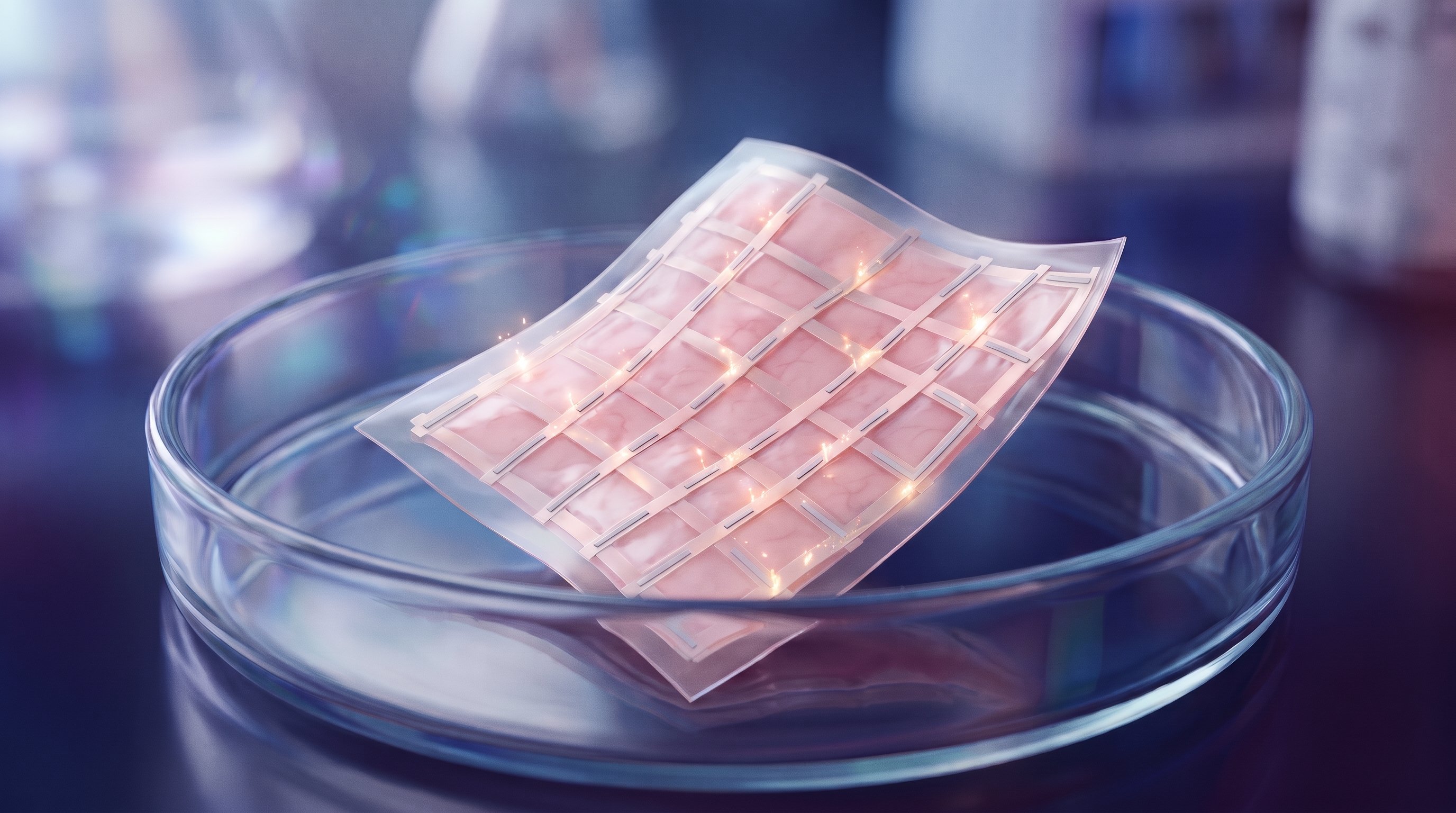
Researchers at the University of Massachusetts Amherst and the University of Connecticut are therefore looking for a different source of power: the body itself. They built a wafer-thin, flexible mesh in and around which human heart cells grow. Every time the cells contract, the mesh generates a tiny electrical current. PhD student Siqi Wang led the research, with Associate Professor Jun Yao as senior author. It appeared in early October in the journal Science Advances.
Electricity from movement
The mesh measures about 7 by 8 millimetres, smaller than a fingernail. It contains 64 narrow strips of a ceramic material that produces an electrical voltage when you bend or stretch it. This is called piezoelectric: the same principle is used in the clicker of a gas lighter. Every four strips together form one small generator. A thin layer of plastic shields the strips from the wet tissue around them. About 78 per cent of the mesh is open space, so that cells can grow through it easily.
The team made heart muscle cells from human stem cells and placed them on the mesh. Within a few days, the cells grew into a continuous layer that began to beat by itself, about once every two to three seconds. With every contraction, the researchers saw a matching electrical current. They checked that it really came from the movement, and not from the cells' own electrical signals or from the liquid around them. Because each current belongs exactly to one heartbeat, the mesh can also serve as a sensor that keeps track of the heart rate without its own battery, according to the researchers.
What is new is that the electricity is generated in many places at once, just as every cell in your body makes its own energy. Existing energy harvesters sit in a patch that is stitched onto an organ, or in a separate casing. That casing takes up space without generating electricity itself. According to the researchers, their mesh therefore collects more than ten times as much energy for its size.
From first measurement to better version
The first version gave about 9 millivolts per heartbeat per generator. The beating tissue turned out to deform the strips about a hundred times less than the test set-up. With a thicker layer of the ceramic and a thicker coating around the strips, the estimated output rose to 450 to 750 millivolts per beat. The energy per heartbeat is still very small: about 7 trillionths of a joule.
The research has so far been done with a thin layer of grown tissue in a dish. The next steps are tests in a living body and actually powering a device with it. Follow-up research also has to show how long the mesh lasts. The ceramic contains lead and must therefore stay well shielded. In the lab, the plastic layer held up for more than two months, and the cells on the mesh stayed alive.
The improved version still fell somewhat short of the team's calculations, probably because the thin layer of cells did not hold the strips firmly enough. Thicker tissue and several meshes stacked on top of each other should deliver more electricity. According to Yao, the body tends to reject devices with a large battery, while a device the size of cells is tolerated much better.
What does this mean for the road to the singularity?
This research brings humans and machines a little closer together. An implant that gets its power from the body itself and grows together with living tissue no longer needs a large, stiff battery and does not have to be replaced again and again. That makes it easier to carry electronics in the body permanently, from pacemakers to future links between nerves and computers. Together with increasingly energy-efficient brain implants, an implant that lasts for years without surgery is coming closer. The output still has to go up a lot, and the researchers already have a plan for that: stacking layers and using thicker tissue.
What is the technological singularity? Read the explanation →