Nederlands
US Navy shows a machine that learns from examples
Frank Rosenblatt of Cornell shows that after 50 examples his perceptron can tell cards marked on the left from cards marked on the right by itself. Nobody wrote the rule: the machine adjusts itself after every mistake.
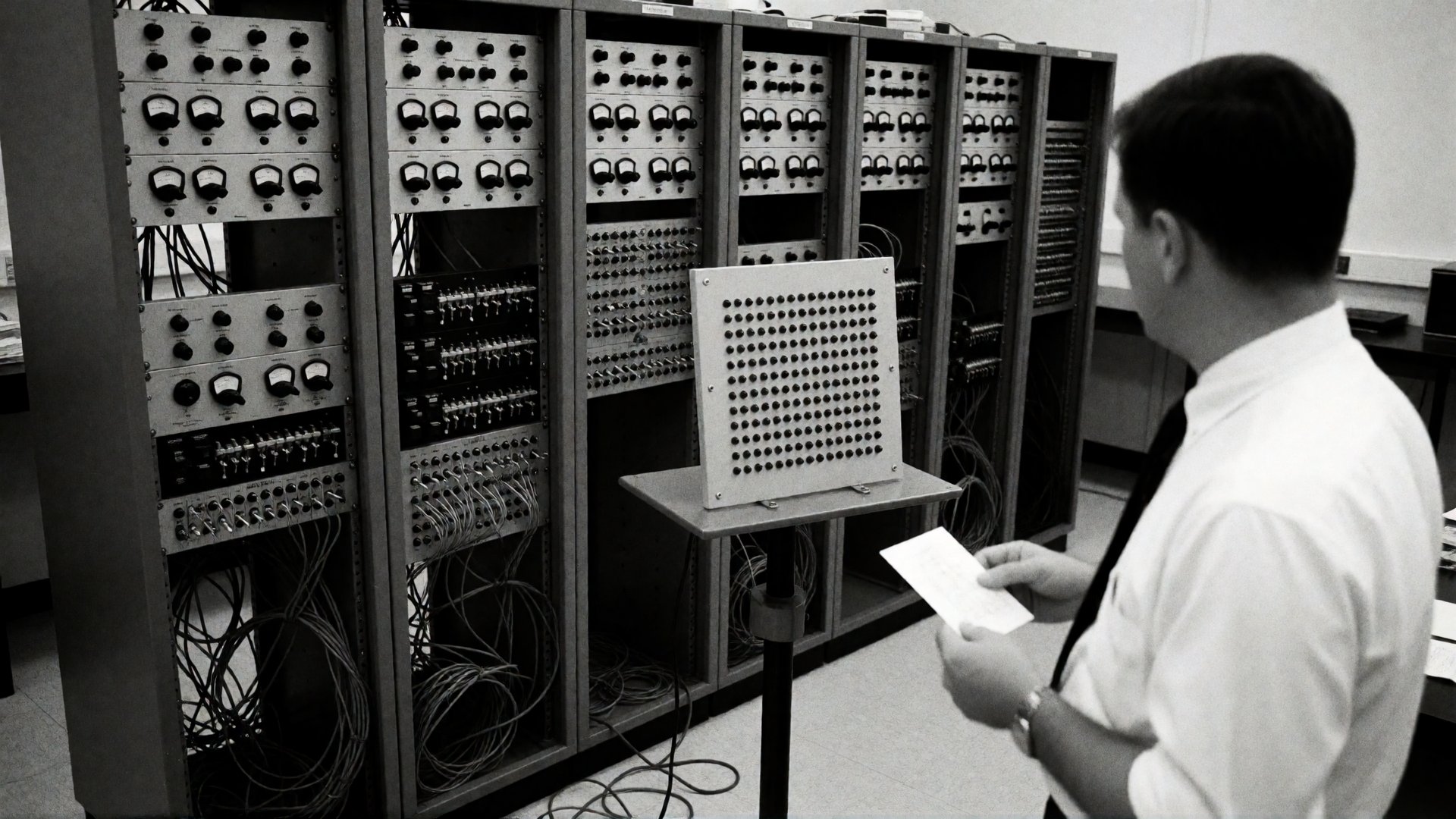
WASHINGTON, JULY 1958 - The Office of Naval Research, the research agency of the US Navy, has shown a computer that does something computers have not done before: learn from examples. The machine, which its designer Frank Rosenblatt calls the perceptron, learned after 50 attempts to tell cards with a mark on the left from cards with a mark on the right. Nobody had told it that rule.
How a computer normally works
An ordinary computer does what a programmer has written down, step by step. If you want it to tell left from right, you write the rule yourself. Rosenblatt, a psychologist and engineer at Cornell, wants something different: a machine that works out the rule from examples, the way a child learns what a cat is by seeing lots of cats.
An artificial nerve cell
His building block is a greatly simplified nerve cell. The cell receives signals from a kind of artificial eye: a grid of light-sensitive points that looks at what is on the card. Each incoming signal has a weight, a number that sets how much it counts. The cell adds up all the weighted signals. If the total is large enough, it gives one answer; otherwise it gives the other.
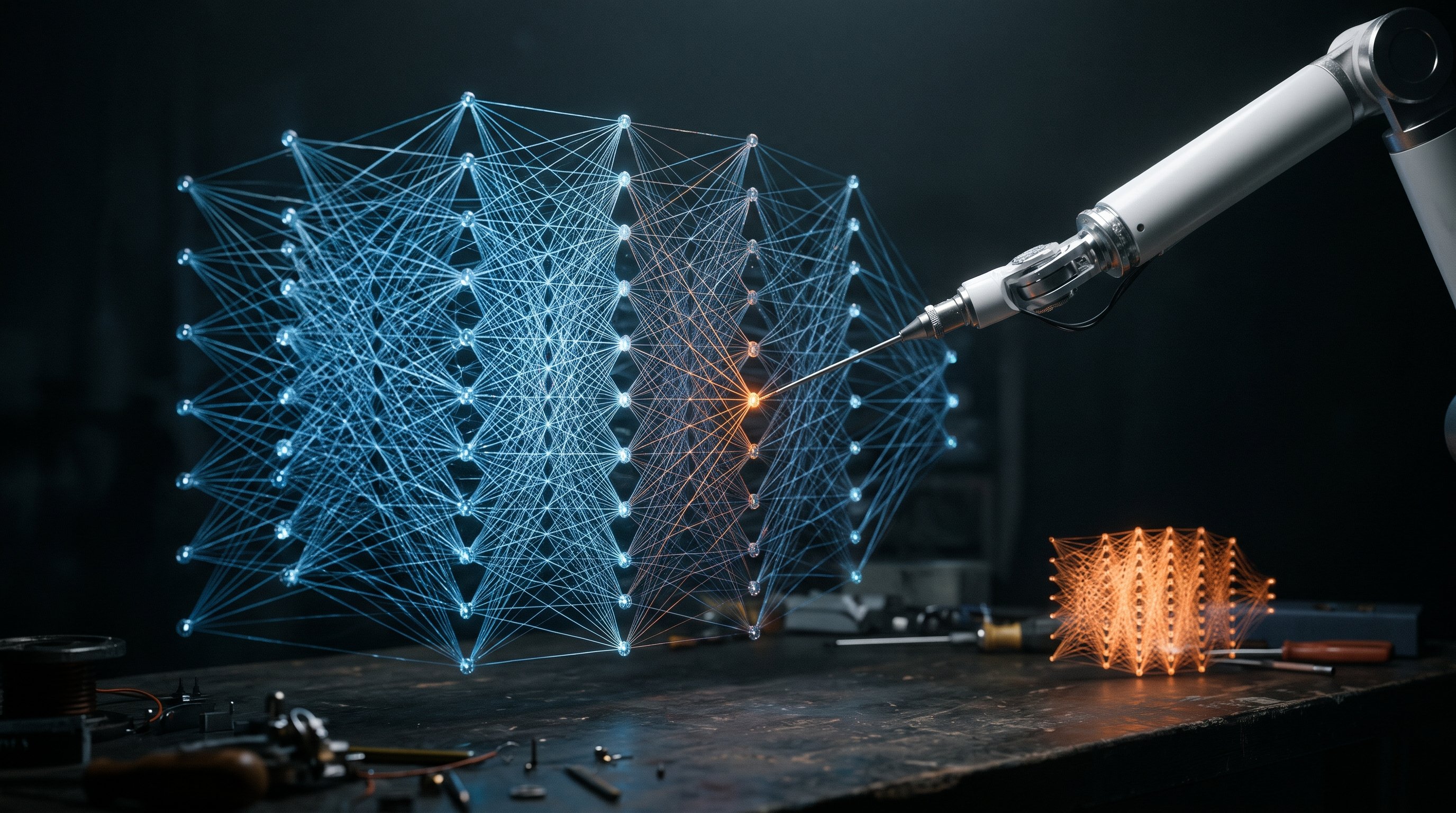
The learning happens in the weights. At the start they are random, so the machine answers by guessing. After each answer, it is compared with the right answer. If it is right, nothing changes. If it is wrong, the weights are adjusted a little, so the same card has a better chance of getting the right answer next time. To give an example of the idea: points that often light up on cards marked on the left gradually count more and more towards the answer 'left'. The real design also has a middle layer, with fixed, random connections between the artificial eye and the cells whose weights change, but the learning principle is the same.
The demonstration used a program on an IBM 704, a large computer that simulates the machine. In the years that follow, Rosenblatt's team builds its own machine, with 400 light-sensitive cells as eyes, adjustable resistors as weights and small electric motors that turn the weights.
Big promises
Newspapers are enthusiastic. The New York Times wrote about the 'embryo' of an electronic computer, and according to Cornell, Rosenblatt himself calls his machine the first that can have an idea of its own. Sceptics wonder how far this can go, because so far the machine does just one small thing.
Looking back from 2026
In 1969 Marvin Minsky and Seymour Papert showed in a book that a perceptron with a single layer cannot learn some simple rules, such as 'one or the other, but not both'. Funding for this research largely dried up. The authors did not say that this also applies to networks with more layers. In the 1980s those came back into the picture. Rosenblatt died in a sailing accident in 1971.
Cornell professor Thorsten Joachims says that Rosenblatt's algorithm is still fundamental to training deep networks. Every large AI model today is a much larger version of this idea: many small calculating units with weights, which are adjusted on the basis of examples.