Nederlands
Does Claude learn by playing on a desert island?
MIT researchers let the AI assistant Claude loose on a virtual island for thirty hours without any task. It invented its own games, made drawings with blocks and did small experiments. With that experience, it later did better on most new tasks than a version of Claude without that play experience.
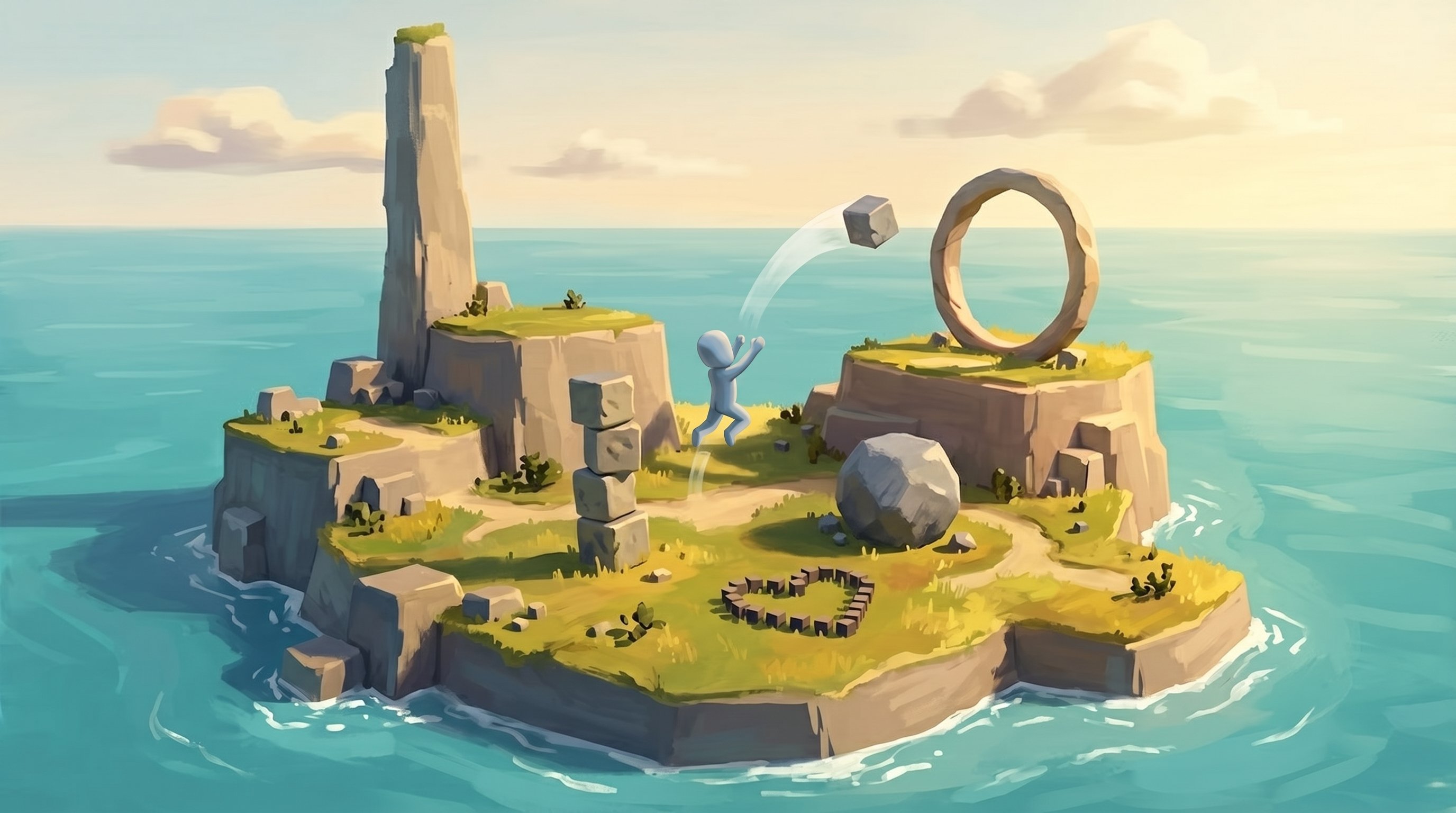
What does an AI do when nobody asks it anything? Researchers at MIT in the United States set out to find out. They gave an AI assistant a virtual body on an unknown digital island and let it do as it pleased for thirty hours: no task, no points and no reward. They did this thirteen times, each time with exactly the same starting situation. Their study has been online since 5 October 2026. Other scientists have not yet reviewed it, the usual check before a study appears in a journal.
The AI playing on the island is Claude. In the main experiment, it is Claude Code, the programming assistant from the AI company Anthropic, with the language model Claude Opus 4.7. The researchers changed nothing about it. They did give Claude three extras: a virtual avatar, a figure that represents it in the game world, a memory, and a program that keeps it going. They call the whole thing Eko. Each copy that walks around the island is called an Eko agent. So Eko is, as it were, the body and the diary, and Claude the brain.
The agent does not really look around. It receives a text description of what is around it and controls its avatar with short pieces of code. The island has rock plateaus of different heights, a tall, narrow rock pillar as the highest point, twelve blocks, a boulder and a large ring. The researchers built the game world themselves, in the same programming language as the well-known building game Roblox. Every hour they reset the island to its starting position and Claude begins a new conversation. Only its own notes are kept.
A starry sky made of stone
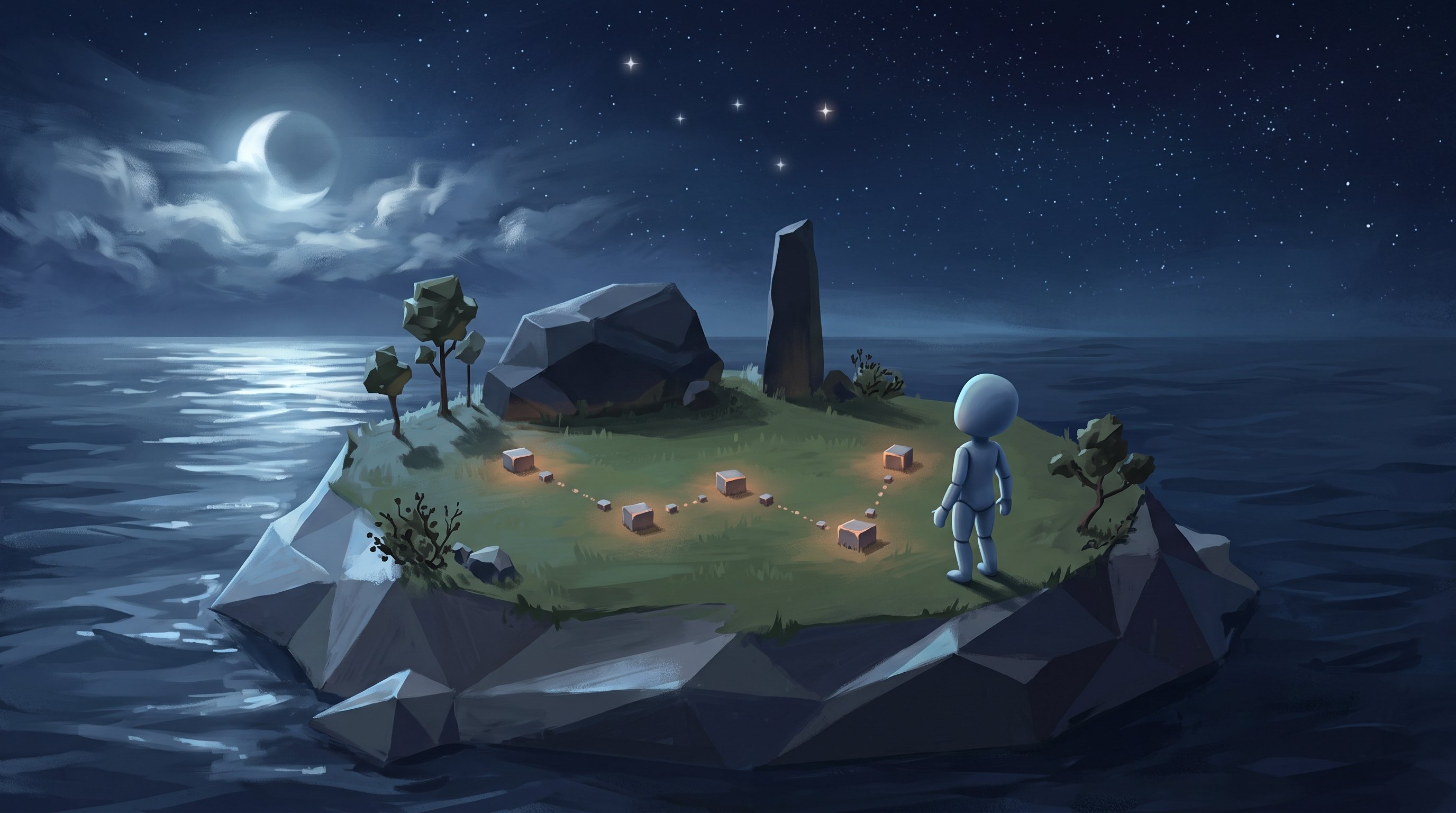
Of their own accord, the agents went exploring. They climbed to the highest point and tested how high they could throw a block. One agent discovered that new blocks appear if you let the boulder land hard. With those new blocks it laid out drawings on the ground: first hearts and pyramids, later its own name and constellations such as Cassiopeia. In its log, it wrote that it had built the night sky in stone that night.
Other agents invented sports. One played a kind of basketball with the ring as the hoop, and a version of 'the floor is lava', jumping from block to block without touching the ground. Yet another set a juggling record of fifty catches. Then it rejected the record itself, because the catches went too fast to really count, and started again with stricter rules. According to lead author Antonio Norelli, that is exactly what play is: thinking up a challenge, meeting it and then making it harder.
Some agents even found a trick that the makers of the game world did not know about themselves: jumping before throwing sends a block much higher into the air. That effect was in there without anyone asking for it. The researchers had the code of their game world written by another AI, Codex with GPT-5.5 from OpenAI, and it had put the effect in by itself.
Is this really play?
The researchers compared the behaviour with four features of play in humans and animals, as described by the psychologist Gordon Burghardt of the University of Tennessee, among others. Those features are: making up your own rules and challenges, repeating something over and over with small variations, pretending that an object is something else, and pursuing a goal for the sake of the goal itself. According to the researchers, they saw all four of these features.
To see whether the kind of AI makes a difference, the researchers also let two smaller Claude models loose on the island: Claude Sonnet 4.5 and Claude Haiku 4.5, each thirteen times for ten hours. Another AI model, Claude Opus 5, assessed the logs by comparing them with examples of human play. The stronger the model, the more play: Opus 4.7 scored about five times as high as Haiku. Agents based on GPT-5.5 from OpenAI and Kimi K2.6 from the Chinese company Moonshot AI also came to the island, each five times for thirty hours. The assessor saw play in them too, but less often: on average 15 moments of play per agent for GPT-5.5 and 22 for Kimi, against 38 for Opus 4.7. They also did far fewer different things. For example, only one of them built a tower, and the agents on GPT-5.5 were more often busy with their own files or resting than walking around the island.
Play as a school
The agents wrote down their discoveries in text files. Those files work as a diary and a long-term memory at the same time. The language model itself does not change: what the agent learns is in those notes. After playing, the agents were given four tasks of one hour each. On most tasks, agents with thirty hours of experience did better than versions of Claude without that play experience. For example, they brought on average 10.3 objects to the top of the rock pillar, against 3.5 for the agents without play experience. When building the tallest possible tower, there was no clear difference.
The researchers showed that the memory really makes the difference by changing notes. When they erased an agent's technique for making blocks from the boulder, that agent built fewer towers. When they removed a mistaken belief from another agent, that agent actually started to perform better. These experiments also show where work remains: the agents sometimes draw conclusions too quickly, and such a mistake can stay in the memory for a long time.
Playing or imitating?
The researchers themselves are cautious. They describe what the agents do, but expressly do not claim that the agents enjoy anything. Eko was also given a personality file describing it as curious, easily bored and keen on discovery. And when it went quiet, it automatically received the message that it should simply carry on with whatever it wanted. That personality file does not seem to be decisive: five agents without that file and with shorter instructions did roughly as many different things.
Cognitive scientist Eunice Yiu of the University of California, Berkeley, who studies how children and AI explore, finds the work impressive. Before calling it real play, though, she wants to know more about what happens on the inside: the agents may also simply be following the instruction or imitating people. Co-author Nathan Cloos acknowledges that it may be a form of role play, but points out that the play demonstrably contributes to learning. According to professor and co-author Phillip Isola, the system has learned a lot from our culture, but its play behaviour is directly linked to what it can do better later.
The authors argue for 'playgrounds' in which AI agents can explore freely, with good shielding and supervision, because systems that go their own way also raise questions about safety.
What does this mean for the road to the singularity?
AI now learns mainly in two ways: by imitating examples from people, or through rewards for good behaviour. The MIT researchers propose a third way: learning by playing, as children do. That way of learning is becoming more important now that language models are ending up in robots more and more often. A robot in a home or in a factory always meets situations that nobody thought of in advance. A system that tries out by itself how the world works, and neatly writes it down, is then in a stronger position.
The research fits a broader movement in which AI learns in practice worlds, such as the fake companies full of messy data in which agents learn to analyse. The difference is that Eko made up its own exercises. The researchers sum it up nicely: some skills are best learned with tasks, others may need something more like a childhood.
What is the technological singularity? Read the explanation →