Nederlands
Artificial muscles let a robot hand press piano keys and move robot eyes
Researchers at the University of Pennsylvania have made soft artificial muscles that measure for themselves how far they have contracted. This lets them hold a position halfway. A robot hand used them to press piano keys, and a pair of artificial eyes used them to look around.
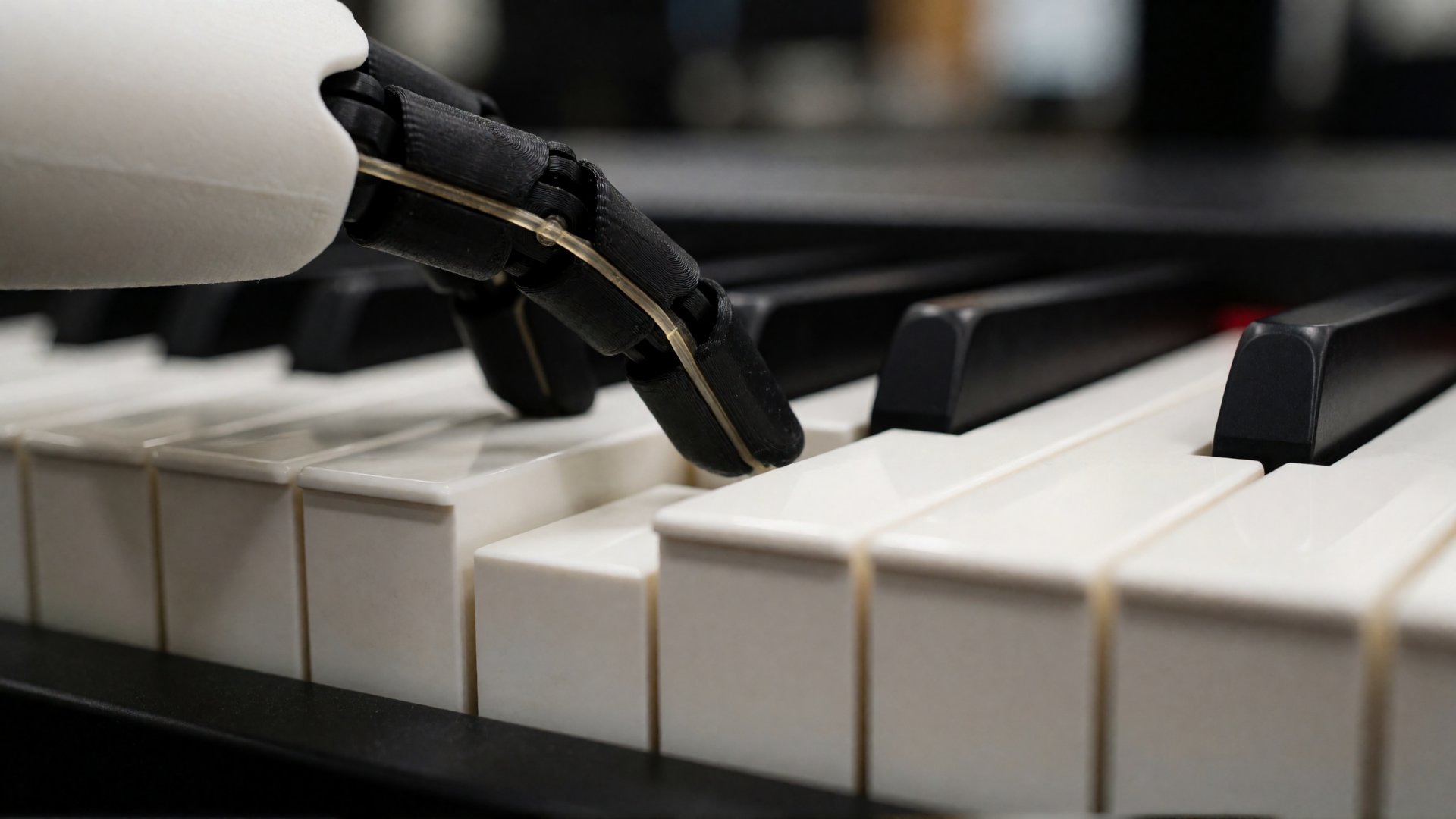
Researchers at the University of Pennsylvania in the United States have made soft artificial muscles that can hold a position halfway. In a test, the fingers of a 3D-printed robot hand pressed individual piano keys, with different force and for different lengths of time. In a second set-up, a pair of artificial eyes changed the direction of their gaze in a controlled way.
The team was led by materials scientist Shu Yang and mechanical engineer Cynthia Sung. The research appeared in November 2026 in the scientific journal Advanced Functional Materials.
A muscle that does not stop halfway
The fibres are made of a liquid crystal elastomer: a rubbery material that contracts when it gets warm and springs back to its old shape when it cools down. Such artificial muscles are hard to control. After heating, they sometimes keep contracting for a moment, or they spring back as they cool. That made it hard to hold a position halfway, while a hand or an eye needs exactly those in-between positions.
The researchers added two things. A little graphene, a layer of carbon one atom thick, makes the material softer and tougher at the same time. This lets it give a little when two muscles pull against each other. And every fibre contains a very thin copper coil. The researchers call their fibres CoilLCE.
Heating and measuring with one coil
The copper coil heats the fibre and at the same time measures how warm it is. This works because the electrical resistance of the copper (how hard it is for current to flow through it) changes with temperature. A control system reads that resistance all the time and adjusts the heating straight away, so the muscle stays at the desired position. As a result, no separate sensor is needed to measure the position.
According to Sung, it is the first time such feedback has worked with this kind of artificial muscle: the muscle itself reports how far it has contracted, and the control system adjusts to that. In a test, a fibre with a 13-gram weight attached held a contraction of 30 per cent for half an hour. In the robot eyes, eight fibres worked in four pairs that pulled against each other, like the muscles around a real eye. The eyes turned by up to 30 degrees.
The next step is to make many such muscles work together in one larger system. The team is thinking of robot faces, in which dozens of small muscles have to create natural facial expressions in very little space. To control so many muscles at once, the researchers want to use AI and computer vision: software that sees what is happening in camera images.
What does this mean for the road to the singularity?
Robots already move precisely with electric motors, but those do not always fit into small, flexible structures such as a face or a fingertip. An artificial muscle that measures for itself how far it has contracted needs no extra sensor and no gears. If researchers can make many such fibres work together reliably, much more movement fits into a small space.
That is not only useful for a robot that can smile or frown. A robot hand that places its fingers carefully and adjusts the force of a touch could, in time, also pick up fragile things, such as fruit, glassware or a human hand. For that, the researchers first have to show that large numbers of muscles can be controlled well together. If that works, robots can do more work that needs both strength and a sense of touch, in healthcare, in the kitchen or in a workshop.
What is the technological singularity? Read the explanation →