Nederlands
Caltech robot builds part of an antenna structure in orbit around the Earth
A Caltech robot has assembled a new section of an antenna frame on its own in orbit around the Earth. According to the team and the US research agency DARPA, it is the first time a structure has been built automatically in space.
Large antennas, telescopes and solar panels for space have one big problem: they have to fit in the nose of a rocket. That is why they often travel folded up and unfold in space. This works up to a certain size. Anything that needs to be even bigger will have to be built in space itself.
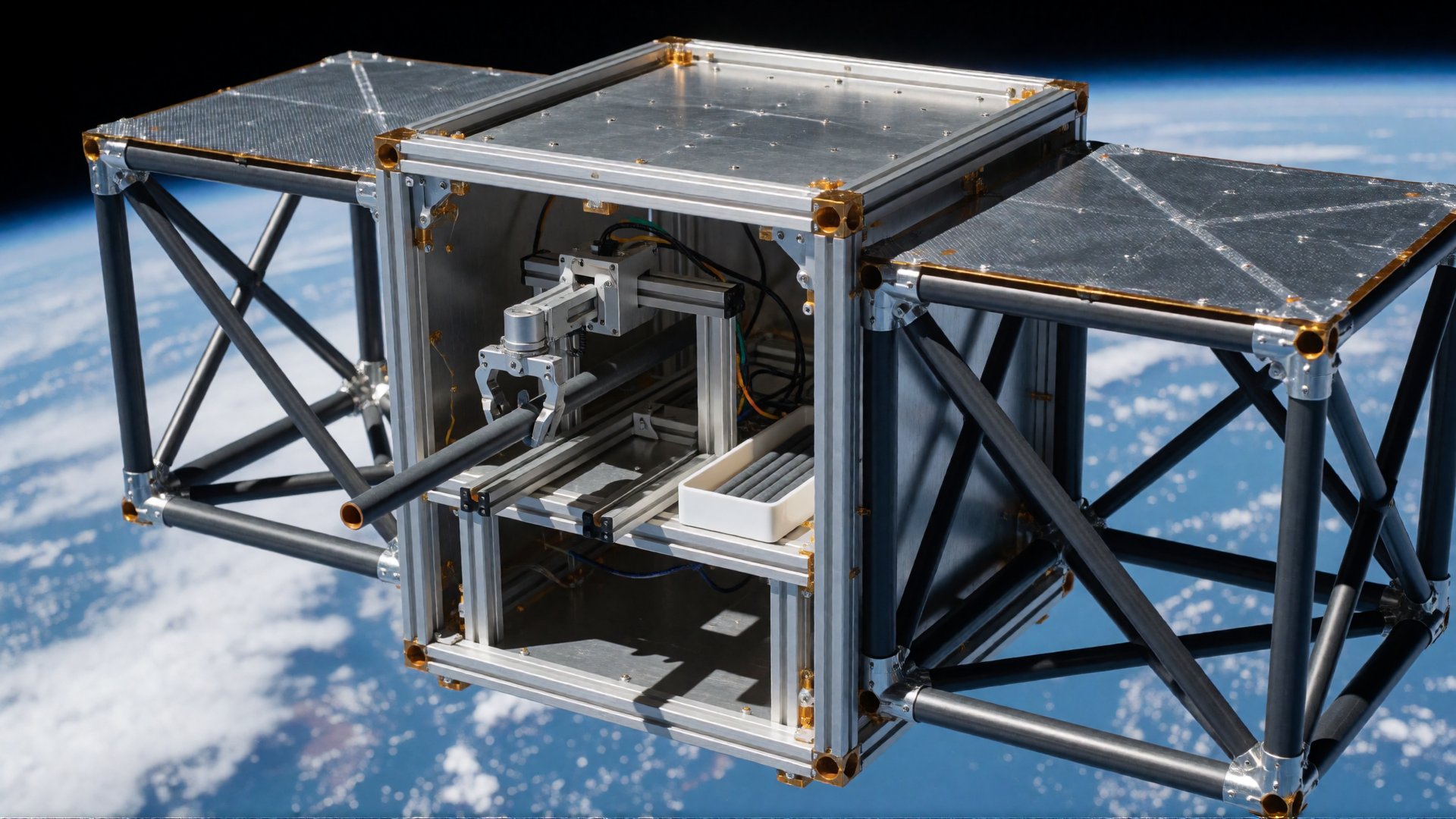
A robot from the California Institute of Technology (Caltech) has now shown that this is possible. The system, called ASTRA, assembled a new section of a truss frame in low Earth orbit: a skeleton of rods and connecting pieces, like the frame of an electricity pylon. According to team leader Sergio Pellegrino, professor of aerospace engineering at Caltech, it is the first time a structure has been built on its own in space. The US defence research agency DARPA, which funds the project, also calls it a first.
A robot with a supply of parts
ASTRA stands for Autonomous In-Space Tensioned Reflector Assembly. The package of about one cubic metre was launched on 30 March 2026 from Vandenberg air force base in California. It was one of ten payloads on board the spacecraft Vigoride 7 of the company Momentus, which flew on SpaceX's Transporter-16 mission.
On board were two ready-made sections of the frame, a robot that picks up parts and puts them together, and motorised trays full of loose parts: tubes made of composite fibre and connecting pieces made of aluminium. After the launch, the team on Earth first released the locks that had held everything in place during the rocket flight. Then they pushed the two prebuilt sections outwards, and the robot built a third section by itself.
Playing loads YouTube, which may set cookies. More information
Each section also comes with a piece of reflective material that catches radio signals. For this, Caltech and the University of Pennsylvania developed a thin film with small holes in it, a kind of net. According to Caltech, it does not need to be stretched as tightly as the knitted metal mesh that is usually used today. The frame then has to carry less force and can be lighter.
Solving problems from a distance
The work did not go without problems. The team could make contact with ASTRA seven or eight times a day, for about fifteen minutes each time. For every problem, the researchers first recreated it on an identical spare robot in Pellegrino's lab. If a solution worked there, they sent the adjusted commands to space and checked the result with photos from the cameras on board.
The plan was a dish antenna 1.4 metres across, with a frame of eleven sections. It will not be finished: the mission ends in December, and according to Caltech the frame will probably not be complete before then. The team has, however, learned enough to show that building in orbit can work this way. The next step is a simpler and more refined design.
The start of much larger structures
ASTRA is part of the DARPA programme NOM4D, which started in 2022. Its goal is structures in space from hundreds of metres to kilometres in size. According to DARPA programme manager Andrew Detor, that is not yet possible today, and this demonstration is not an end point but a beginning. A second project in the same phase, from the University of Illinois Urbana-Champaign, will test a way to harden carbon fibre tubes in space at the International Space Station (ISS).
What does this mean for the road to the singularity?
A robot that builds in space removes a limit: what you launch no longer has to fit in a rocket in one piece. Pellegrino is thinking of large telescopes, antennas for communication and huge solar panels that collect solar energy in space. ASTRA has now built one section of an antenna about one and a half metres across. With a simpler design and ever larger frames, the scale of kilometres that DARPA is aiming for is coming closer step by step.
What is the technological singularity? Read the explanation →