Nederlands
Bell Labs makes a silicon solar cell that converts almost 6 per cent of light
At Bell Labs, three researchers have made a silicon solar cell that turns about 6 per cent of sunlight into electricity. Earlier cells managed about 1 per cent. That is enough for a small radio transmitter and a toy Ferris wheel.
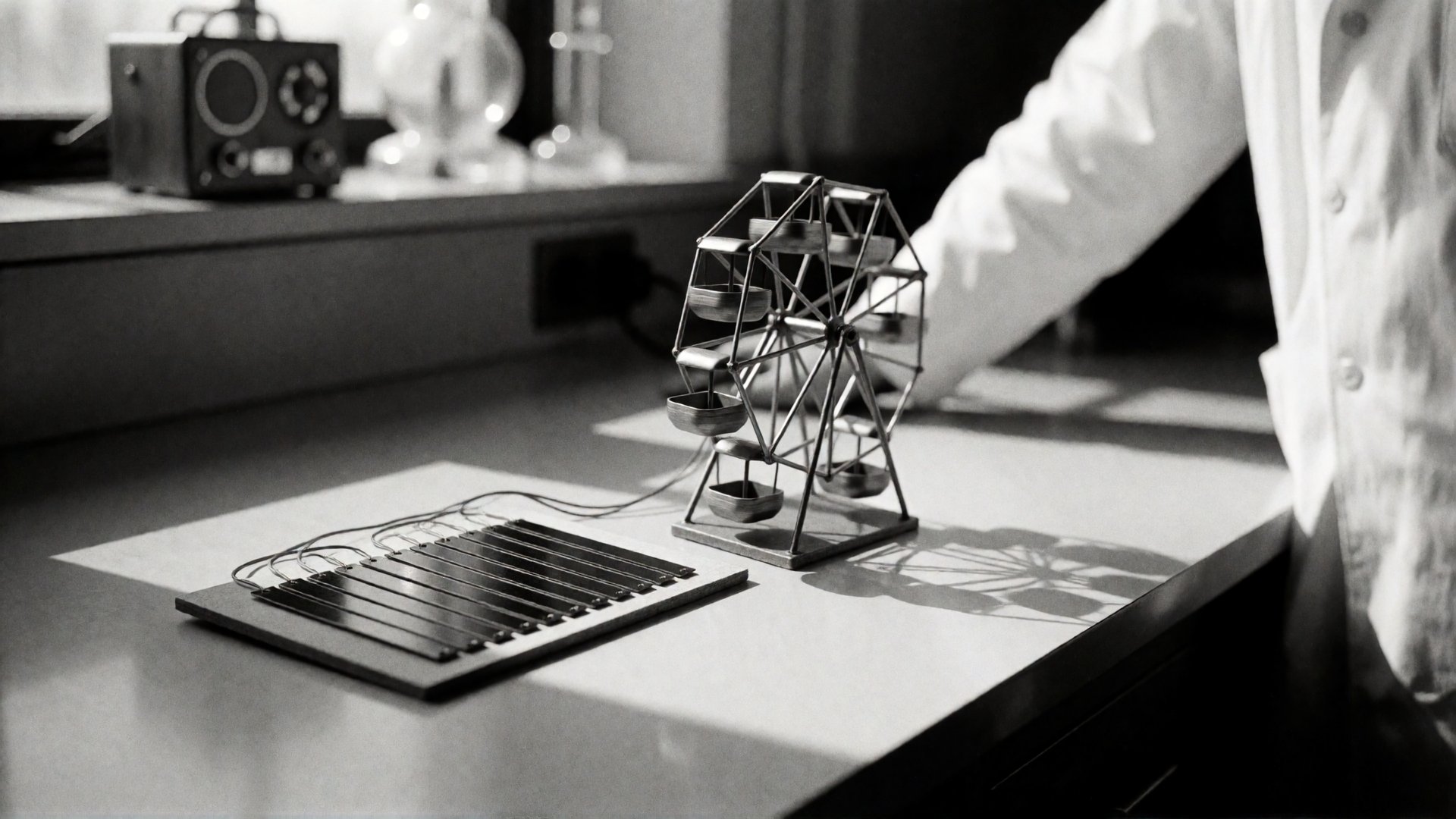
MURRAY HILL (NEW JERSEY), APRIL 1954 - On 25 April, Bell Labs showed a silicon solar cell that turns about 6 per cent of the light falling on it into electricity. That may sound like little, but earlier solar cells got no further than about 1 per cent. For the demonstration, the cell powered a small radio transmitter and a toy Ferris wheel.
Light that becomes electricity
It has long been known that light can generate electricity: in 1839 Edmond Becquerel built the first cell that did so. The problem was always the amount. In 1883 Charles Fritts made a cell of selenium with a thin layer of gold, which reached about 1 per cent. In 1940, silicon did no better than about 1 per cent either. A solar cell that delivers little electricity is a laboratory curiosity, not a source of energy.
How the new cell works
The material is silicon, the substance that sand and quartz are largely made of. It is a semiconductor: it conducts electricity less well than metal, but better than glass. Silicon becomes interesting when it is mixed with small amounts of other substances.
The team makes a cell from two layers of silicon. In one layer, a little of another substance has been added, which leaves loose electrons. In the other layer there is a shortage of electrons instead. Where the two layers meet, an electric field forms: a push in one direction.
Then light falls on it. Particles of light, photons, give their energy to electrons and knock them loose from their place. The electric field in the cell pushes those loose electrons to one side. When the two sides are connected with a wire, a current flows through the wire, and that current can be used. This is also how it works with the small transmitter: the sun supplies the energy, and the cell turns it into electricity.
Three researchers
The discovery comes from three people with different backgrounds. Daryl Chapin is an engineer, Calvin Fuller a chemist and Gerald Pearson a physicist. During a test with a piece of silicon to which he had added gallium and which he dipped in lithium, Pearson noticed a strong reaction to light for the first time.
The cell is still expensive to make. Many people therefore do not expect it to appear on rooftops soon. Satellites, however, could make use of it: they need a power source that does not run out.
Looking back from 2026
That last point proved right. In 1958 Vanguard 1 became the first satellite with solar cells, alongside its battery. After that, the cells slowly became better and cheaper, until panels appeared on houses and in fields.
In the laboratory, a new double cell of perovskite on silicon now reaches 35.1 per cent, Chinese researchers reported in Nature. That is more than five times as much as the 1954 cell. AI data centres need a lot of electricity, and solar power is one of the sources that can grow quickly.