Nederlands
Flexible solar cells reach high efficiency and pass a tough endurance test
Chinese researchers have made flexible solar cells that also work well as larger panels. A small cell converts a certified 26.9 per cent of sunlight into electricity. After more than 1,000 hours of heat and humidity, a test panel kept 92.5 per cent of its efficiency.

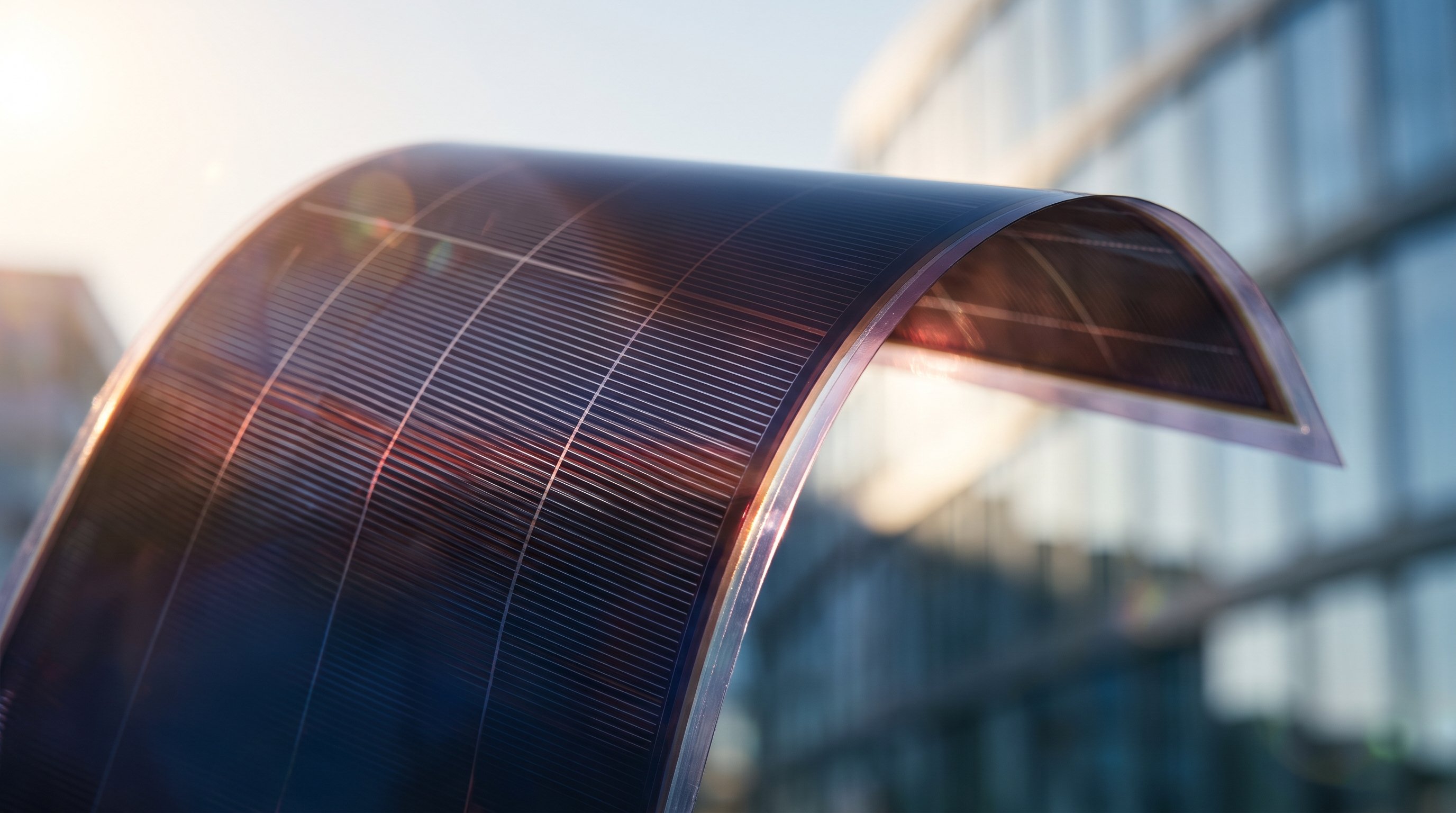
Solar panels on a car roof, a tent or a backpack: for that you need panels that are thin, light and flexible. Perovskite solar cells can do this. Perovskite is a crystal-like material that can be applied as a kind of ink in a wafer-thin layer on plastic film. In the lab, small flexible cells made of this material already work almost as well as rigid ones. The hard part is the step to larger panels: then the efficiency and the lifetime drop sharply.
A team led by Southeast University and Soochow University in China shows how to do better in the journal Science, on 22 October 2026. Their flexible panels reach a high efficiency and keep working well even in a tough endurance test.
The problem: a layer that does not attach in time
A perovskite cell consists of several thin layers stacked on top of each other. Beneath the light-capturing perovskite lies a layer just one molecule thick. It guides the generated charge to the electrode, a transparent conductor on the film. The molecules of that layer have to fix themselves with a small 'foot' to anchor points on the electrode.
On flexible film there are fewer of those anchor points, and they are unevenly spread. On top of that, the perovskite ink spreads poorly over the thin layer. That is why researchers often apply both layers in one go: the molecules of the bottom layer are mixed into the ink and find their own way to the film.
According to the researchers, that is where things go wrong. In the ink, the anchor points disappear quickly. At the same time, particles of the perovskite cling to the molecules of the bottom layer and hold them up. Those molecules then arrive too late: the anchor points are already gone. Compare it with laying tiles in glue that dries fast: if you are held up on the way with a tile ready to lay, you are too late and the tile no longer sticks. The bottom layer ends up with gaps, and the crystals above it also grow less neatly. That costs efficiency and makes the cell more vulnerable.
The solution: a molecule that clears the way
The team added an extra molecule to the ink. It attaches to the perovskite particles more readily than the molecules of the bottom layer do. Those molecules are then free and quickly fix themselves in place, before the anchor points disappear. The extra molecule does one more thing: it slows down crystal formation slightly. As a result, the crystals grow more calmly and neatly, even over a large surface.
High efficiency, also for larger panels
In this way a small cell reached an efficiency of 26.9 per cent, measured by an independent lab. This means the cell converts more than a quarter of sunlight into electricity. Larger panels were also measured independently: 22.3 per cent at 5 by 5 centimetres, 20.6 per cent at 10 by 10 centimetres and 20.2 per cent for a panel of just over 1,000 square centimetres, about 32 by 32 centimetres. It is normal for the efficiency of larger panels to be somewhat lower: the bigger the surface, the greater the chance of small defects. The researchers say their approach also works on rigid panels.
Resistant to heat and humidity
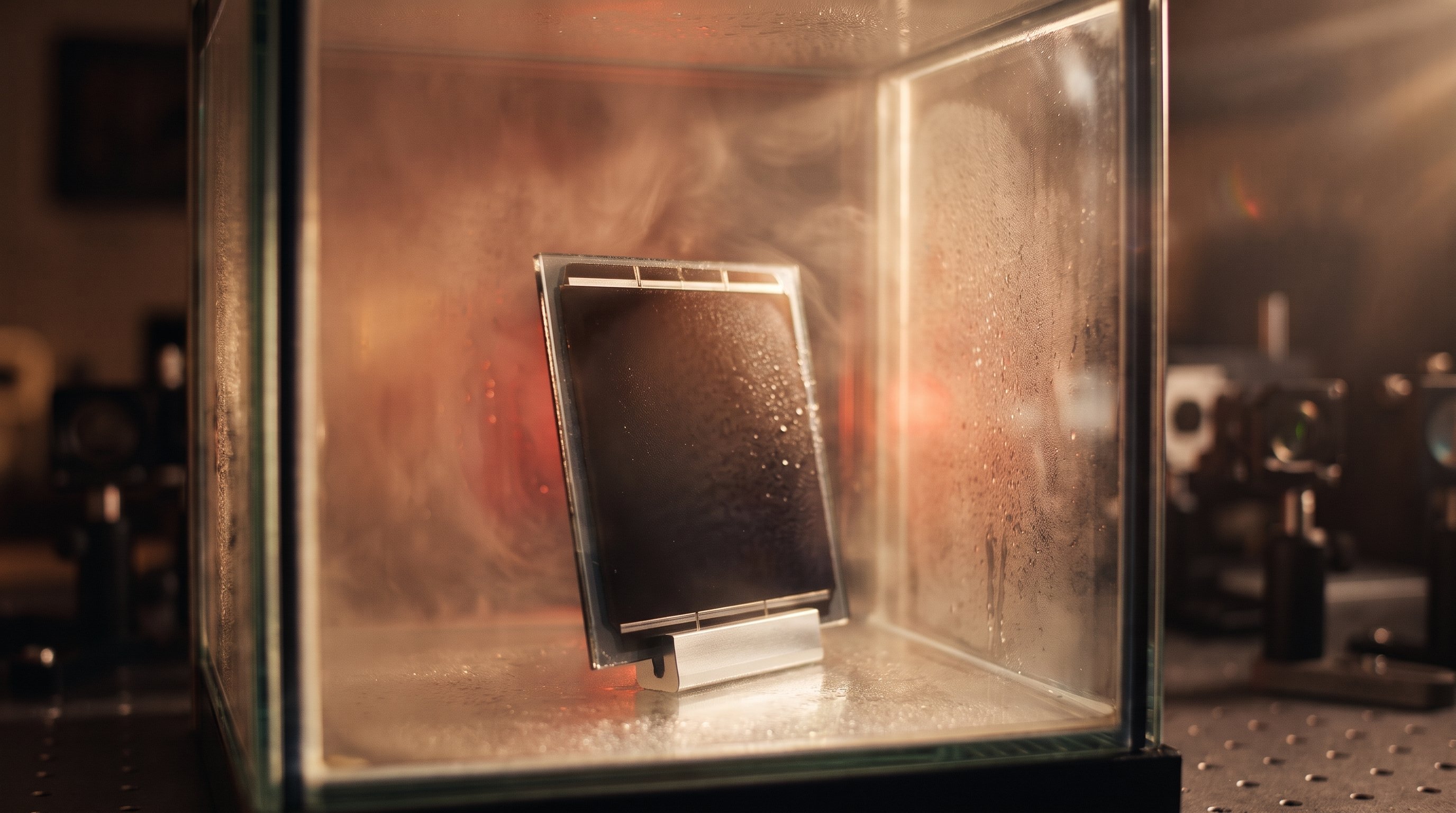
A 5 by 5 centimetre panel with a starting efficiency of 22 per cent worked for 1,044 hours, more than six weeks, at 85 degrees Celsius and 65 per cent humidity. All that time it lay under a lamp and delivered electricity without a break, just as in real use. Afterwards it still had 92.5 per cent of that efficiency. The panels also passed all test sequences of the international standard IEC TS 63163, for flexible and wearable solar panels. The German testing company TÜV SÜD has confirmed this.
According to the researchers, the next step is to make better versions of the extra molecule, to combine the cells with other types of solar cells into so-called tandem cells, and to scale up production to printing on large rolls of film, as with a newspaper printing press.
Work on this in Europe too
European researchers are also working on flexible perovskite cells printed on rolls of film. This happens, among other places, in the three-year PEARL project, which started in October 2023, with ten partners led by the Finnish research institute VTT. Within it, the Spanish institute ICIQ got a single cell on flexible film to reach 21.6 per cent. The Dutch research organisation TNO made a cell in which all the layers were applied with a roll machine, an important step towards factory production. The partners also developed a protective layer that kept cells stable for more than 2,000 hours at 85 degrees and 85 per cent humidity. The project announced those results in September 2025.
What does this mean for the road to the singularity?
A future full of electric vehicles, robots and smart devices needs clean electricity that can be generated almost anywhere. Flexible, light solar cells can do that in places where ordinary panels are too heavy or too rigid: on vehicles, building facades, tents and small devices.
It is striking that this is not the only team tackling this weak spot in the same week. In organic solar cells, another light and flexible type, a team from the Chinese institute NIMTE chemically fixed the one-molecule layer to the electrode, so that it no longer comes loose under heat and light. There the problem was molecules that come loose over time; here it is molecules that do not attach in time during manufacturing. That several groups are arriving at this bottleneck at the same time shows how far these technologies have come: the work is now about the last hurdles on the way to the factory. And the pace is high: the first perovskite cells reached almost 4 per cent in 2009; now even a flexible cell reaches almost 27 per cent.
That perovskite now also reaches high efficiency on a large flexible panel and passes a recognised endurance test removes one of the biggest objections to this technology. The next step is to show that this also works in a factory, on large rolls and at low cost.
What is the technological singularity? Read the explanation →