Nederlands
Bell Labs makes a tiny piece of crystal amplify a signal
At Bell Labs, John Bardeen and Walter Brattain have demonstrated that a piece of germanium with two gold contact points amplifies a weak signal, with no glowing filament and no warm-up time. It could replace the vacuum tube.
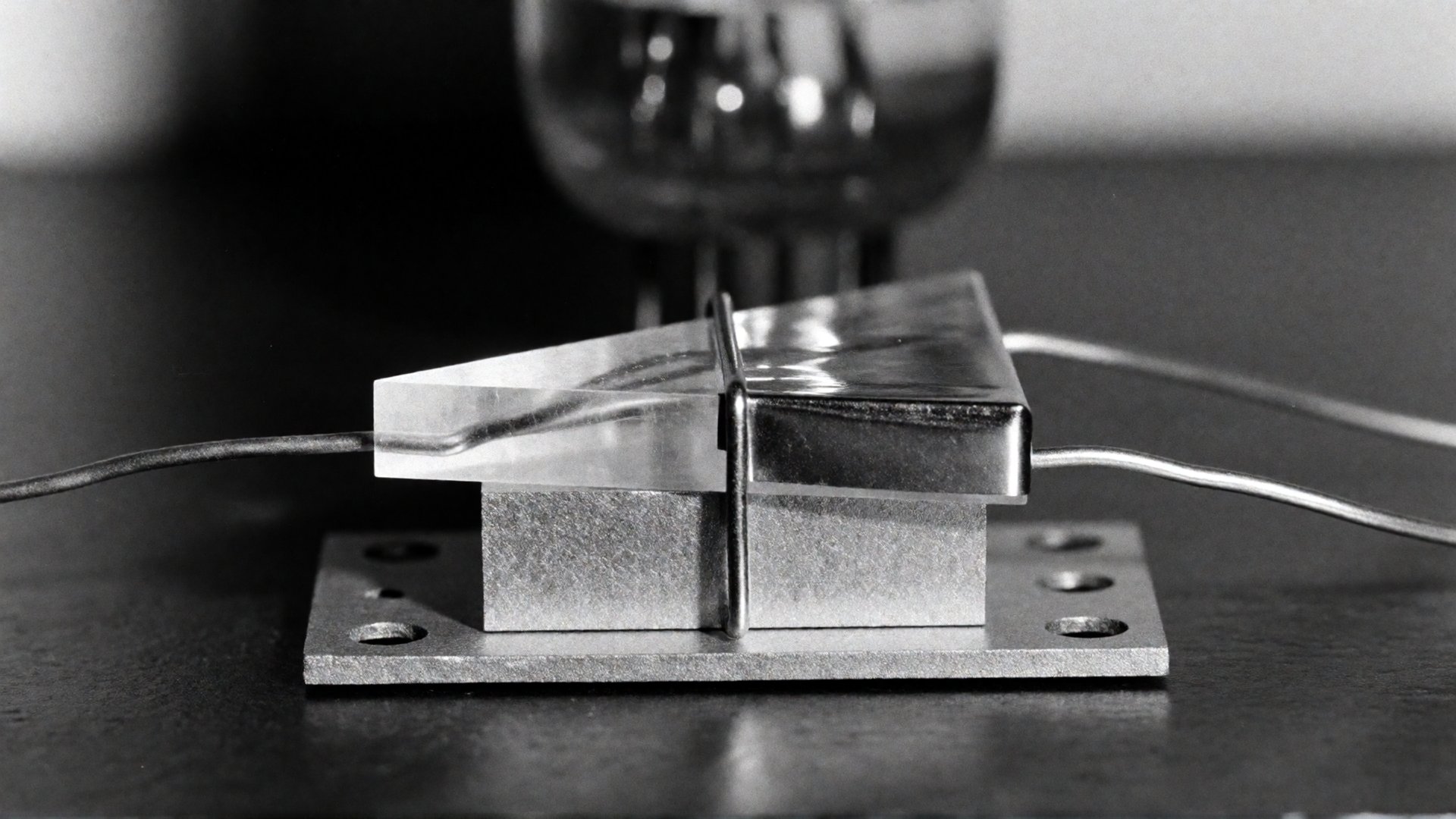
MURRAY HILL (NEW JERSEY), DECEMBER 1947 - At Bell Telephone Laboratories, the research company of the American telephone company, two physicists showed a small invention to their colleagues on 23 December. John Bardeen and Walter Brattain, from William Shockley's group, switched a small piece of crystal in and out of an audio circuit. Those present heard the signal get louder. A week earlier, on 16 December, a signal had been amplified for the first time.
What an amplifier has to do
An amplifier turns a weak signal into a strong signal with the same shape. Every radio and every telephone network needs one: a voice travelling along a long cable gets weaker and weaker and has to be boosted again along the way.
Until now, the vacuum tube has done that job. It works like this: a filament inside a glass tube gets hot and sends electrons into the empty space. A fine grid between the filament and the plate on the other side controls how many electrons arrive. So a very small voltage on that grid controls a much larger current, and that produces a stronger copy of the signal.
A tube also has drawbacks. It is large, hot and fragile, and it has to warm up before it works. A filament can burn out, and then the tube has to be replaced. Bell Labs hopes that a part made entirely of solid material, with no filament and no vacuum, can replace the tube and the mechanical relays.
A crystal with two gold points
The new part is surprisingly small. Bardeen and Brattain use a small block of germanium, a semiconductor. That is a substance that conducts electricity less well than a metal, but better than an insulator. Onto the block they press two gold contacts that sit very close together. Brattain made them by cutting a strip of gold foil over the tip of a small plastic triangle.
One contact is the input. The signal that comes in there changes the current that connects the block with the other contact and with the base. In this way, a small change at the input gives a larger change at the output. That is amplification. In the first version, the signal became about two to three times stronger. Such devices are still difficult to make, and not every one works equally well.
It is not yet ready for mass production, but the advantage is clear. It works straight away, with no warm-up time, and no filament has to glow. The part can become much smaller than a tube.
Looking back from 2026
Bell Labs did not hold a press conference in New York about the invention, which it called the transistor, until 30 June 1948. The New York Times gave it a few paragraphs on page 46. The trade journal Electronics put the three inventors on its cover, with the headline "Revolutionary amplifier: the crystal triode".
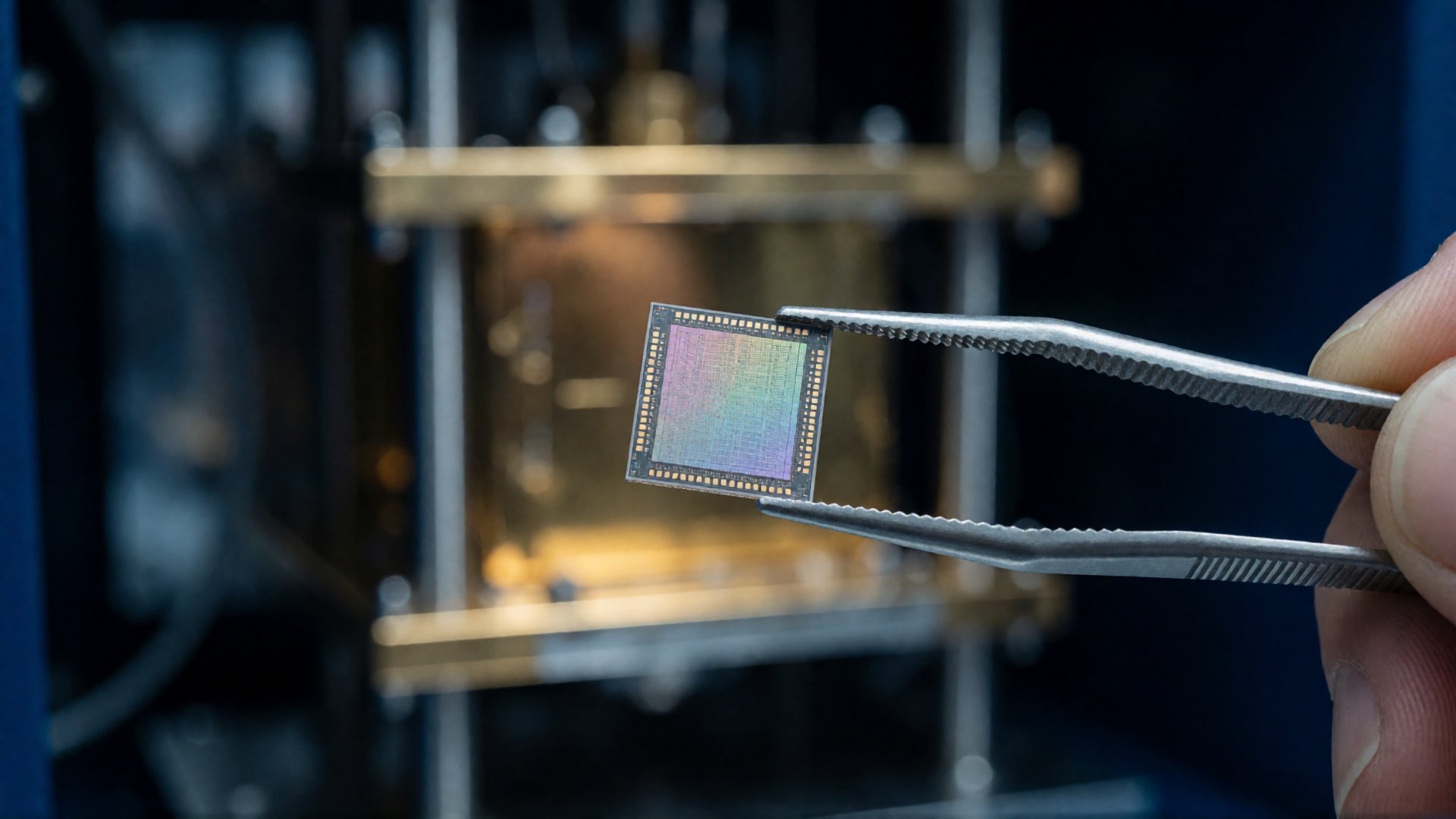
The point-contact transistor was followed by stronger types that were easier to make, and later almost everything moved to silicon. A transistor can also work as a switch, on or off, and that is what computers need. A modern chip contains billions of these tiny switches. Every AI model being trained today ultimately runs on chips built from them.