Nederlands
Google runs an AI model on a TPU in space for the first time
Google's Project Suncatcher has reached a milestone: a Gemma 4 model aboard a prototype satellite answered a prompt from orbit. It is a first step towards data centres in space.
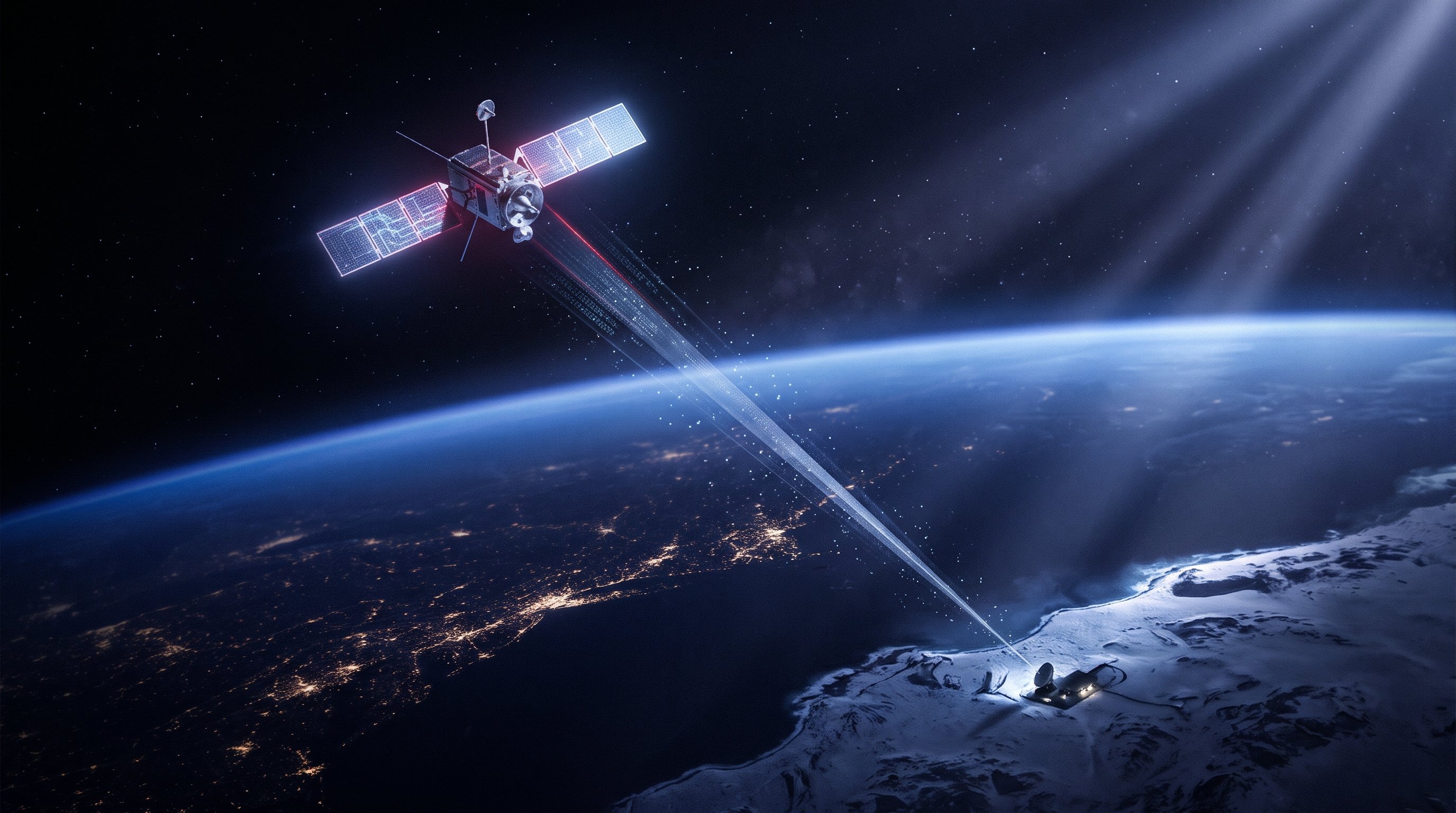
Google has run an AI model on a data-centre-class chip in orbit around the Earth for the first time. The company calls it a "hello world" milestone for Project Suncatcher, the long-term research project exploring whether AI computing is possible in space. CEO Sundar Pichai announced the result: the team sent a prompt up, powered on the TPU on board and received the first complete answer back on Earth.
The prototype satellite was launched on 1 October aboard SpaceX's Transporter-18 rideshare mission, in cooperation with the satellite company Planet. It carries four TPU chips of the Trillium generation. Since then it has been in a commissioning phase, in which the host and TPU trays were started up and the first machine learning tests were run.
The haiku from orbit
During a pass over a ground station, when the satellite flew over Svalbard in Norway, the team sent a prompt to Google DeepMind's open model Gemma 4, which is on board. The request was to write a haiku about being in space. The poem that came back reads:
Blue marble below Data streams in silent grace Starlight feeds my core.
The team then tested space-themed limericks and prompts in which the satellite had to report telemetry about its on-board systems. According to a spokesperson quoted by TechCrunch, the satellite is operating nominally.
What is being tested now
The next test phase must show how the TPUs cope with thermal stress and radiation in orbit. Google has already tested the chips extensively on Earth in particle accelerators, but the real radiation environment is different. Radiation can cause so-called "bit flips", where a stored value in computer memory flips, so data can be corrupted without standard monitoring tools noticing. According to TechCrunch, ground tests suggested that radiation has a limited impact on inference workloads and could be mainly a problem for training models. The team will now assess that in practice.
The satellite generates up to 1 kW of power. The TPU can therefore only be switched on for about twenty minutes at a time, which makes communication between space and Earth more complex.
If the chip proves itself, Google wants to launch two more satellites in 2027. They will have higher power generation and are meant to demonstrate high-bandwidth optical links between satellites. This is an important difference from competing plans: according to TechCrunch, Google is almost the only player relying on fast links between satellites to run shared, distributed workloads. Companies such as Starcloud and Cowboy Space are betting on inference on individual satellites.
Starcloud, a start-up backed by Nvidia, got there before Google. In November 2025 it flew an Nvidia H100 GPU aboard its Starcloud-1 satellite and trained an AI model in orbit for the first time. Starcloud has since raised hundreds of millions of dollars, with Nvidia as an investor, and is working towards satellites with several H100s and eventually newer Blackwell hardware.
The idea behind Suncatcher is mainly about energy. According to Pichai, the sun produces roughly 100 trillion times more power than humanity's total electricity production. Satellites in a sun-synchronous orbit can use that source almost continuously, which no data centre on Earth can match. In a recent peer-reviewed analysis, Suncatcher researchers estimate that, for the number of launches needed, SpaceX would require around 1,800 flights of its Starship rocket, which is still in development, to achieve the same cost reductions through learning effects as with earlier rockets. Both Google and SpaceX depend on fully and rapidly reusable Starship flights for their orbital data centres. Alphabet also holds a significant investment stake in SpaceX.
What does this mean for the road to the singularity?
This news removes a concrete limit in the search for computing power for scaling AI: energy. Data centres on Earth run into grid congestion and power shortages, while the sun in a sun-synchronous orbit supplies almost unlimited, continuous energy. Google has now shown that a data-centre-class TPU in space can run a model and send an answer back. This means the first building block of orbital AI infrastructure works, not as a simulation in a lab but as a verifiable signal from orbit. The big open questions are whether the chips can withstand long-term radiation, whether optical links between satellites are feasible and whether the launches make economic sense. These will be tested over the coming years. If that succeeds, the energy limit of AI computing moves from the Earth's surface to space. That could considerably shorten the remaining distance to ever more capable AI systems that run continuously.
What is the technological singularity? Read the explanation →