Nederlands
ENIAC calculates with electricity instead of gears
The University of Pennsylvania has unveiled ENIAC, a calculating machine with about 18,000 vacuum tubes. It does in seconds calculations that take a person weeks. Setting up a program, however, still takes days of work with cables and switches.
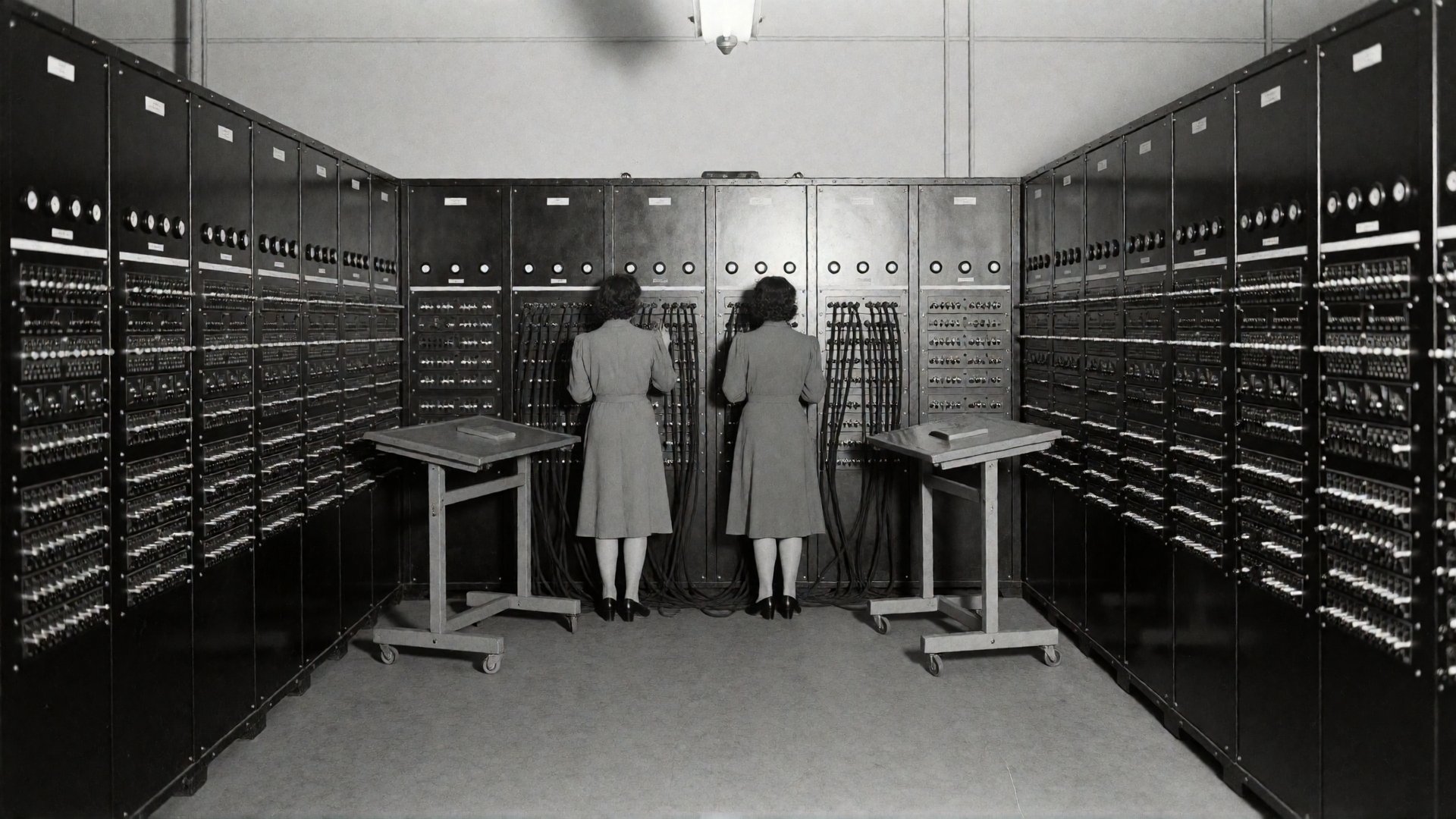
PHILADELPHIA, FEBRUARY 1946 - On 15 February, the University of Pennsylvania unveiled a machine called ENIAC. According to its makers, it is the first calculating machine that works fully electronically and that can be set up for all kinds of calculations. It fills a large room: more than 27 tonnes of equipment on about 28 square metres. At the presentation, it calculated the path of a projectile in about 15 seconds, a calculation that took a human computer weeks.
Why artillery needed calculations
The builders, John Mauchly and J. Presper Eckert, worked for the United States Army. The army needed tables that tell gunners how to aim a cannon. Each table consists of thousands of paths, and each path is a long series of calculations. Hundreds of people worked these out by hand and with small calculating machines. ENIAC was built to take over that work.
What a vacuum tube does
Anyone who owns a radio with tubes knows the part: a glass tube with a glowing wire inside. The hot wire sends electrons into the tube. A fine metal grid decides how many of those electrons reach the other side. A very small voltage on the grid therefore controls a much larger current, and a strong voltage cuts the current off completely. This also makes a tube a switch without moving parts.
That is the difference from older calculating machines. They are full of gears and small switches that really move back and forth, and that takes time. In a tube, only electrons move. As a result, ENIAC can add or subtract two numbers 5,000 times per second. Multiplying and dividing are slower.
Calculating like people
ENIAC counts in tens, as we do on paper, and not in zeros and ones. Each digit of a number has its own small group of tubes, and one of them at a time shows the value. This is how the machine holds numbers, in so-called counters. The memory is small: it holds twenty numbers.
Set up with cables
ENIAC cannot store a text or a program in its memory. The instructions for the machine lie in the way its parts are connected. Staff plug cables into a large patch board, as in a telephone exchange, and set switches on three tables on wheels. Turning a calculation into such a set-up takes weeks of thinking, and the setting up itself takes days. Once it is ready, the machine calculates in minutes what used to take hours or weeks.
The machine cost about 487,000 dollars. Its first real job, at the end of 1945, came from Los Alamos: a calculation for the development of the hydrogen bomb. The public did not know this.
Looking back from 2026
ENIAC worked until 1955 and showed that electronic calculation works in practice. The lesson about setting it up was quickly learned: computers from the following years store their program in memory, so rewiring is no longer needed. That idea is the basis of every computer since.
The link with AI is direct. In the end, an AI model is an enormous amount of adding and multiplying, exactly the work ENIAC was built for. The speed of that work has grown by a huge factor since then, and this makes it possible to process language and images with such calculations.