Nederlands
Bacteria as a calculator: swimming through a maze, they test many solutions at once
Researchers led by Canada's McGill University have bacteria solve a calculation puzzle by letting them swim through a network of tiny channels. Because bacteria divide, the number of "calculators" grows by itself. It is a first trial.
Some calculation puzzles are almost impossible for ordinary computers. They are problems where you must find the right answer among a huge number of possible combinations. With every extra piece of the puzzle, the number of combinations roughly doubles. A computer that checks them one by one soon needs longer than a human lifetime.
A team led by Canada's McGill University has tested a different approach: let living bacteria do the work. The researchers describe their experiment in the journal Microsystems & Nanoengineering. The senior author is Dan Nicolau, professor of bioengineering at McGill. According to the university, the work is the result of twenty years of cooperation between researchers in Canada, Europe, the United Kingdom and Australia.
A maze in which every route is an answer
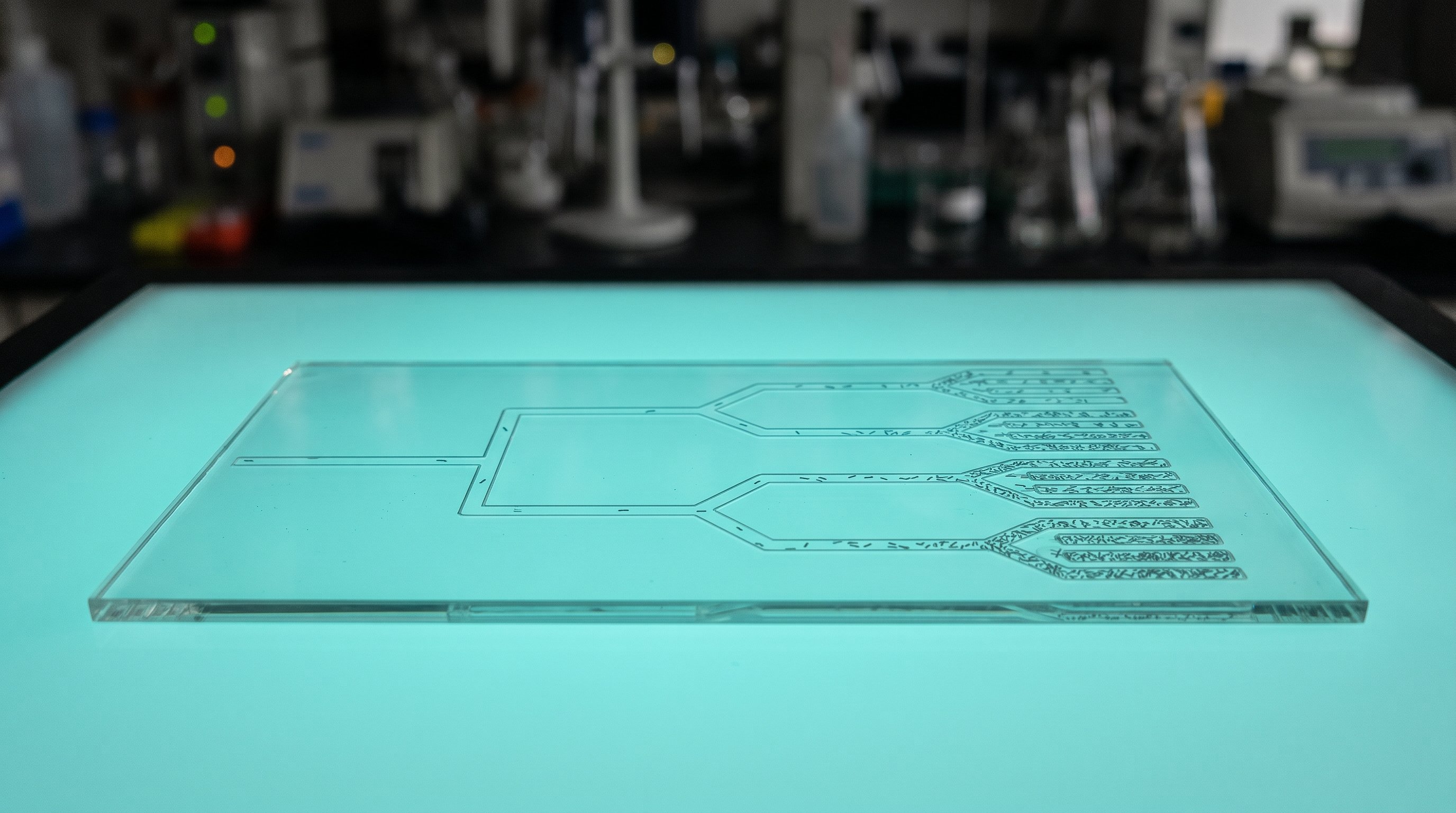
The researchers first turn a calculation puzzle into a diagram of choices: at every step you can go one way or the other. They then rebuild that diagram as a network of tiny, connected channels. Every junction is a moment of choice. Every route from start to finish stands for one possible solution.
Next, they let bacteria swim through the network. At every junction, each bacterium chooses a side. In this way, very many routes are travelled at the same time, and so very many solutions are tried at the same time. A computer with image recognition looks at where the bacteria end up and which routes are correct.
Calculators that double themselves
The special part is the dividing. A bacterium that divides becomes two calculators. According to Nicolau, it works as if you were getting more and more computer chips along the way, at the moment you need them. An electronic chip is much faster per step, but with a million bacteria, a million are at work at once. Because the number of bacteria grows with the size of the puzzle, the computing power grows with it.
The researchers can steer the growth with temperature. This stops the network from getting too crowded. According to McGill, the biocomputer uses only a small part of the memory and resources that an ordinary computer needs for such a puzzle.
A first trial
This is a first trial in the lab, not yet a working machine for large problems. The researchers say themselves that the aim is not to replace ordinary computers or quantum computers. They see it as a cheap tool for puzzles that ordinary computers handle poorly. As possible uses, they name encryption, research into how proteins are built, and artificial intelligence. The next step is to show that the approach also works for larger puzzles.
What does this mean for the road to the singularity?
Computing power is one of the raw materials of the future: the more of it is available, the bigger the problems we can tackle. This research shows that computing power does not have to come from silicon alone. A calculator that multiplies itself is a very different way of thinking about computers. If this approach can be scaled up, it could become a useful addition to ordinary computers and quantum computers, especially for the puzzles they find hardest.
What is the technological singularity? Read the explanation →