Nederlands
First computers talk to each other over a network: "lo" gets through
From UCLA, student Charley Kline tries to send 'LOGIN' to a computer at Stanford. Only 'LO' arrives before the system crashes. An hour later it works: the first message over the ARPANET.
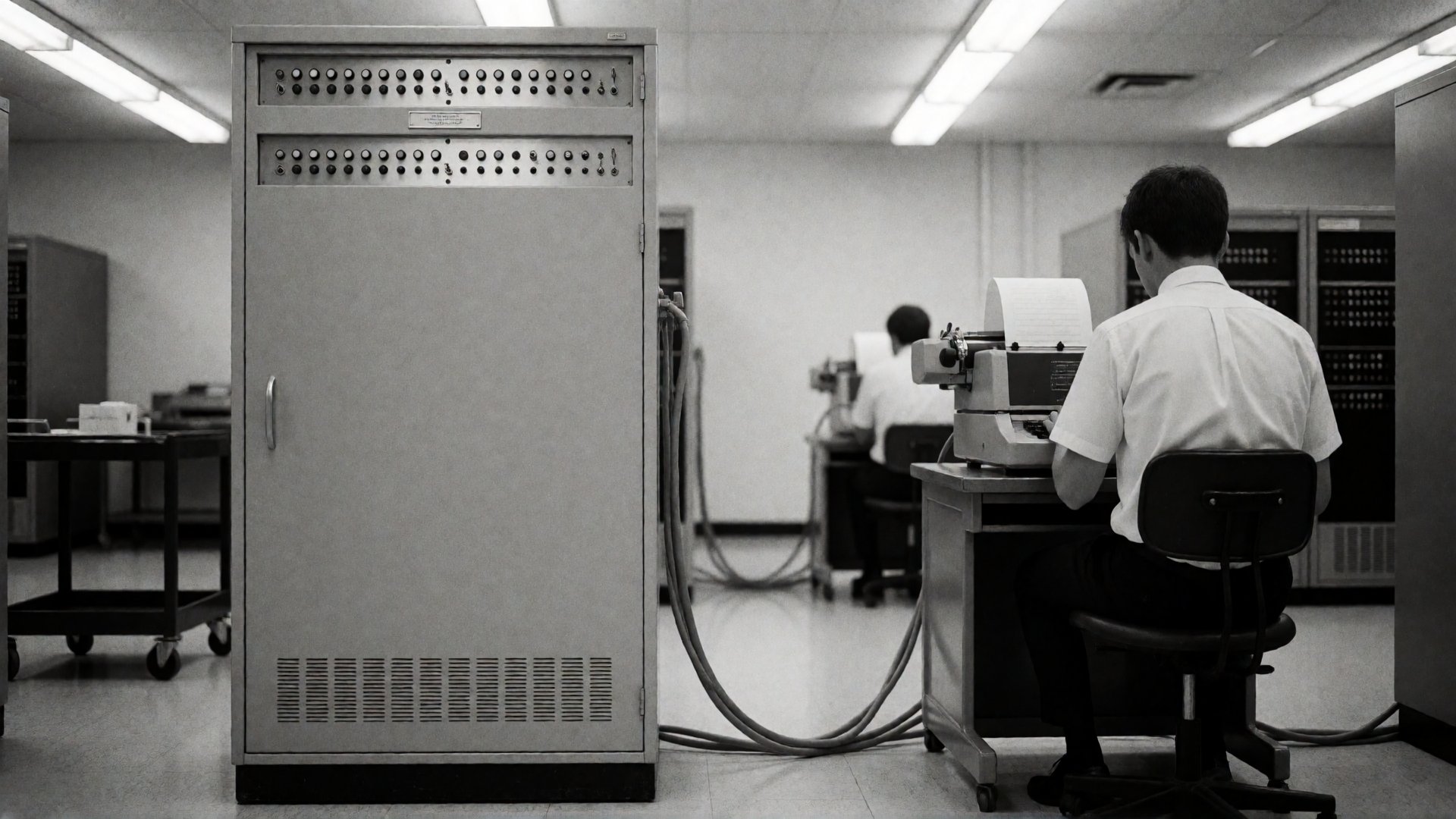
LOS ANGELES, OCTOBER 1969 - At half past ten in the evening on 29 October, student Charley Kline at the University of California, Los Angeles (UCLA) attempted the first computer-to-computer connection over the ARPANET. He wanted to log in to a computer at the Stanford Research Institute (SRI), more than 500 kilometres away. He typed the letters of LOGIN, and only the letters L and O arrived. Then the system crashed. So the first message over the network was 'lo'. About an hour later, logging in did work.
What the ARPANET is
ARPA is a US government research agency that pays for technical research. The agency wants its researchers to be able to use each other's computers, even when they are far apart. To make this possible, Charles Herzfeld moved one million dollars from another project. The hardware and software were designed and installed in nine months.
The problem with a telephone line
Computers can already talk to each other over a telephone line. But a telephone line is made for conversations: as long as a call lasts, the whole line is reserved for you, even when you say nothing for a while. If you want to talk to many computers, you need a separate connection between every pair. That is expensive and impractical.
Messages in packets
The ARPANET works differently. It uses an idea that Paul Baran came up with in the early 1960s and that Donald Davies in England named packet switching in 1965. A message is chopped into small pieces, called packets. Each packet travels separately over the lines, via small relay stations, and at the end they are put back together in the right order. Packets from many different users can pass one after another over the same line, so the line never sits idle as long as there is something to send.
For this, every participating computer gets its own relay station: an IMP, an Interface Message Processor. Bolt Beranek and Newman built these minicomputers, based on a rugged version of the Honeywell DDP-516. An IMP receives packets, stores them briefly and passes them on to the next one. The receiver reports that it is ready for the next message. Up to four local computers can be connected to one IMP. The lines between the IMPs are leased connections of 50 kilobits per second. That is about six thousand characters per second.
Four sites
On 5 December 1969 the network is complete, with four nodes: UCLA, the Stanford Research Institute, the University of California, Santa Barbara and the University of Utah.
Looking back from 2026
In the years that followed, the ARPANET grew into the internet. The packets stayed; they are still the way data travels across the internet. In 1991 Tim Berners-Lee made the web public, and with that the network became a collection of text, images and sound from billions of people.
This matters directly for AI. Language and image models learn from that huge amount of text and images on the internet. Without that network, the material would not have existed. It started with two letters.