Nederlands
Anthropic buys a one-person biotech company: Claude handled the work with eleven laboratories
With help from Claude, one scientist took a possible treatment for a rare muscle disease from idea to first results in mice in less than 18 months. Anthropic took over his company and also reports early results from six partners.

Anthropic, the company behind the AI Claude, has taken over the American biotech company Mithril Medicine. What makes it unusual: Mithril had only one permanent employee, its founder Cody Tranbarger. Anthropic announced the takeover on 27 October 2026; the purchase itself took place in July.
Developing a medicine normally takes a large team. Someone has to sign contracts, plan experiments, send samples and keep track of results. According to Anthropic, Tranbarger left a large part of that organising work to Claude. The AI helped with the contracts, the logistics and the experiments at eleven outside laboratories. Tranbarger also worked with eight paid advisers. Mithril's two projects are now Anthropic's first in-house drug projects. Tranbarger now works at Anthropic and is continuing the research there.
A bridge between muscle fibre and surrounding tissue
Mithril is working on a treatment for LAMA2 muscular dystrophy. This is a rare muscle disease that people are born with. Because of a fault in the LAMA2 gene, muscle fibres are attached less firmly to the tissue around them. As a result, the muscles are damaged with every movement and become weaker and weaker.
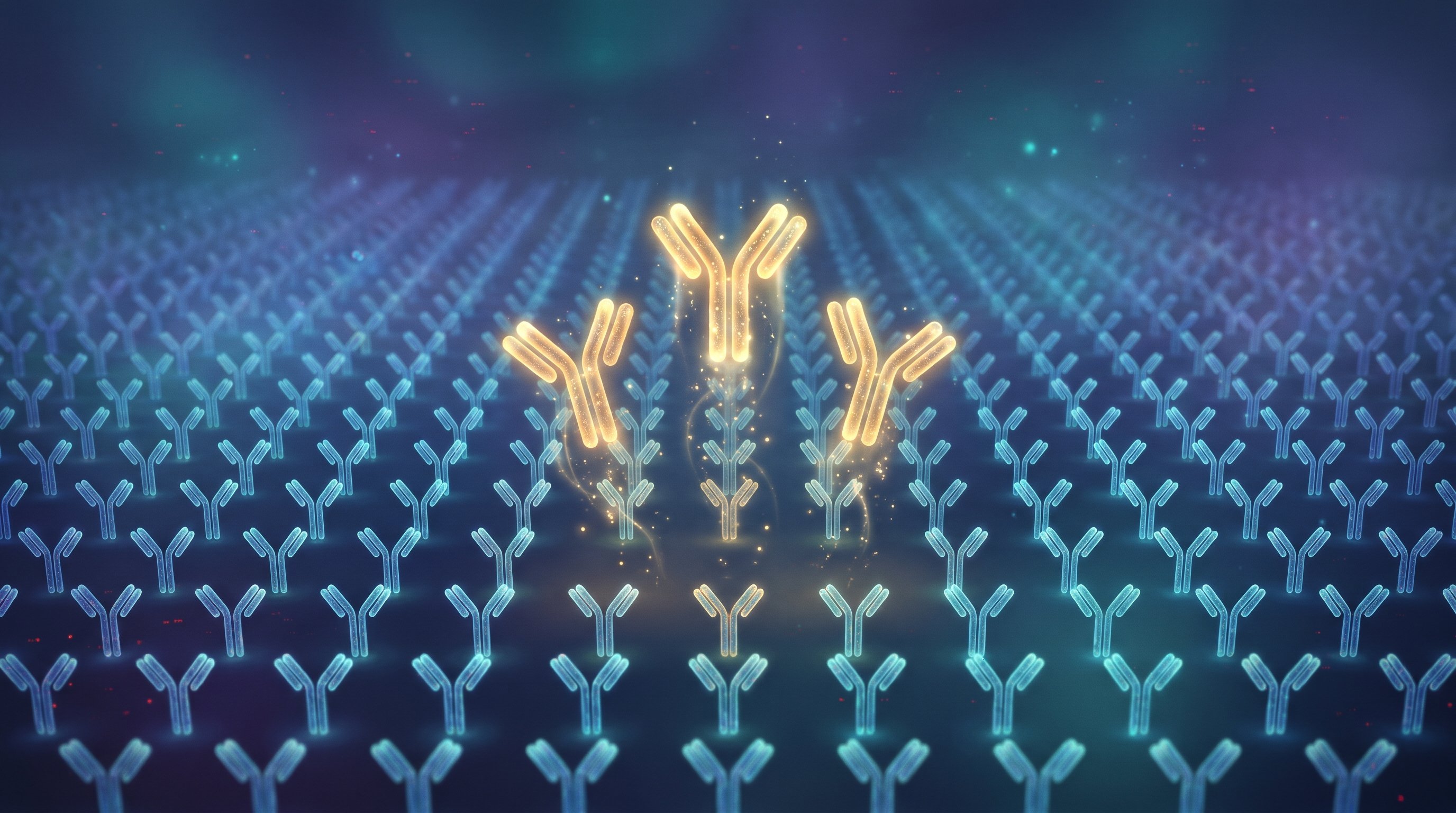
Mithril's idea is a special kind of antibody. An antibody is a protein that grabs hold of something else, as our immune system does with germs. Mithril's antibody grabs hold on two sides at once: on the muscle fibre and on the tissue around it. In this way it forms a bridge that partly takes over the missing connection.
Stronger mice, but still a small experiment
According to Anthropic, the project went from idea to first evidence in mice in less than 18 months. In the experiment, seven mice with the disease received the antibody and, for comparison, four mice received a solution without the antibody. At six weeks of age, the treated mice had about twice as much grip strength and muscle strength in their front legs as the other mice.
The team itself is open about the limitations. It was a small group. The mice were put into groups by litter, not at random. And the treated mice were tested 126 to 161 days later than the other group, while the mouse colony moved in between. The research has not yet been reviewed by other scientists. The team therefore wants to repeat the experiment, with both groups at the same time and without the researchers knowing which mouse received what.
Claude made mistakes too. The team looked at six of them. At least three of these reached outside laboratories through emails, even though people read those emails first. Once, Claude asked a lab for less material per tube than was needed; this was caught in time. At the same time the AI also worked fast: Claude summarised a 341-page production report on 113 antibody variants in less than eight minutes.
Anthropic calls this way of working "Pipeline-in-a-Person": one scientist decides, the AI organises and coordinates. Mithril wants to choose the final drug candidates in 2027. If everything keeps going well, the treatment for LAMA2 muscular dystrophy could be tested in people at the end of 2028 at the earliest. The second project, for another rare muscle disease (alpha-dystroglycanopathy), aims for trials in people from 2029.
Partners also report early results
At the same time, Anthropic reported first results from six partner companies. These figures come from the companies themselves.
- Generate Biomedicines is working on CAR-T therapy, in which a patient's immune cells are modified so that they recognise cancer cells. With help from Claude Code, six scientists designed a recognition part that is about 70 per cent shorter. As a result, in lab tests the immune cells made about ten times as many of these recognition parts, and killed cancer cells better.
- Divergence Labs is looking for a medicine against food allergy. In about a month, Claude came up with some 35,000 designs for antibodies. From these, the company found three that attach to IgE, the substance that plays a role in an allergic reaction, and twenty that can release IgE.
- BigHat Biosciences tested, in about ten weeks, some 1,010 antibody variants that Claude had proposed. The best ones attached more than ten times more strongly than the original versions.
- Enveda had Claude check 1,061 pages of production documents. Claude found all eleven problems that people also found, plus seven that they had missed. The time people spent on checking fell by 89 per cent.
- The Column Group is setting up the new company Pleiades, which wants to use Claude to run more drug projects than a small team can normally handle.
- Bristol Myers Squibb uses Claude to assess plans for clinical trials.
All this work is still at an early stage. None of these treatments has yet been tested in people. The next step is for other researchers to check and repeat the results.
What does this mean for the road to the singularity?
This is a real-world test of whether one scientist with an AI model can do the work that normally needs a whole team. That matters especially for rare diseases. There are many such diseases, but few patients per disease, and so it is often too expensive for companies to develop a medicine for them. If a small team with AI can do that work, many more of these diseases could get a chance. For now the evidence is a small mouse experiment. The repeated, stricter experiment has to show how strong the effect really is.
What is the technological singularity? Read the explanation →