Nederlands
Four AI agents finish Minecraft together using programs they wrote themselves
Four AI agents from Google DeepMind have finished Minecraft on their own. In just over 27 hours they shared out the work through chat, wrote 2,783 programs of their own and defeated the final boss. They played on easy mode, with software that tells them exactly what is around them.
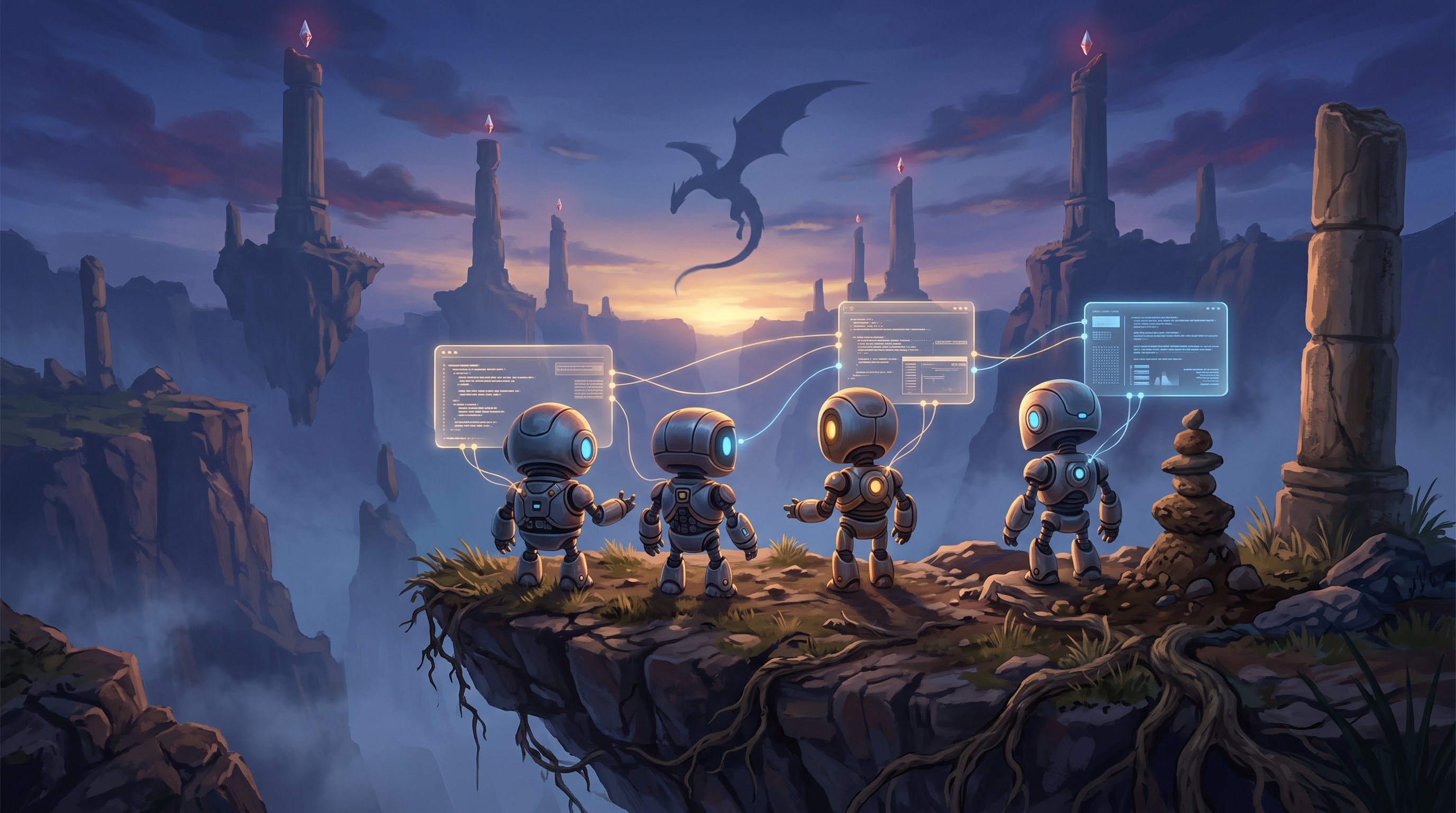
A team of four AI agents has played Minecraft from start to finish without any human stepping in. Google DeepMind reports this in a research paper. An AI agent is an AI program that does not just give answers, but takes steps on its own to reach a goal. All four ran on Gemini 4 Argon, Google's newest large language model, which has been widely available since 13 October.
From the first program to the victory took 27 hours and 14 minutes. In that time the agents wrote 2,783 programs, sent each other 229 chat messages and died 605 times. According to the researchers, this is, as far as they know, the first time AI agents have finished Minecraft completely on their own without tools that people made specially for the game.
Playing without a screen
In Minecraft you gather resources in a world made of blocks, make tools and finally defeat a large dragon, the Ender Dragon. To do that you have to complete a long series of steps in the right order: collect wood and iron, find diamonds, build a portal to a dangerous fire world, fetch items there to find an underground fortress, and travel through that fortress to the dragon's island. There, the dragon is healed again and again by ten crystals on tall pillars.
The agents did not look at a screen or press any keys. They played through Mineflayer, a freely available software package that lets a program control a Minecraft character. Each time, an agent wrote a short program, for example "walk to this spot and mine all the iron ore nearby", and then read the text that came back: where it was, how much health it had left, what it had found or which error occurred. Based on that, it wrote the next program. Mineflayer only carries out simple actions, such as walking, digging and attacking. What had to happen and in which order, the agents worked out themselves.
The game was set to easy mode, in a randomly generated world and with cheat commands switched off. The agents received one paragraph of explanation about the game: defeat the dragon, and divide the work among yourselves. Apart from that, they got the same general working rules as for programming work, such as: check whether an action succeeded, make reusable tools and write down lessons in a shared memory.
A team that organises itself
Ten minutes after the start, one of the agents proposed a division of tasks in the chat. A second agent came up with a different plan within a minute, and the roles were soon settled: one looked for food, beds and flint, one dived deep for diamonds, one smelted iron and made tools, and one prepared the portal to the fire world. Within two hours the team had iron tools, diamonds and a working portal.
After that, too, the agents worked as a team. They noted where chests, portals and dangers were, and they turned setbacks into rules for everyone. When a fireball from an enemy destroyed a pile of dropped items, one agent shared a lesson with the group. Two minutes later another came up with the cause and a solution. They also built their own tools: 42 pieces of code that stayed available between programs, such as a function that makes a character float in water.
A clever moment came in the search for the underground fortress. In Minecraft, a special eye flies in the direction of that fortress when you throw it. One agent threw two of them from different places, followed their flight twenty times per second and calculated where the two lines crossed. That estimate was 1.3 kilometres from the team's village, and only 43 metres from the real room with the portal to the dragon. When an agent then drowned while carrying all twelve eyes that were needed, two teammates passed on the exact location and the moment at which the items would disappear. A third agent collected them with two and a half minutes to spare.
Honesty was part of it too. When an agent's program reported a success that had not really happened, that agent corrected it itself two minutes later.
The fight with the dragon
The final battle took the most time: almost 14 hours, about half of the whole session. The dragon beat the agents 69 times. Between attempts they wrote down rules, such as: never wait on the platform where you arrive. After about 21 hours came the breakthrough. One agent saw that the ten crystals kept healing the dragon, and came up with a simple way to reach them: stacking a small tower of earth next to each pillar. In 4 hours and 40 minutes all the crystals were destroyed, and 39 minutes later the dragon was defeated.
For comparison: according to the website HowLongToBeat, an ordinary player takes about 45 hours on average to finish Minecraft. The very fastest players manage it in under seven minutes.
Costs and honest caveats
Google estimates the computing costs up to the victory at about 520 dollars (around 450 euros). That is at the temporary introductory price of Gemini 4 Argon, which applies until 30 November. At the normal price it would be about 1,040 dollars (about 930 euros). Including a fifth agent that checked everything, and an extra day of play after the victory, the whole session comes to about 810 dollars (about 720 euros), or 1,620 dollars (about 1,450 euros) at the normal price.
That fifth agent did not play itself. It watched as an independent witness and checked whether the players were cheating or making up results. It found no signs of that, and neither did the researchers in their own check. They could follow the session live and stop it, but that was not necessary.
The researchers are open about the limits of their result. The software tells the agents exactly which blocks and creatures are around them, even behind walls, and finds its own route around obstacles. A human player has to see and judge all of that themselves. On easy mode, enemies hit less hard. Gemini also already knows a lot about Minecraft from the texts it was trained on. In addition, 22 per cent of the programs ended in an error. It was one session, the first one they tried. Repeating it has to show how often this approach succeeds.
Others have beaten the dragon with AI before. In September, a single agent using Claude Opus 5 from Anthropic did it in almost four hours, dying only once and with computing costs of roughly 93 dollars (about 83 euros). That agent did, however, get 37 ready-made tools specially for Minecraft, such as a command to find a fortress, and played on normal mode. Another project used a fixed, known-in-advance world on a mode without enemies. The difference at DeepMind lies mainly in what the agents did not get: no explanation of the game, no route and no tools made by people. Everything they used, they wrote themselves.
What does this mean for the road to the singularity?
Minecraft is the practice ground here, not the goal. Google wants to show that a general AI model, not built for this game, can keep working on one goal for more than a day, through thousands of steps and hundreds of failures, while cooperating with other agents. That is exactly what is needed for big work in the real world, such as building and maintaining complex software.
The most striking thing is how human that cooperation looked: dividing tasks, sharing lessons, rescuing each other's items and correcting their own mistakes. Nobody had told the agents to do that. There is still much to gain, because dying 605 times shows that they mainly learn by trying a lot. But every failure became a rule that helped the team further. If such teams soon work on their own for days or weeks on a software project or a research question, checking each other as the fifth agent did here, the pace of progress could rise sharply. The next step is to show that it also works without the complete overview the software now gives, and on tasks the AI does not already know from its training.
What is the technological singularity? Read the explanation →