Nederlands
Four researchers ask for money to make machines think, and give the field a name
John McCarthy, Marvin Minsky, Nathaniel Rochester and Claude Shannon ask a foundation to fund a two-month summer project. Their proposal is the first to use the term 'artificial intelligence'.
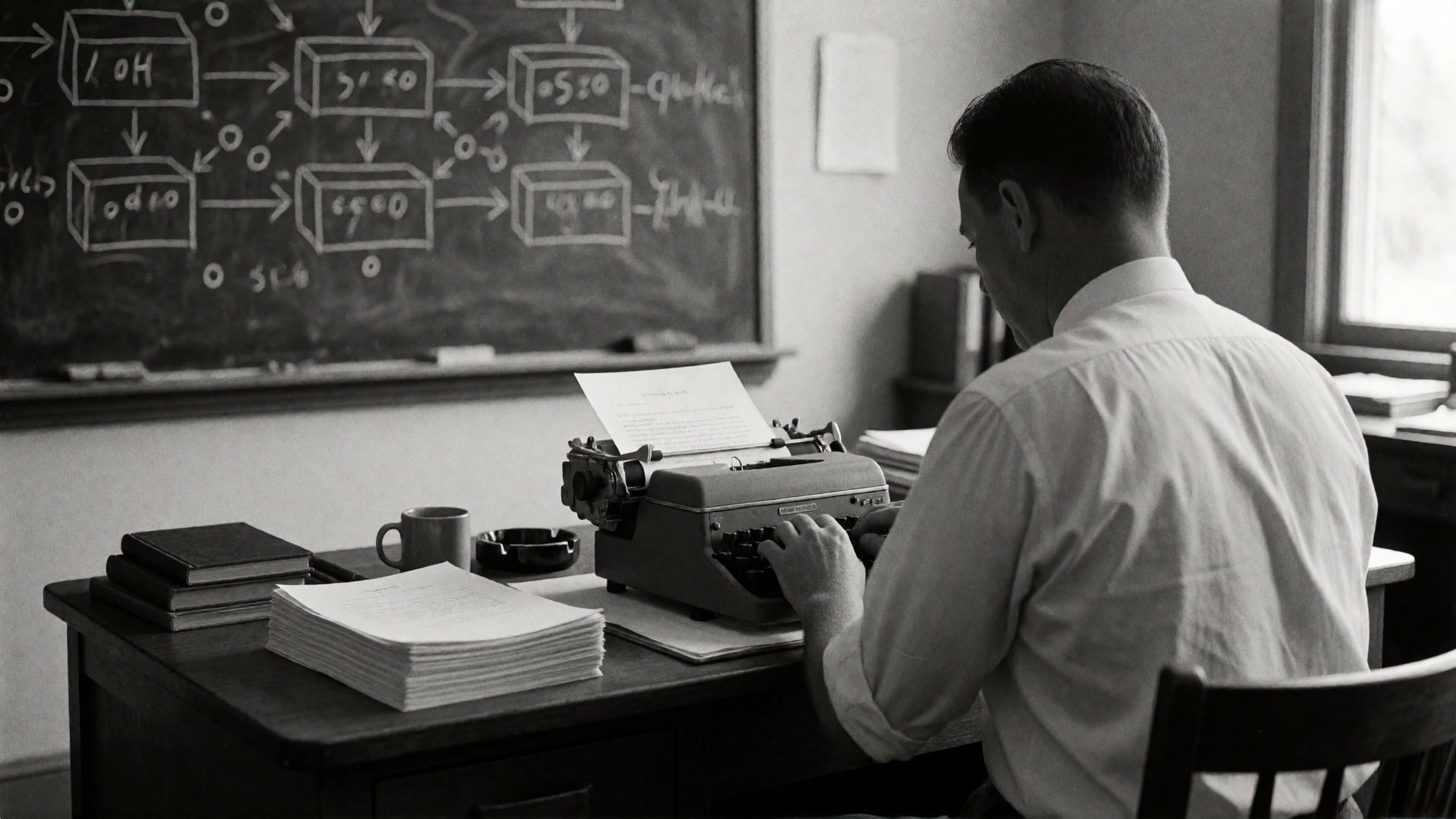
HANOVER (NEW HAMPSHIRE), AUGUST 1955 - Four American researchers have submitted a proposal for a summer project at Dartmouth College. In the summer of 1956 they want to spend two months, with about ten people, studying how to build machines that behave like a thinking person. The proposal is dated 31 August 1955 and is addressed to the Rockefeller Foundation, a foundation that pays for scientific research. It is the first text to contain the words 'artificial intelligence'.
Who they are
The authors are John McCarthy, a mathematician at Dartmouth, Marvin Minsky of Harvard, Nathaniel Rochester of IBM and Claude Shannon of Bell Labs. They share one idea: every part of learning, or any other feature of intelligence, can in principle be described so precisely that a machine can imitate it. That is not a proven fact. It is the starting point of the project.
Why now
Computers are about ten years old. ENIAC and its successors calculate at lightning speed, but they only do what a programmer has spelled out in detail. The proposal asks whether a machine can also be made to reason on its own, use language or learn from experience. That calls for a name of its own for the field, and the name has now been coined: artificial intelligence.
Six themes
The proposal contains a list of topics the project wants to work on, here in plain words:
First, automatic computers: how can programs be written so that a machine does what a person would do? Second, language: can a machine use and understand words? Third, networks of neurons: can circuits that resemble nerve cells be made to learn something? Fourth, the theory of calculation: how can the size of a calculation be measured, and when is it too large? Fifth, abstraction: can a machine work out a concept, such as 'chair', from separate examples, instead of remembering each example on its own? Sixth, creativity: can a machine come up with something new?
The project itself is a summer of discussions and experiments with a small group, not a large laboratory. That is enough to start a new field if the idea catches on.
Looking back from 2026
The meeting took place in the summer of 1956. It lasted six to eight weeks. Eleven people were on the list, but many participants came for only part of the time. Only McCarthy, Minsky and Ray Solomonoff stayed for the whole period. The discussions were loosely organised.
Even so, that summer is seen as the start of the field. The term 'artificial intelligence' stuck, and many of the six themes can be found in AI work today. Language and neural networks became the basis of today's large language models, while abstraction and learning from examples became the core of machine learning.