Nederlands
Hera sees a large crater on an asteroid after its collision with a NASA spacecraft
The European spacecraft Hera has, for the first time, taken clear pictures of what a deliberate collision did to the asteroid Dimorphos: a crater the size of a stadium, across the whole width of the asteroid.
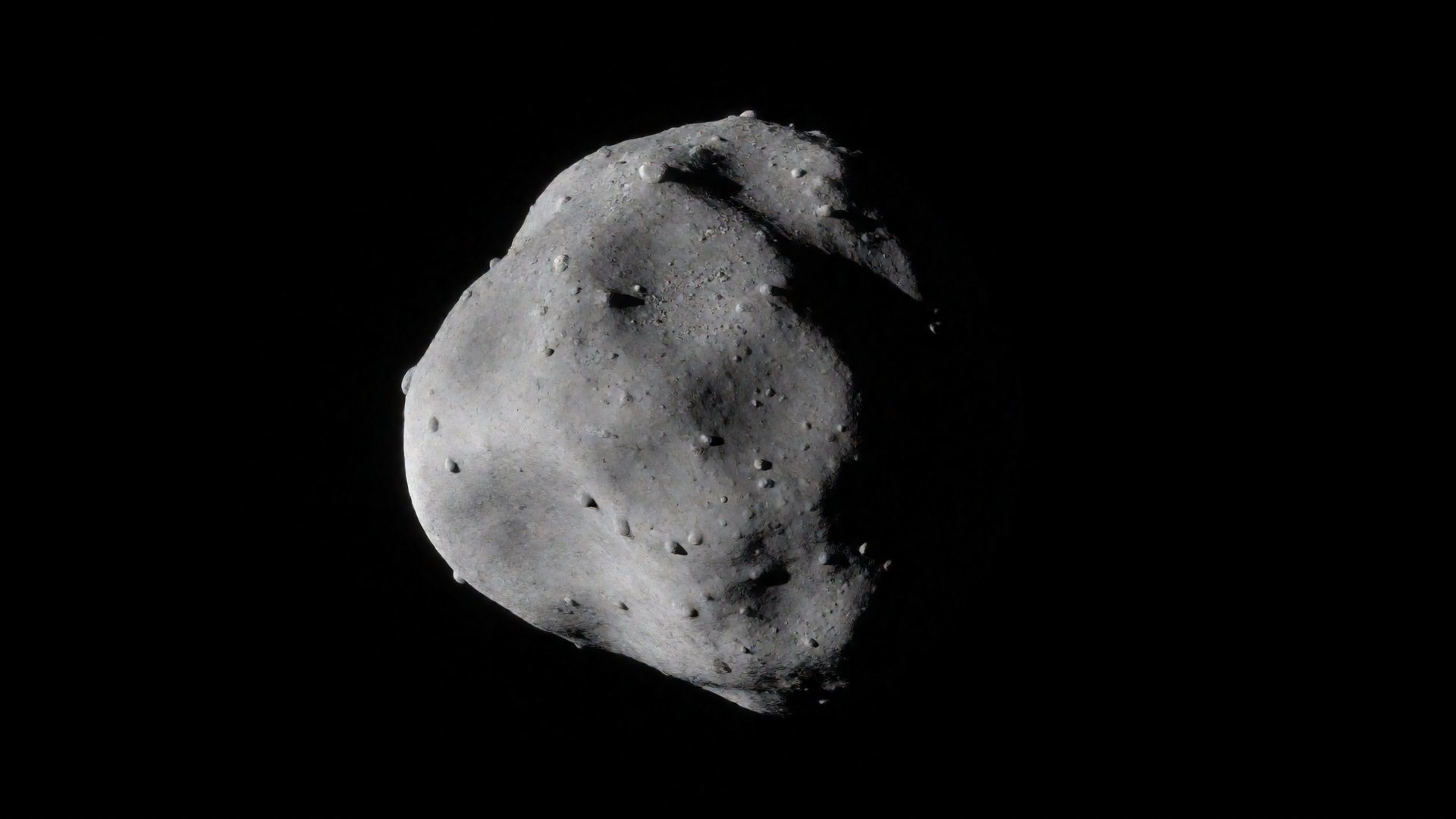
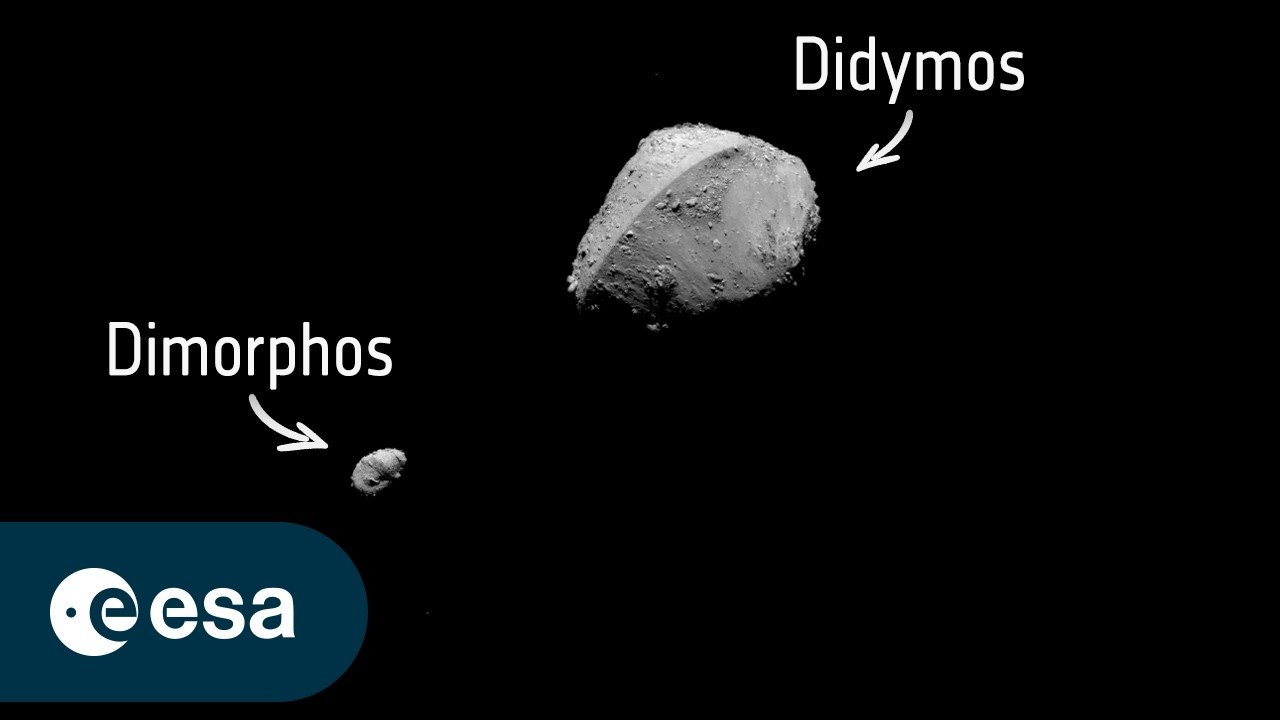
The Hera spacecraft of the European Space Agency, ESA, arrived at the asteroids Dimorphos and Didymos, two space rocks that travel around the Sun together. ESA showed the first images in Berlin. Because of a collision in 2022, Dimorphos now has a flattened side, with a crater the size of a sports stadium. The crater runs across the whole width of the asteroid.
The US space agency NASA deliberately crashed its DART spacecraft into Dimorphos on 26 September 2022. It was a test: can a spacecraft change the path of an asteroid? Dimorphos posed no danger to Earth.
Dimorphos is about 151 metres wide and circles the much larger Didymos, which is about 730 metres wide. Before the collision, one lap took almost 12 hours. The impact made that lap 33 minutes shorter. NASA had said beforehand that 73 seconds shorter would already count as a success.
A crater, and an asteroid that tumbles
For a long time it was not possible to see what Dimorphos looked like after the collision. A small Italian spacecraft, LICIACube, flew along with DART to photograph the impact. But the huge cloud of debris hid the damage from view.
Hera now shows that the impact changed the shape of Dimorphos. On the rest of the surface, researchers recognise individual boulders from photos that DART took just before the collision. Those boulders are still in the same place.
Dimorphos also spins differently from before. Before the collision, researchers thought that Dimorphos always turned the same side towards Didymos, just as the Moon always turns the same side towards Earth. Now Dimorphos tumbles wildly along its orbit.
Playing loads YouTube, which may set cookies. More information
Around the two asteroids, Hera also sees hundreds of boulders a few metres across. Some of them may have broken loose in the collision, but that is not yet certain. The team is taking them into account for the next steps.
What Hera will do next
Hera is now flying 25 to 30 kilometres from the asteroids. In December 2026 the spacecraft will move closer, to about 13 kilometres. In January 2027 Hera will release two small satellites, each the size of a shoebox. Juventas will use radar to look inside an asteroid for the first time. Milani will study the material of the asteroids and the dust around them.
The researchers also want to know how heavy Dimorphos is and how it is put together. Then they can calculate how much of DART's push was really transferred to the asteroid.
What does this mean for the road to the singularity?
With DART, humanity showed that it can change the path of an asteroid. Hera adds the measurements needed to calculate such a push properly in advance. How an asteroid reacts to a collision depends on how heavy it is and how it is put together. Once researchers know this for Dimorphos, they can better predict for the next asteroid how hard and when a spacecraft needs to hit it.
If this continues, pushing a dangerous asteroid off course will no longer be a one-off experiment, but a standard tool. It does require that such an asteroid is discovered years in advance, because a small push needs time to shift the path far enough. For the first time in history, humanity could protect itself in this way against the kind of disaster that struck the dinosaurs.
What is the technological singularity? Read the explanation →