Nederlands
Trial participant plays GTA VI with Neuralink brain implant
A participant in a Neuralink clinical trial is playing Grand Theft Auto VI with a brain implant. He imagines small movements of his fingers, hand and foot, and these are turned into buttons on a PlayStation 5 controller.
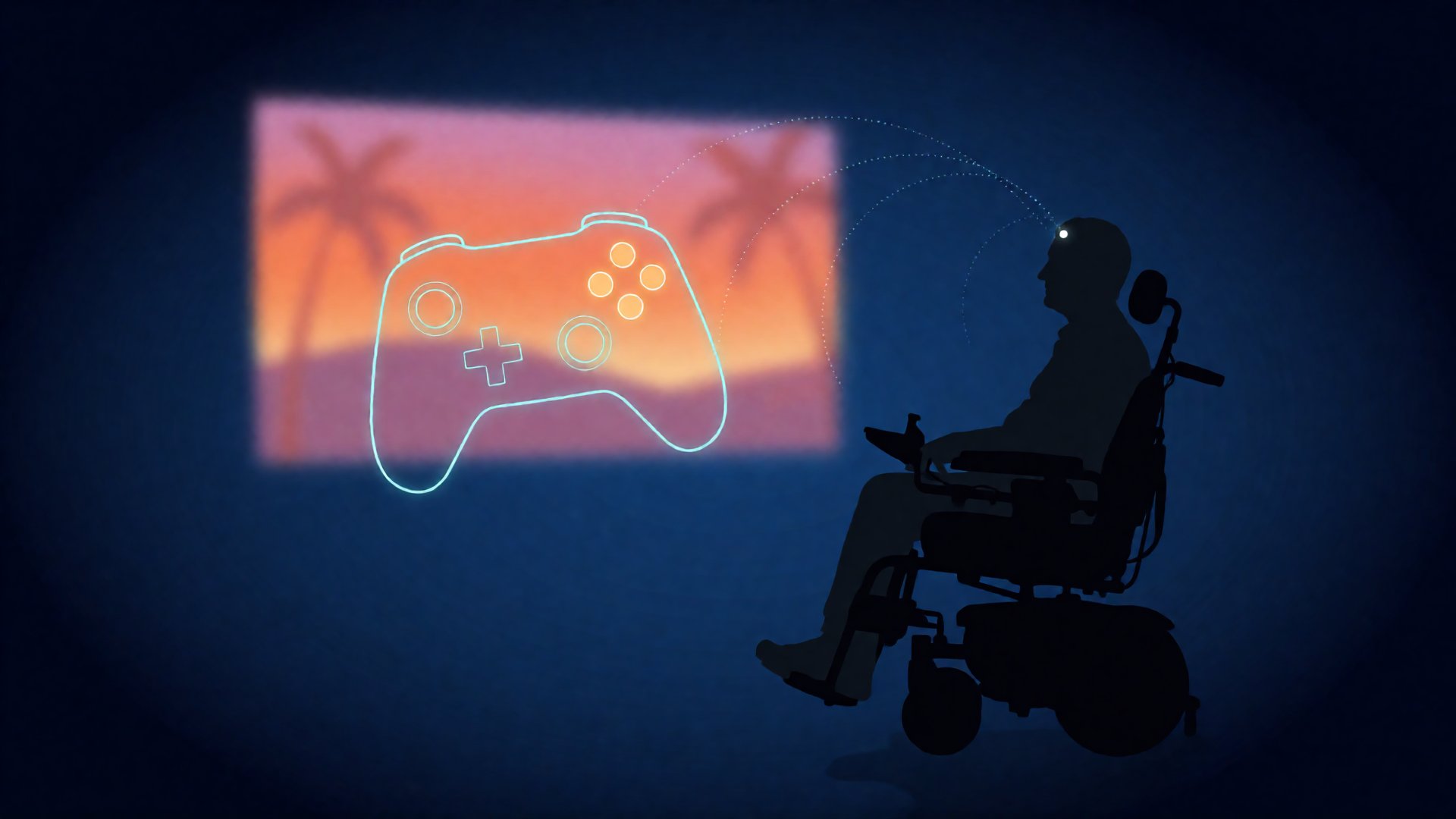
Neuralink has shared a video in which a participant in a clinical trial plays the new game Grand Theft Auto VI with his brain implant. He drives, flies and fights by imagining small movements of his fingers, hand and foot. His name is not given in the video.
The two-minute video appeared on X , one day after Rockstar Games released the game for the PlayStation 5 and the Xbox Series X|S. Next to the player, the video shows how his brain signals are translated, and a PlayStation 5 controller on the screen lights up with every command.
Imagining movements instead of pressing buttons
The team linked imagined movements to buttons on the controller. When the player imagines tapping his ring finger, he throws a punch in the game. To pull up the nose of a plane, he imagines sliding his right hand forward, roughly the way you move a computer mouse. Later the team also added a foot movement, so he can use more buttons.
Before the operation, he used a mouth stick, a small rod held in the mouth to touch a screen, and an iPad. This gave him a sore jaw. With the implant he can use a computer on his own again, which he described as getting back his portal to the world. Playing is not easy. The game looked beautiful, he told the news site RuntimeWire, but he had to remember many imagined movements, each linked to a finger.
Robert Dale Smith, who works at Neuralink on applications for the implant, wrote on X that he is working to make it possible to control any device with Neuralink, including a PlayStation 5. For this he used JoypadOS, software he made himself for adapters that convert signals between different kinds of game controllers.
Earlier steps
Neuralink placed its first implant in a human in January 2024. That participant was then able to move a mouse pointer and play computer games with his thoughts. In August 2024 the company showed a second participant playing the shooting game Counter-Strike 2. Neuralink's devices are still being studied and have not been approved by the US regulator FDA or other regulators, the company wrote alongside the video.
What does this mean for the road to the singularity?
That a brain implant can move a mouse pointer has been known for almost two years. What is new is that someone plays a large, busy game with an ordinary controller, with each imagined movement acting as its own button. The work is shifting from the implant itself to the translation: software that turns brain signals into the signals a device already understands. Engineers did the same for the man with ALS who phoned his wife: they built the features around him, in his own home.
If that trend continues, a manufacturer will not need to make a special version for people with an implant. A small adapter makes the implant look like an ordinary controller or keyboard, and everything that works with those then also works with thoughts: a games console, a smart home, perhaps one day a wheelchair or a robotic arm. Someone who is paralysed would then not have to wait for someone else to adapt something for them, but could choose what to use. The hard part remains remembering all those imagined movements, as the player himself said. An obvious next step is software that learns what someone wants to do, so they no longer have to think of every button separately.
What is the technological singularity? Read the explanation →