Nederlands
Home-built drone flies and steers with a single propeller
Maker Joshua Bird built a small drone at home that flies and steers with one motor and one propeller. The secret lies in a hinge in the hub and lightning-fast motor control. The design files and code are free online.
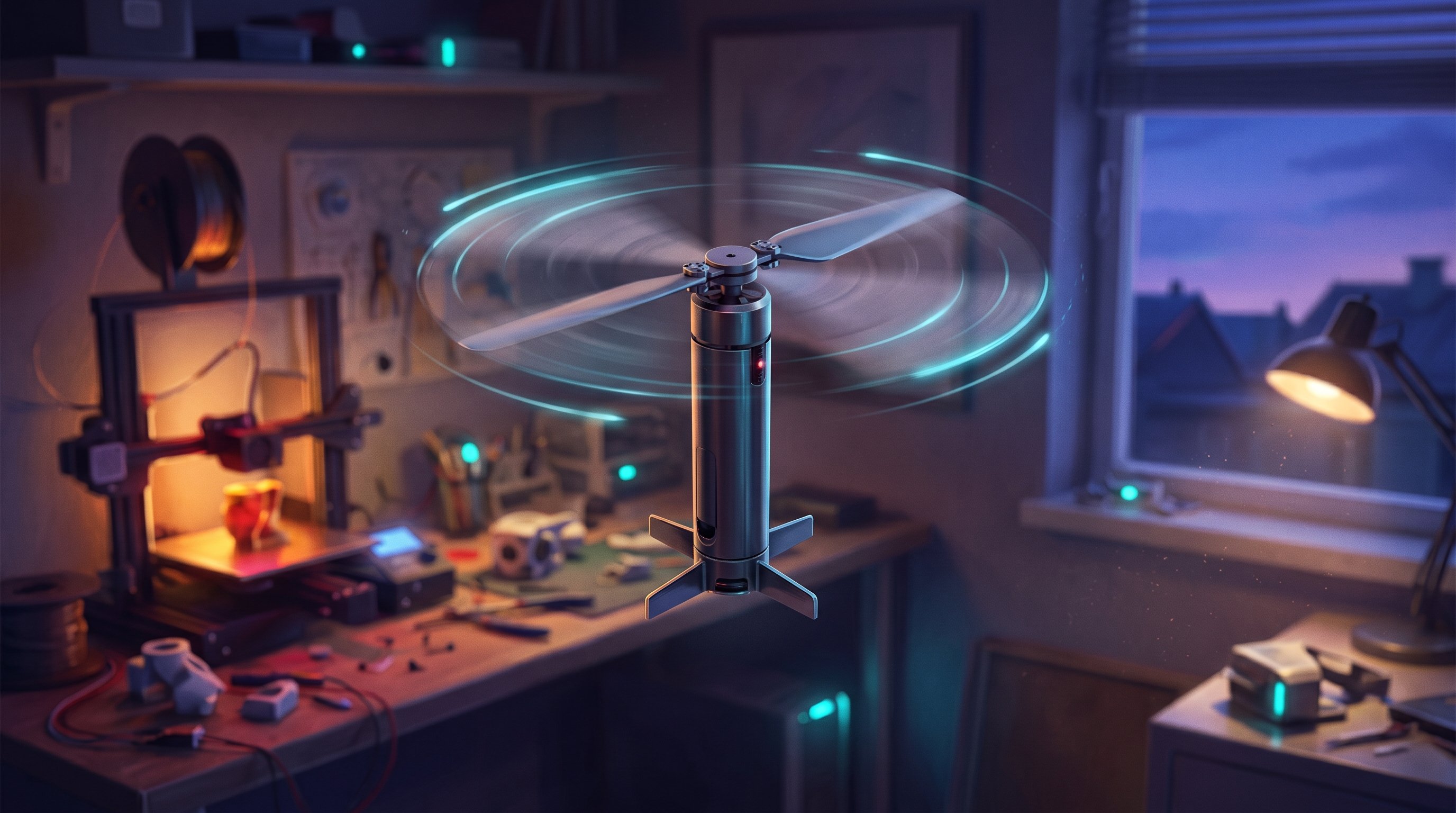
An ordinary drone has four propellers. To fly forwards, the rear propellers spin slightly faster than the front ones, so that the drone tilts a little. With fewer propellers, steering is much harder. Yet maker Joshua Bird built a small drone at home that flies and steers with just one motor and one propeller. The test flights simply took place in a bedroom.
A hinge in the propeller
The secret lies in the hub, the central part to which the propeller blades are attached. In Bird's design, the blades are not fixed, but attached to the hub at an angle with a hinge. When the motor briefly speeds up, one blade lags behind by a fraction. Because of the slanted hinge, that blade then tilts slightly up and the other blade slightly down. One blade thus gives more lift than the other.
By making the motor turn slightly faster or slower at exactly the right moment in each revolution, the drone can tilt forwards, backwards or sideways. So one motor does the work that a complicated mechanism of rods does in a helicopter. The idea is not new: researchers at the University of Pennsylvania showed back in 2013 that such a hinged propeller can work. Bird mainly wanted to make a small version, because earlier single-propeller designs often used very large propellers.
Correcting at lightning speed
That correcting has to be extremely fast. The propeller is about 15 centimetres across and turns at some 20,000 revolutions per minute, so more than 300 times per second. An ordinary motor controller for drones cannot keep up with that. It only estimates the position of the motor from the electric current.
Bird therefore used a motor controller that measures the position of the motor shaft directly with a magnetic sensor. Bird adapted the software of that controller and also that of the flight computer, so that the two talk to each other directly. That made the drone faster, lighter and cheaper. Fins on the body stop the drone from spinning round like a top.
The parts come from a 3D printer. It took a lot of trial and error: the first flights often ended in a crash. A vibration was solved by making the blades stiffer, and with a home-built high-speed camera Bird could see exactly what the blades do while spinning.
What is still to come
For now, the drone does not yet know by itself which way it is facing. An infrared lamp on the wall, which a sensor on the drone can see, helps with that. That is why it flies indoors for the time being. The next step is a sensor that uses ordinary objects in the room as landmarks. Then the drone can also fly without the lamp, and perhaps outdoors. The design files and the adapted software are free online, so that others can build on them.
What does this mean for the road to the singularity?
This project shows how far one person can get at home with a 3D printer, smart software and open knowledge. Fewer moving parts means lighter, cheaper and stronger flying robots. That is useful for, say, small drones that inspect buildings or check crops in a greenhouse.
AI can take such designs further. Tuning the timing, the shape of the hub and the stiffness of the blades cost Bird a lot of trial, error and crashes. An AI model can first test thousands of variants in a simulation and also learn to steer, so that fewer test flights are needed. And because everything is public, both people and AI systems can build on what Bird has worked out. In this way, an invention from a bedroom becomes a building block for everyone.
What is the technological singularity? Read the explanation →