Nederlands
Soft beetle robot with artificial muscles can be steered with one finger
Researchers from KAIST, Caltech and NTU Singapore built a small soft robot modelled on a beetle. You steer it with your finger and get images and touch feedback straight back. The next step: making it faster and more energy-efficient.
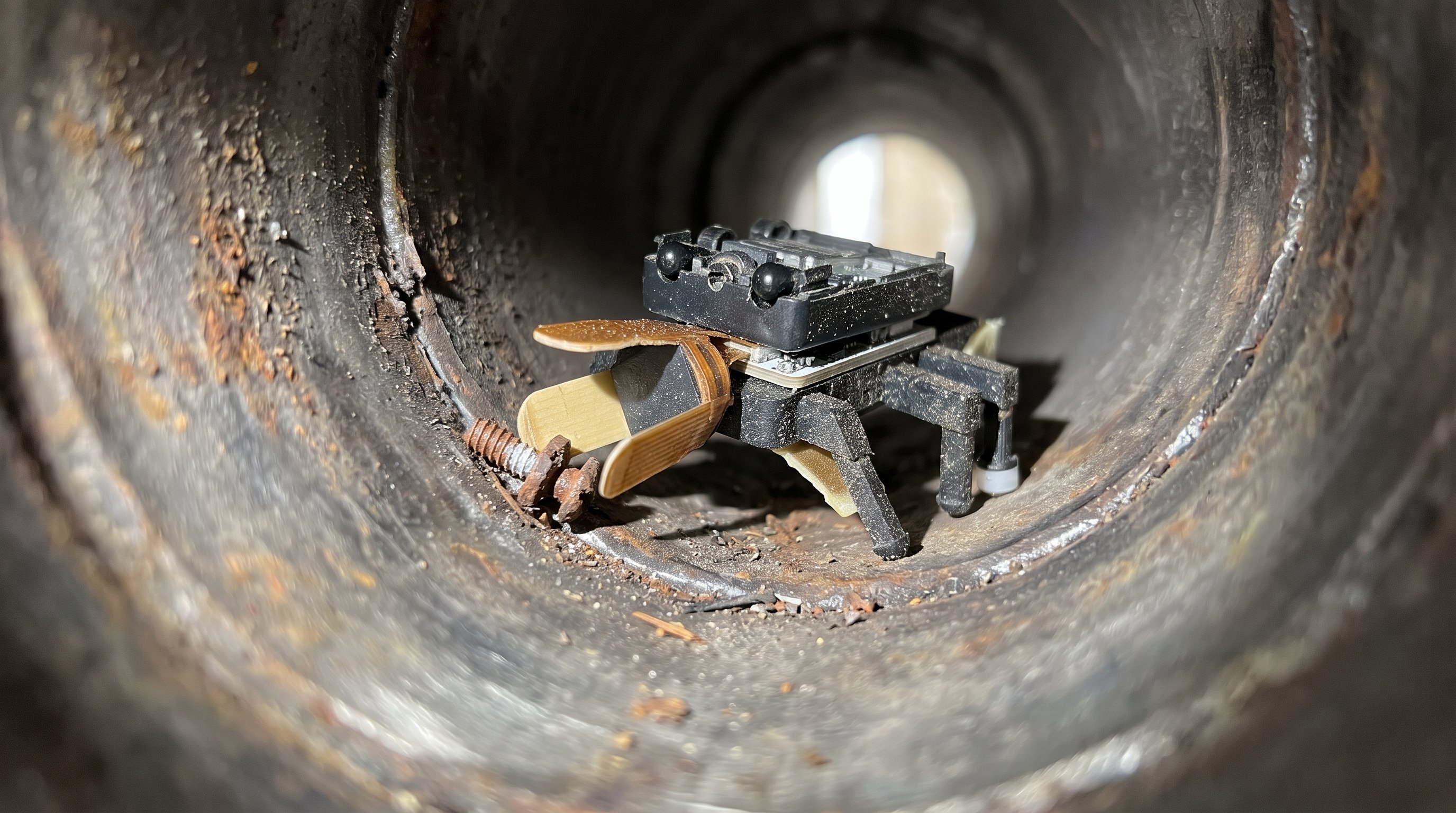
A small robot that walks like a beetle, can pick things up and can be steered by bending one finger. Researchers in South Korea, the United States and Singapore have built it. Their robot is called BeetleBot. What makes it special is that the control works both ways: the user gives commands, and the robot immediately sends back camera images and information about what it is touching.
The team is led by Professor Sang Ouk Kim of the South Korean institute KAIST. The groups of Professor Wei Gao of the California Institute of Technology (Caltech) and Professor Hirotaka Sato of Nanyang Technological University (NTU) in Singapore also took part. The first author is Inho Kim, now a lecturer at Sungkyunkwan University. The research appeared on 19 August 2026 in the scientific journal Science Advances; KAIST announced it on 13 October.
Muscles that shrink with heat
Most robots move with electric motors. These are hard and difficult to make very small. Soft robots therefore often use artificial muscles: materials that contract by themselves, just like a real muscle.
BeetleBot's artificial muscles are made with a 3D printer from a rubber-like plastic that gets shorter when it gets warm. An electric current through thin wires in the muscle provides that heat. According to the technology magazine New Atlas, the muscles shrink by up to 45 per cent at a temperature of 110 degrees Celsius. When they cool down, they return to their original shape.
To decide where the muscles should go, the researchers studied the leg muscles and joints of the beetle Mecynorrhina torquata, one of the largest insects in the world. Each group of muscles can be controlled separately, in an order that can be changed. This way the robot can walk forwards and turn left and right.
A gripper that can feel
To grab things, the team built a soft gripper, modelled on the jaws that beetles use to hold something. The gripper works with the same artificial muscles and has a pressure sensor. When the gripper presses on something, two tiny metal layers in the sensor move closer together. That changes an electrical signal, and from it the robot can tell how hard it is squeezing.
Steering with a finger
The user wears a stretchy patch on one finger. It contains carbon nanotubes: tiny tubes of carbon that conduct electricity. When you bend the finger, the patch stretches and the current that can flow through it changes. These signals become four commands: forward, left, right and grab. They go wirelessly to the robot via Bluetooth.
A small camera on the robot shows the user where it is. The pressure sensor tells whether the gripper is holding something. Based on those images and that sense of touch, the user chooses the next movement.
In the lab, the robot showed that it could move around obstacles, walk towards an object, pick it up and carry it to another place.
Everything in one small robot
According to the researchers, moving, sensing and control are often built as separate parts in soft robots. In BeetleBot they come together in one small system. That makes it easier to have the robot do real work from a distance.
The researchers have this in mind too: looking into narrow spaces that people find hard to reach, for example inside machines or factory installations, and retrieving small objects. First the muscles need to become faster and more energy-efficient, and the power supply has to improve. According to New Atlas, heating the muscles takes a lot of energy. After that, the team wants to test the robot in real working environments.
What does this mean for the road to the singularity?
Robots only become truly useful when they can also work in places where people and large machines cannot go. BeetleBot shows that a small, soft robot can walk, grip, see and feel, and that a person can steer it with a simple finger movement. For now a person still controls every step. If the robot becomes faster and more energy-efficient, small helpers that can look inside a machine by themselves or fetch a loose part come closer.
What is the technological singularity? Read the explanation →