Nederlands
Humanoid robot helped manage traffic at Hangzhou marathon
At the Hangzhou marathon on 1 November, humanoid robots from DEEP Robotics helped manage traffic. They watched junctions, warned about rule-breaking and gave safety tips to 36,000 runners.
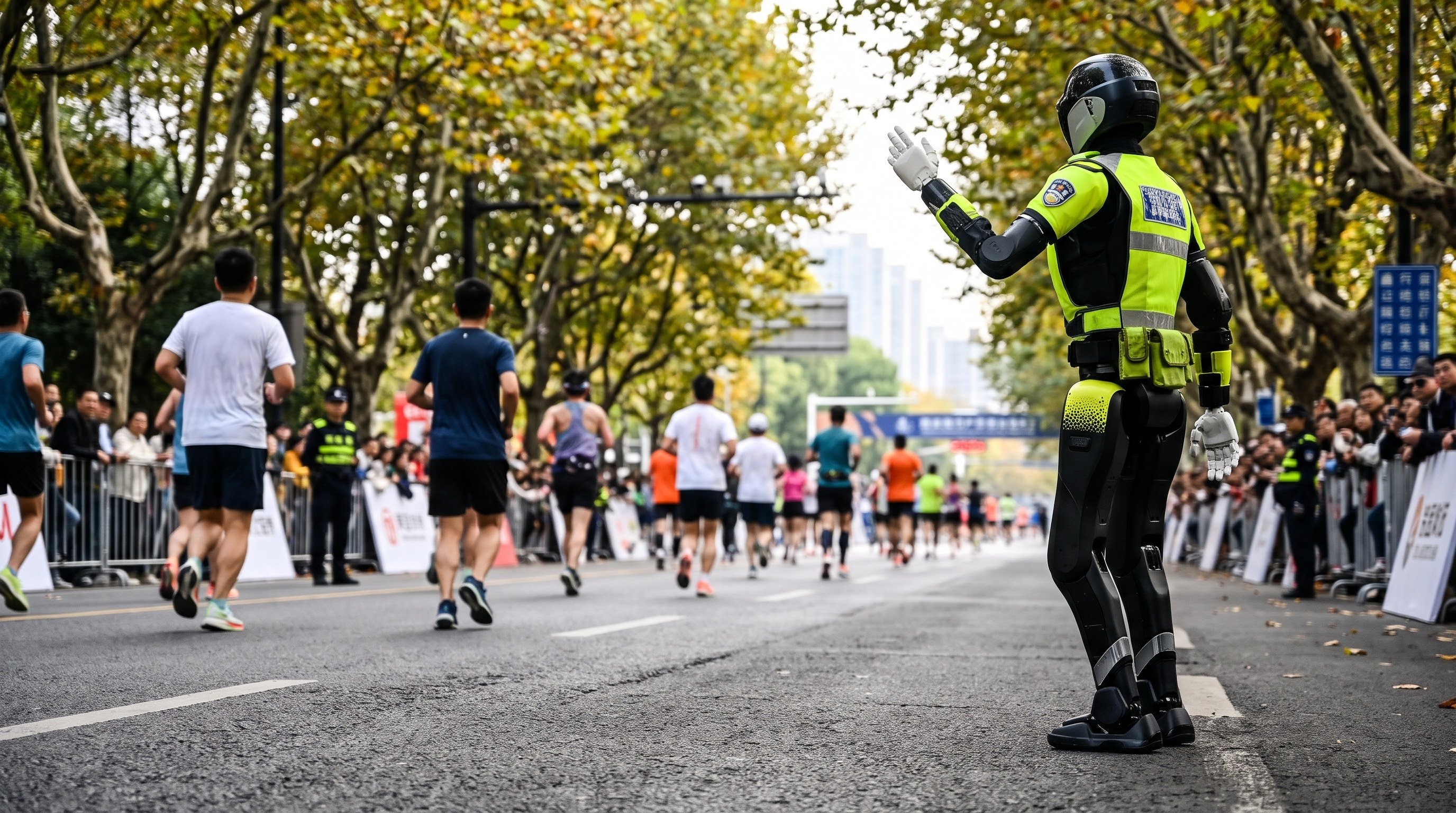
At the Hangzhou marathon on Sunday 1 November, humanoid robots helped manage traffic. The robots come from the Chinese company DEEP Robotics, which is itself based in Hangzhou. They were part of a team that patrolled four points around the Huanglong sports centre. In total, 36,000 people ran; more than 300,000 had signed up. This is reported by the Chinese state newspaper Global Times.
What the robot did
The robot is called Hangxing No.2 and is built on the DR02, the humanoid robot from DEEP Robotics. It is 1.78 metres tall. It followed fixed routes past several posts and watched junctions. When it saw a rule being broken, such as a pedestrian crossing the course or a car pushing in ahead of others, it gave a warning. It also made the standard gestures of a traffic officer and played safety messages. According to the organisers, ordinary security staff cannot see every corner. The robot therefore had to cover the places that fixed cameras miss.
To see its surroundings, the robot combines a lidar (a sensor that measures distances with laser light), a depth camera and a wide-angle camera. It is fully dustproof and withstands heavy rain and jets of water. According to the manufacturer, it works at temperatures between -20 and 55 degrees Celsius. This means it can work outdoors, even in bad weather.
Why a marathon
Meng Yuan of DEEP Robotics told Global Times that a marathon is a good place to give robots their first real work. The security work is short but intense, many people are in one place and the tasks repeat. The company sees the deployment as a first exploration of a regular way of working for humanoid robots in traffic management at large marathons.
Wang Peng is a researcher at the Beijing Academy of Social Sciences and was not involved in the project. He told Global Times that the step from the factory to the marathon course is important. In his view, large events are a good testing ground for how a robot senses, moves and carries out its tasks.
Hangzhou has used traffic robots for some time
The city has been using robots in traffic for some time. In May, Hangzhou put fifteen traffic robots on wheels, made by the company SUPCON, into service around West Lake. They had already been tested at half marathons in March and April. According to SUPCON, its robots gave more than 170,000 warnings up to August, and some offences, such as riding without a helmet, fell by more than 40 per cent per month. The news agency Reuters could not check those figures itself. The robots cannot fine or arrest anyone: they help the police officers.
The DR02 itself also did traffic work before. In early October, according to DEEP Robotics, it managed traffic at busy junctions in the Xihu district as a trial, also in the rain, and answered visitors' questions in several languages. What is new at the marathon is the use at a large event, with a robot on two legs that walks between posts instead of a robot on wheels at a fixed spot.
What does this mean for the road to the singularity?
Humanoid robots are moving step by step from the test hall to the street. A robot that works on two legs among thousands of runners has to recognise people, move safely and decide for itself when to give a warning. A marathon is a good practice ground for that: busy, but with clear tasks that keep coming back. This is still a trial, and the robot helps the police officers instead of replacing them. If such deployments keep going well, humanoid robots can take on more and more simple, repetitive work outdoors.
What is the technological singularity? Read the explanation →