Nederlands
One short measurement beforehand halves a qubit's errors
A team led by the University of Regensburg had a qubit briefly measure which frequency it was on before each series of calculations, then adjusted the controls automatically. Errors fell by about 54 per cent. The next step is more qubits at once.
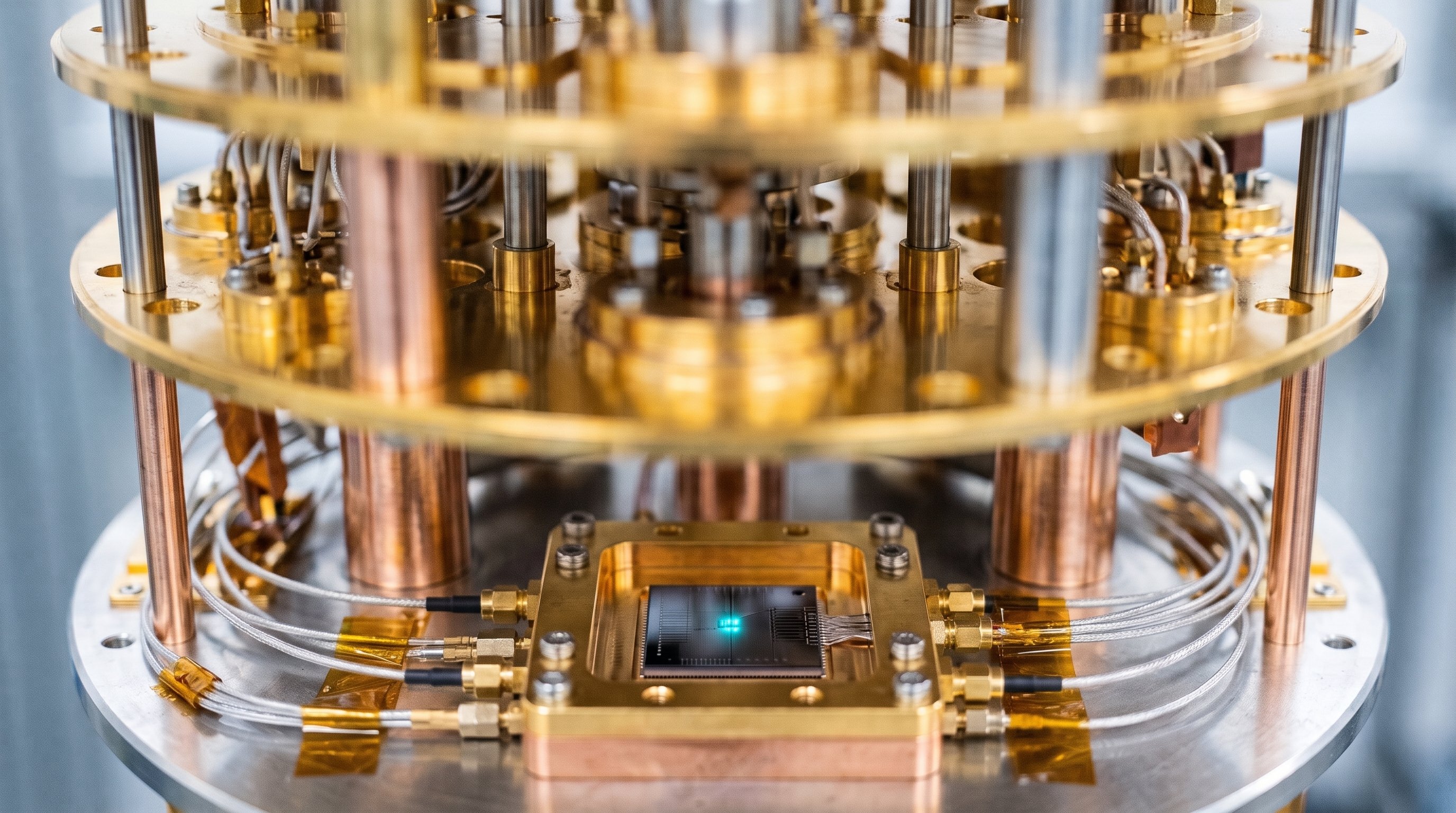
Quantum computers still make many errors. Some of these errors do not come from the qubit itself, but from controls that are set to a value that is no longer correct. An international team has greatly reduced this problem for a single qubit: with one short measurement just before each series of calculations, the average number of errors fell by about 54 per cent.
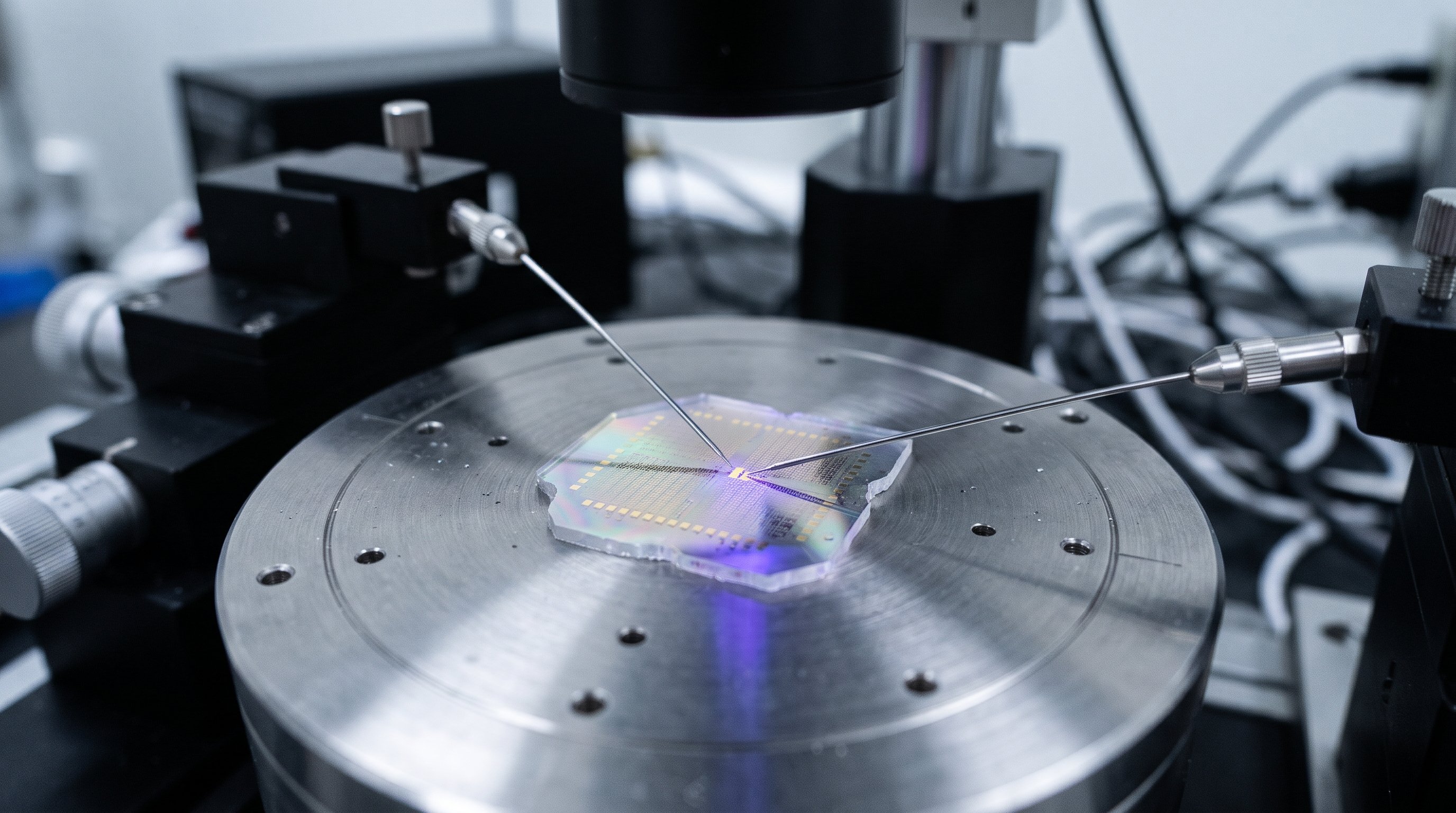
The research was led by Ferdinand Kuemmeth, professor of experimental physics at the University of Regensburg in Germany, who is also affiliated with the Niels Bohr Institute in Copenhagen. It was published in the journal Applied Physics Reviews, and the university announced it on 3 November 2026. The experiments ran on a superconducting chip at the Israeli Quantum Computing Center. First author Fabrizio Berritta, a researcher on behalf of Regensburg who works at the Massachusetts Institute of Technology (MIT) in the United States, operated the equipment remotely from his office. Leiden University, the Norwegian University of Science and Technology (NTNU) and the companies Quantum Machines and Qolab also took part.
A qubit that jumps between frequencies
A qubit is the computing element of a quantum computer. In this type, it is a tiny superconducting electrical circuit on a chip. It is controlled with short pulses of microwaves, the same kind of radiation as in a microwave oven, but very weak. These pulses must match the qubit's own frequency exactly, just as a radio must be tuned to the right station to pick up anything.
In this qubit, a tiny flaw in the material of the chip made the qubit's frequency jump back and forth between two values from time to time. If the pulses were set to one value while the qubit was on the other, they did not hit their target properly. The qubit still worked, but the calculation went wrong more often.
First look, then steer
Earlier studies had already shown that such a qubit can have two possible frequencies. What is new is that the team now adjusts the controls during the calculation itself. Before each series of calculations, the system briefly puts the qubit in a starting state and measures it. The result of that measurement depends on the frequency the qubit is on at that moment. So after one measurement, the controller knows which of the two is active.
The measurement takes about two millionths of a second, plus about six millionths of a second to get the measuring component ready again. The controller then sets the pulses to the right frequency straight away. This only works because the controller itself calculates fast enough: it has a programmable chip that processes the measurement data directly, without calling on an ordinary computer first.
The numbers
In a test of about fourteen minutes, the team repeatedly ran series of randomly chosen operations. Without adjustment, on average 0.14 per cent of the operations went wrong; with adjustment, 0.065 per cent. That is about 54 per cent fewer errors. Compared with the worst moment without adjustment, when about 0.28 per cent went wrong, the drop was 77 per cent.
The method has conditions. The two possible frequencies must be known in advance and be easy to tell apart. And the qubit must stay on one frequency for long enough: here that was usually tens of seconds, while the measurement takes millionths of a second. The experiment used one single qubit. The next step is to show that it also works with more qubits at once, and with so-called logical qubits, which are made up of several qubits together and can in this way catch errors.
Kuemmeth says that at first sight this may look like an experiment with little practical use. But future quantum computers will have to run millions of nearly perfect qubits at the same time, and even in the purest chips, small flaws will remain. According to him, his group has already developed methods to find unknown qubit frequencies automatically and quickly.
What does this mean for the road to the singularity?
Quantum computers will one day be able to do calculations that are too heavy for ordinary computers. For that, they must make far fewer errors than they do now. This research shows that some of these errors disappear when the controls adapt by themselves to how the qubit is behaving at that moment. On a chip with millions of qubits, nobody can keep track of that by hand, so self-adjusting controls will become an important part. Now that it works for one qubit, the way is open to try it on larger chips.
What is the technological singularity? Read the explanation →