Nederlands
Printer from Mainz makes Bibles with loose letters
In Frankfurt, parts of a Bible can be seen that nobody wrote with a pen. Every page comes from a press, set from loose metal letters. According to the cleric Enea Silvio Piccolomini, the script is so clear that you can read it without glasses.
WIENER NEUSTADT, MARCH 1455 - A Bible that nobody wrote with a pen: that is the most striking news from Frankfurt. The cleric and diplomat Enea Silvio Piccolomini writes about it to Cardinal Juan de Carvajal. At the Imperial Diet in Frankfurt he saw loose gatherings of the book, and he is full of praise for it.
Anyone who wants a book has to have it copied by hand. A scribe spends months on it, and every copy gets its own mistakes. The new method comes from Mainz, from the goldsmith Johannes Gutenberg. He has found a way to put the same page on paper again and again, without a pen.
A seal for every letter
Anyone who presses a signet ring into warm wax gets the same mark every time. Gutenberg applies that idea to writing. For every letter of the alphabet he makes a small rod of metal, with the letter as a stamp at the end.
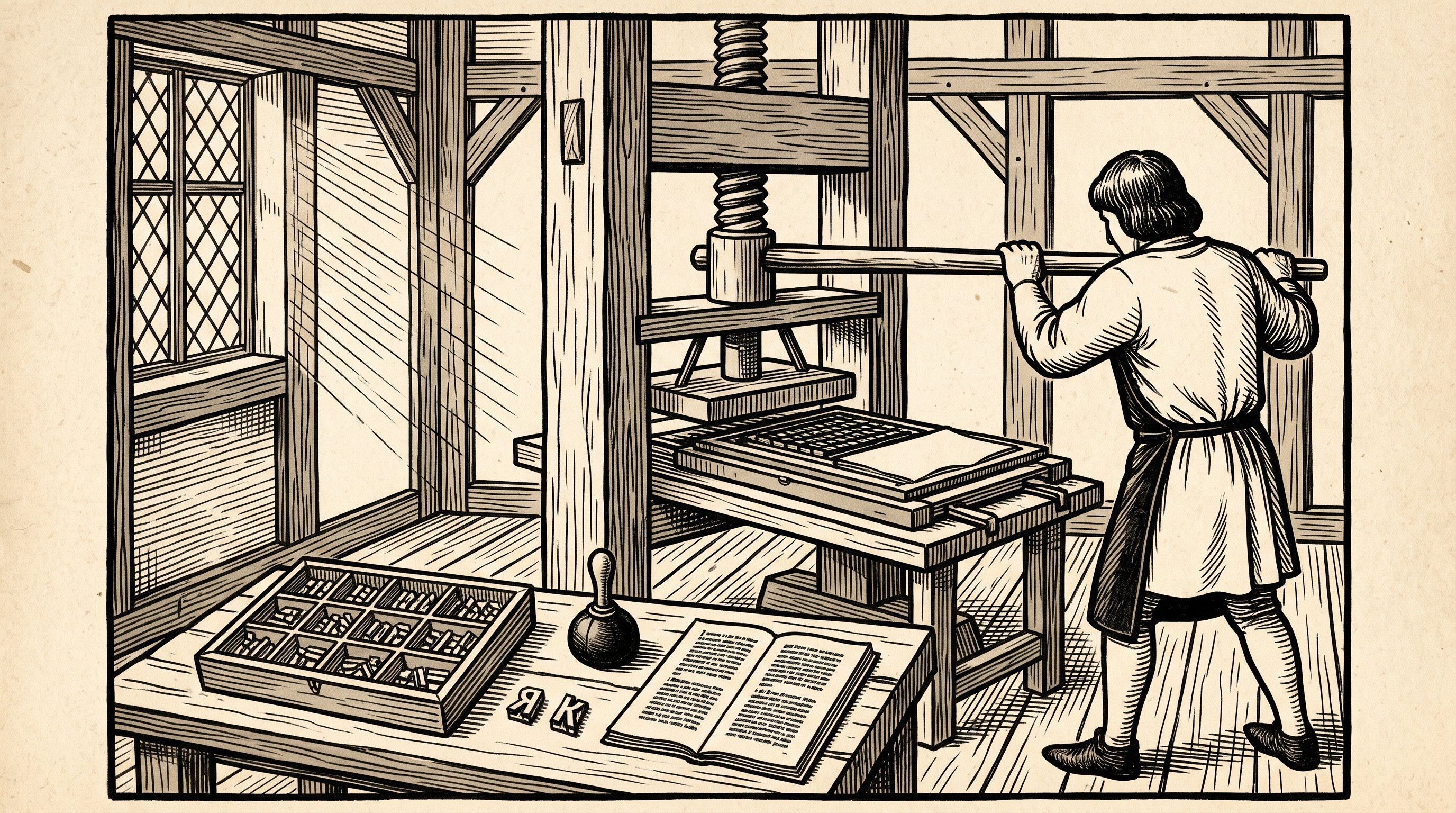
He sets those little stamps loose next to each other to make words and lines, and he stacks the lines into a whole page. Everything stands in mirror image, just like on a signet ring, because on the paper it comes out exactly the other way round. This makes one big stamp of a whole page, with 42 lines in two columns.
Casting letters like a goldsmith
Cutting thousands of letter rods by hand would take years. So Gutenberg uses his knowledge of metal. He cuts each letter once in hard metal and strikes it into a small block of copper. This leaves a hollow mould, and into it he pours a mixture of molten lead, tin and antimony. It sets quickly, and one mould gives as many identical letters as he needs. That is why every a in his Bible looks like the others.
The winegrower's press
Ordinary writing ink runs off metal. So Gutenberg uses a thick ink based on linseed oil, as painters know it for their paint. It stays on the letters as a thin layer.
For the last step he borrows a tool from the winegrowers: the wooden press with a big screw, which they use to squeeze grapes. The page of letters lies on a flat plate and gets a layer of ink. A sheet of paper goes on top. Then the printer turns the screw tight, and a heavy plate pushes the paper evenly onto all the letters at once. When he loosens the screw, the whole page is on the sheet, sharp and black.
For the next sheet, only the ink has to be put on the letters again. When the whole print run is finished, he takes the page apart and puts each letter back in its compartment. With these he sets the next page.
A script you can read without glasses
Piccolomini is mostly impressed by the quality of the work. The letters are so large and clear that the cardinal could read the book without glasses, he writes.
How many copies were made is not certain. Piccolomini heard both 158 and 180. Buying one is no longer possible in any case: according to him, the whole print run has already been sold.
Looking back from 2026
Piccolomini's letter of 12 March 1455 is the oldest proof that the Gutenberg Bible existed. Three years later the writer himself became pope, as Pius II. Based on the surviving books, researchers now estimate that between 160 and 185 copies were printed, about three quarters on paper and the rest on parchment. Of these, 49 still exist, 21 of them complete.
In Korea and China, printing with loose letters had been done earlier. Gutenberg's contribution was the whole system: the cast letters, the oil-based ink and the press together. This made printing in Europe fast and cheap enough to become an industry.
The importance of the printing press lies in the price of knowledge. An idea could suddenly travel across Europe in hundreds of copies at the same time. Researchers could read and improve each other's work, and that is still the way science moves forward. Everything that comes after this on this timeline builds on it.
Sources
- History of Information: Piccolomini over de Gutenbergbijbel
- Princeton University Library: The Gutenberg Bible
- Bayerische Staatsbibliothek: Gutenberg Bible
- Wikipedia: Gutenberg Bible
- Wikipedia: Printing press
- Engineering and Technology History Wiki: Typefounding
- National Diet Library: Gutenberg en de drukkunst