Nederlands
Small snakes on Borneo escape by doing cartwheels, with their head pointing straight ahead
Japanese researchers filmed dwarf reed snakes that roll away like a wheel when in danger. That is four times as fast as ordinary slithering. The clever part: while the body spins round, the head keeps looking steadily ahead.
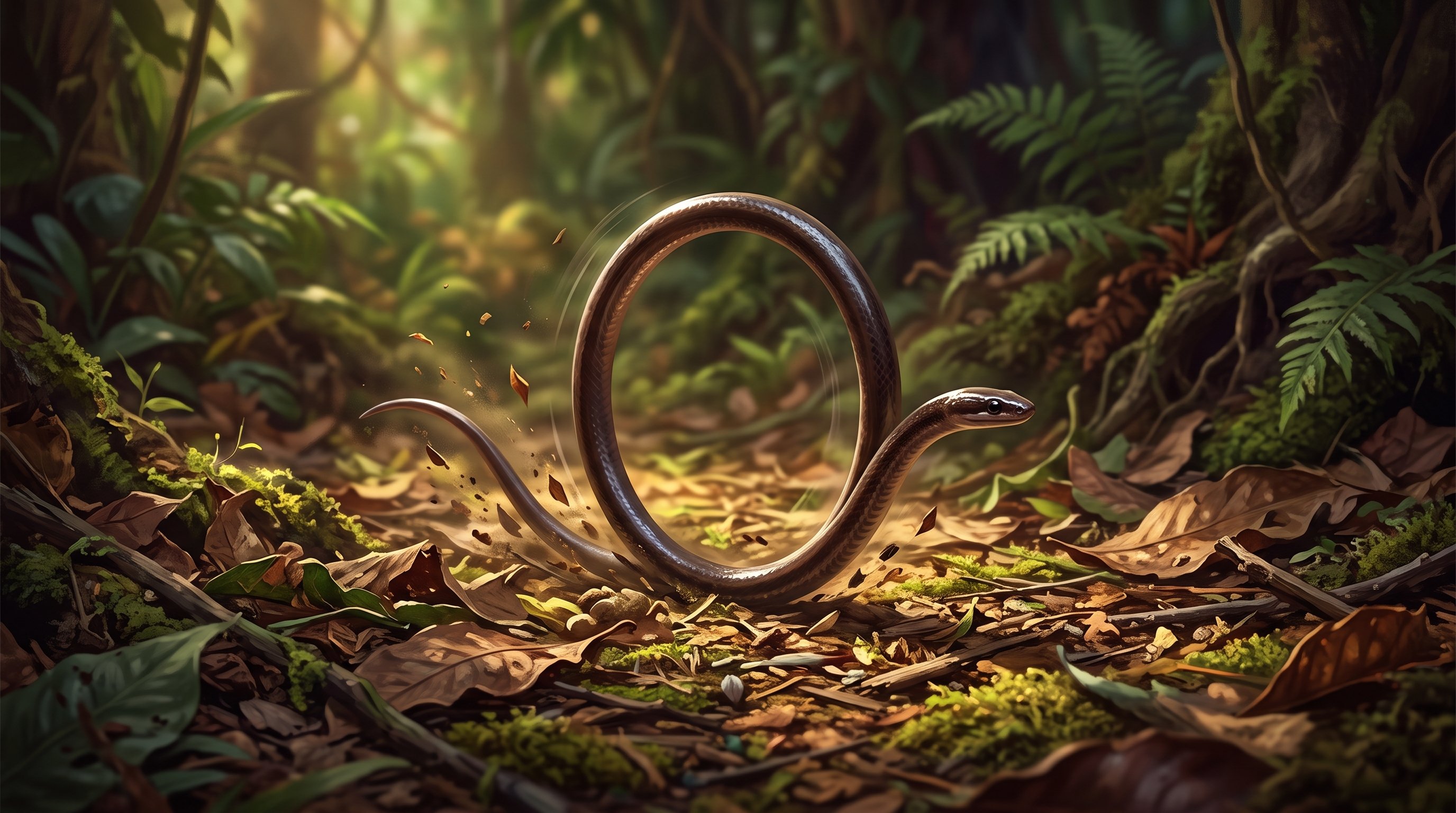
A snake doing a cartwheel: it sounds like a fairy tale. Yet small snakes from the rainforests of Borneo do exactly that when they are in danger. Researchers at Toho University in Japan have now recorded precisely how they do it for the first time. They published their results on 19 October 2026 in the scientific journal Current Biology.
The animals are dwarf reed snakes, small, shy snakes 11 to 28 centimetres long that live on the forest floor in South-East Asia. In 2023, other researchers had already described that these snakes sometimes roll away. How that works was still a mystery at the time.
Racing on a two-metre track
Research leader Yosuke Kojima and his team collected thirteen dwarf reed snakes of three species in Kubah National Park, in the Malaysian state of Sarawak. For comparison, six snakes from a related group also took part. Each snake got a gentle tap on a racetrack 2.2 metres long and 20 centimetres wide. Cameras above and beside the track filmed what happened.
All the dwarf reed snakes started rolling. None of the related snakes did. Rolling, the dwarf reed snakes reached speeds of about 6 to 13 kilometres per hour. That is about four times faster than when they simply slither, and lightning fast for such a small animal: the fastest go quicker than a person jogging at an easy pace. After rolling, the snakes often shot quickly under a nearby object to hide.
The body spins, the head stays still
Rolling without a wheel or axle is tricky. If your whole body spins round, your eyes and head spin with it, and you can no longer see where you are going. The faster you roll, the bigger that problem.
The snakes solve it cleverly. They curl up into a loop, and part of their body keeps swinging forward past the side of their head. The tail then pushes off for the next loop. They keep switching sides as they do so: one time the body rolls over the left, the next time over the right. In this way only the rear part of the body spins round. The head keeps pointing forward, and also stays at roughly the same height. At high speed, the snakes even hold their head extra still and slightly raised.
According to the researchers, this shows how new behaviour lets animals do more than you would expect from their body shape. The American biologist Jessica Tingle of Brown University, who was not involved in the research, told the magazine Science News that it is beautiful behaviour. She now wants to know whether these snakes have a special build or special control by their nervous system that makes the rolling possible. That is a good question for follow-up research.
What does this mean for the road to the singularity?
Robot builders have long looked to snakes. Snake robots can crawl through rubble, pipes and narrow spaces where wheels and legs get stuck. But slithering is slow. These small snakes show that one long, flexible body can also switch to a fast rolling movement, while keeping its 'camera' still. Exactly that steadiness of the head is extremely valuable for a robot with a camera at the front.
The research itself relies on precise video analysis: every movement of the body, frame by frame, from several angles. That kind of work is more and more often something AI programs can take over for biologists, so that they can compare many more animals and movements. And an AI model that knows both biology and robotics can link such finds from nature more quickly to a technical problem that has been waiting for years. In this way, a shy snake from the forest floor of Borneo could well inspire the next generation of search robots.
What is the technological singularity? Read the explanation →