Nederlands
Texas Instruments puts all the parts of a circuit on one small piece of crystal
At Texas Instruments, Jack Kilby has shown a working circuit whose parts are all made from a single piece of germanium. It solves the problem of the thousands of components that are now soldered together by hand.
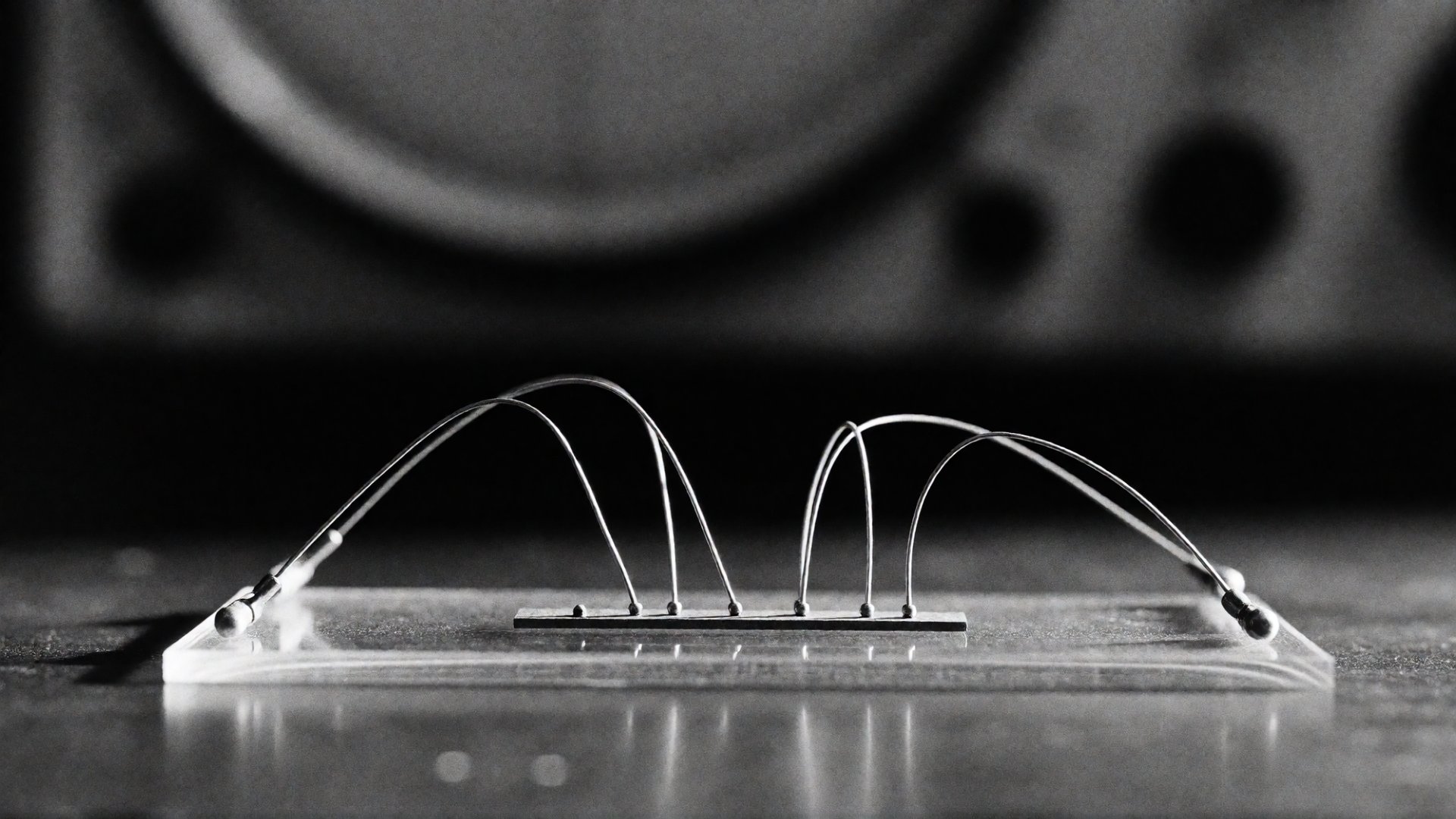
DALLAS, SEPTEMBER 1958 - On 12 September at Texas Instruments, engineer Jack Kilby showed his managers a circuit made in a new way. All its components sit in one small bar of the material germanium, about 11 millimetres long and 1.6 millimetres wide. Connected to a screen, the circuit showed a steady wave when a switch was pressed.
The problem: too many separate parts
Every electronic circuit is made of components such as transistors, resistors and capacitors. A transistor amplifies a signal or works as a switch, a resistor holds back the current, and a capacitor stores a small amount of charge. A radio has dozens of them. A large computer or a missile guidance system has thousands.
All those components are made separately and soldered together by hand. That is expensive, it takes a lot of time and it is unreliable: one bad solder joint can stop the whole circuit from working. The more complex the equipment becomes, the bigger the problem. Engineers call it 'the tyranny of numbers'.
The idea: one material for everything
Kilby joined Texas Instruments only this summer. His idea is that all the components can be made in one go from the same piece of semiconductor. A semiconductor is a material that conducts electricity less well than metal, but better than glass, and whose properties can be controlled by adding tiny amounts of other substances. A transistor can be made from it. But the same material, treated in a different way, can also serve as a resistor or a capacitor. That means no more separate components, and no soldering between them.
The test
The circuit Kilby built is an oscillator. This is a circuit that produces an electrical signal going back and forth by itself, the basis of small transmitters and of the clock in a computer. A calm, regular wave appeared on the screen of the measuring equipment. It was the first proof: the circuit works, and everything sits in one small piece of material. The connections between the components are still ordinary thin wires, attached on top of the crystal.
In February 1959 Kilby applies for a patent for 'miniaturised electronic circuits', with transistors, diodes, resistors and capacitors on one small piece of material.
Looking back from 2026
A few months later, Robert Noyce of Fairchild Semiconductor independently made a similar circuit. He used silicon and a process in which the connections are laid on the crystal as thin metal layers instead of loose wires. Modern chips follow his design. Kilby is widely seen as one of the two inventors, and he received the Nobel Prize in Physics in 2000.
Because the components are no longer made separately but all at once, more and more of them can fit on a chip. That is the subject of the next article: in 1965 Gordon Moore predicted how fast this would go. The chips on which AI models are trained are direct descendants of this small piece of germanium.