Nederlands
Tim Berners-Lee invites everyone to join the World Wide Web
In a post on the newsgroup alt.hypertext, Tim Berners-Lee of CERN explains how the World Wide Web works: an address for each document, a server that answers and a reader that displays. The software is free to try.
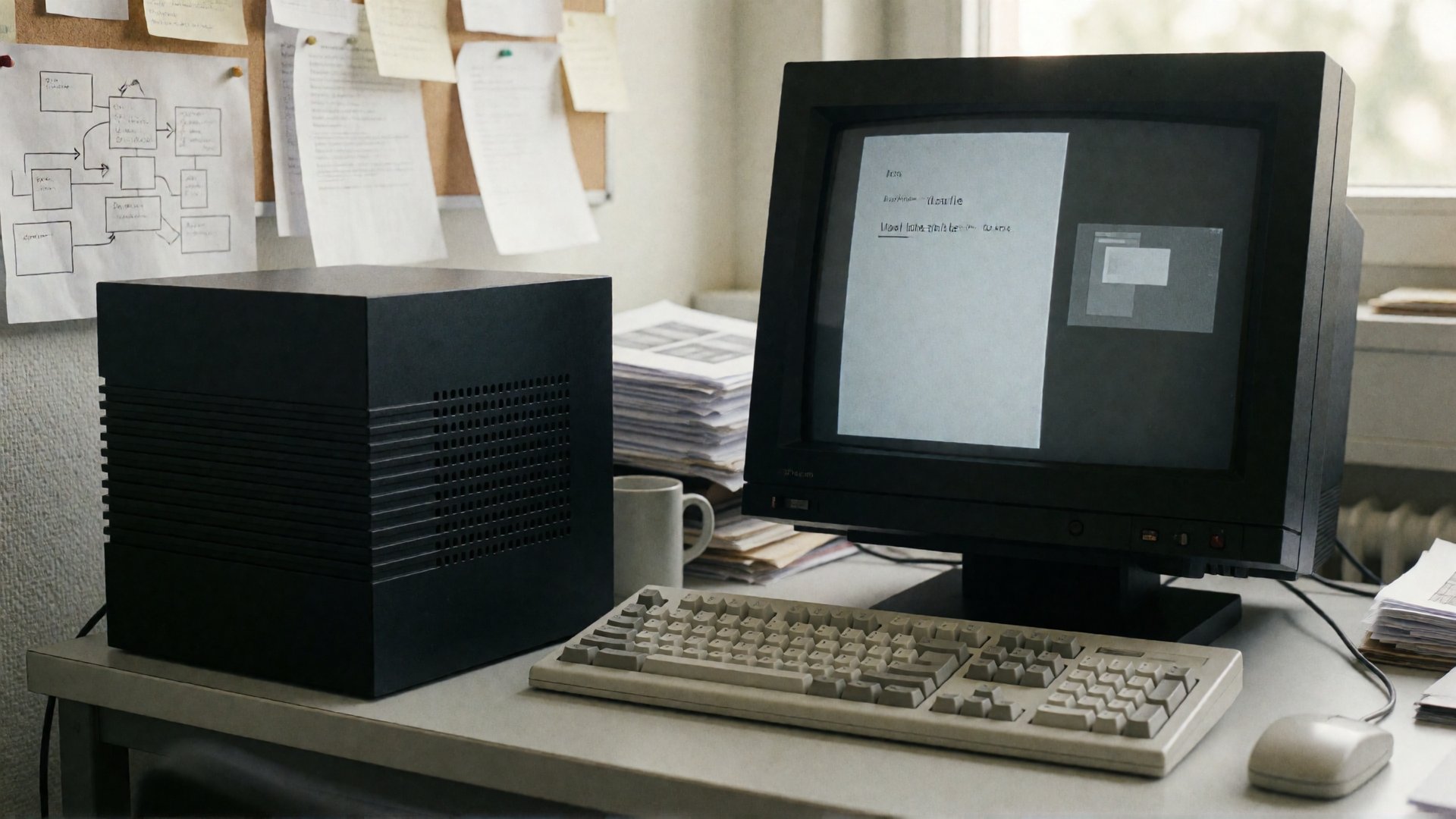
GENEVA, AUGUST 1991 - On the newsgroup alt.hypertext, a public notice board on the network where anyone can read and reply, a post by Tim Berners-Lee has been online since 6 August. Berners-Lee works at CERN, the European physics laboratory near Geneva. A reader, Nari Kannan, had asked whether there is research into references in texts that fetch information from different kinds of sources. Berners-Lee replies with his own project, the World Wide Web, and invites everyone to use the software.
The problem: information in too many places
The project started so that physicists working with high energies could share their data, news and documentation. That information is stored on many different computers. Anyone looking for something now has to know which machine it is on and which program can reach it. Berners-Lee wants a reference in a text, a link, to be able to point to information wherever it is stored. Clicking on the link shows the document.
An address for everything
For this, every link gets an address. It states how the document is fetched, usually the name of the computer it is stored on, and the path to the document on that computer. Nothing more is needed to find something again. The fetching can use routes that already exist, for example files on a connected disk or FTP, a service for copying files from another computer.
The server: the computer that answers
What is new is a simple set of rules, HTTP, that computers use to talk to each other. The user's program sends a request to the computer where the document is stored, a server, and the server sends the text back. A server can hand out ordinary files. It can also create a document at the moment someone asks for it, from a database or from current data. At CERN, such a server is already running on the large computer of the computing centre. It makes the computing centre's documentation readable. A search on a keyword returns a list of links to matching documents, in the form of a document that only exists at the moment of the search.
The reader: the program for the user
Anyone who wants to read the texts needs a program that sends the request and shows the answer: a browser. Berners-Lee has two prototypes. The first is an editor and reader for the NeXT computer, which can also display newsgroups. The second is a simple reader that works on almost any text screen, but cannot read newsgroups yet.
Taking part
The software is still a prototype, he writes himself. The code can be downloaded anonymously via FTP from info.cern.ch, or requested from him by e-mail. CERN holds the copyright, but free distribution and use are generally fine. He is looking for people to extend the web to other fields and to build servers that open up other sources. A separate overview article will follow.
Looking back from 2026
Berners-Lee had submitted his proposal at CERN in March 1989. By the end of 1990 the system worked, with a browser and a server, and in 1991 it went beyond CERN. On 30 April 1993, CERN released the protocol and the code free of rights. That same year Mosaic came out, a browser that could show pictures within the text and send forms. This helped the web become popular quickly.
The web became the largest collection of text and images in the world. That collection is the raw material on which later language models and image models were trained. So the post of August 1991 began as a physicist's invitation to a few colleagues, and grew into the place where AI gets its knowledge.