Nederlands
Open source and open weights
Open source means the blueprint of software is public and you may use it freely. With an open AI model, the weights, the numbers in which it stores its knowledge, can be downloaded.
With open source, the source code of software is public, and anyone may use, inspect and modify it under certain conditions. Those conditions are set out in a licence. With AI models you mostly come across the term open weights. The weights, or parameters, are the numbers in which a model stores everything it has learned. If they can be downloaded, you can run the model on your own computer.
It is like a recipe that a restaurant shares: with the weights you have the finished dish and can cook with it. With all the sources as well, such as the training data and the training code, you could rebuild the whole recipe yourself.
How does it work?
Open is a spectrum. Some makers share only the weights, others also the code to run or train the model. A licence usually comes with it that determines what is allowed. The large DeepSeek model, for instance, is under the permissive MIT licence, which means anyone may download and use it for free. Nvidia's OpenShell, software that shields AI agents, falls under the Apache 2.0 licence.
What is called open is not always available everywhere. The Chinese tech company Baidu, for example, released a large model that developers can train further themselves, but its licence does not apply in the EU, the United Kingdom and South Korea (link).
Why it matters
Open models can be checked, improved and run on your own hardware by anyone. The company Unsloth, for instance, made a heavily shrunken version of the open DeepSeek model that runs on a powerful laptop or mini computer with 128 gigabytes of memory, although that costs some accuracy (link). The blueprint for shielding agents is open too: Nvidia offers the software for free, so that anyone can use it (link).
For researchers and small companies, that makes the difference: they do not have to depend on the servers of a few large companies, and they can build on what others have already done.
Articles about Open source and open weights
-
No need to take the AI's word for it: Claude delivers a mathematical proof for software
How do you know whether an AI's work is sound if nobody can read it all? Anthropic has Claude supply a mathematical proof that a small program checks step by step. This way Claude examined 123 widely used software building blocks and found hundreds of hidden bugs.
-
Nvidia lets AI agents do only what is allowed, and checks the rules in advance with mathematics
Nvidia presents OpenShell: free software that lets AI agents work in a sealed-off space. A mathematical check looks in advance at whether the rules allow more than intended, and according to Nvidia a separate chip can stop an agent within milliseconds.
-
Free coding model for the laptop was largely developed by AI itself
The AI company Recursive has released Flint, a free AI model that helps with programming and runs on an ordinary laptop. According to the company, its own research AI did a large part of the work: a first step towards AI that improves itself.
-
AI model designs working proteins from a sentence in plain language
Researchers in China have built an AI model that designs proteins from a description in plain language. In four trials, the result actually did what was asked of it: give off light, break down plastic, convert alcohol and help capture CO2.
-
A different order makes AI servers start answering more than three times faster
Engineers from Amazon and Mistral have made the open software vLLM, which many companies use to run AI models, work together more cleverly. With long questions, the first word of the answer appeared more than three times faster in their test. The new method is free to use.
-
AI researcher learns from its own work and comes up with better and better hypotheses
The young company PhAI Labs built a team of AI agents that comes up with research ideas, tests them and keeps track of what worked. The system learns from that record, and its hypotheses improved after two rounds. The code and model are publicly available online.
-
Large open AI model from DeepSeek now fits on a computer with 128 gigabytes of memory
DeepSeek's new open AI model is too big for an ordinary computer. The company Unsloth made a heavily reduced version that runs on a powerful laptop or mini computer with 128 gigabytes of memory. This costs some accuracy.
-
Physicist lets AI swap calculation methods between fields: 36 papers in three months
Harvard physicist Matthew Schwartz had the AI model Claude apply calculation tricks from one field in another. With 19 colleagues, that produced 36 scientific papers in three months, from sunspots with a life expectancy to a rainforest that changes faster than expected.
-
Home-built drone flies and steers with a single propeller
Maker Joshua Bird built a small drone at home that flies and steers with one motor and one propeller. The secret lies in a hinge in the hub and lightning-fast motor control. The design files and code are free online.
-
Nvidia releases open AI models for digital assistants on servers and laptops
Nvidia has released three new open AI models for assistants that carry out tasks on their own. The largest runs in companies' data centres; the smaller ones simply work on a laptop. According to Nvidia, the large model beats top models on specialist tasks after extra training.
-
Made-up company data with a known answer teaches AI agents to analyse better
Researchers from Meituan and Chinese universities build fake worlds full of messy files, and they know exactly what lies behind them. That makes it possible to check whether an AI agent really draws the right conclusion. A model that practised with them became clearly better at data analysis.
-
Researchers let an AI agent think partly without words: faster and cheaper
Researchers from Stanford and Together AI let an AI agent do part of its thinking without writing it out. It only switches to text to look something up or to answer. According to them, it works up to 2.6 times faster this way and scores better than comparable systems.
-
AI model IRIS reads which signals cells in an embryo have received
Researchers at MIT and the Whitehead Institute have built an AI model that can tell from a cell's gene activity which signals that cell received from its neighbours. With that knowledge, they have already improved a lab recipe for growing precursors of lung tissue from human stem cells.
-
Meta releases Muse Spark Open: a large AI model for programming that also runs on your own computers
Meta has released Muse Spark Open, a large AI model for programming and independent agent tasks that anyone can download. According to Meta, it is the strongest American open model so far, and it even runs on two Mac Studios.
-
Lab-grown human brain tissue learns to balance a virtual pole with an AI coach
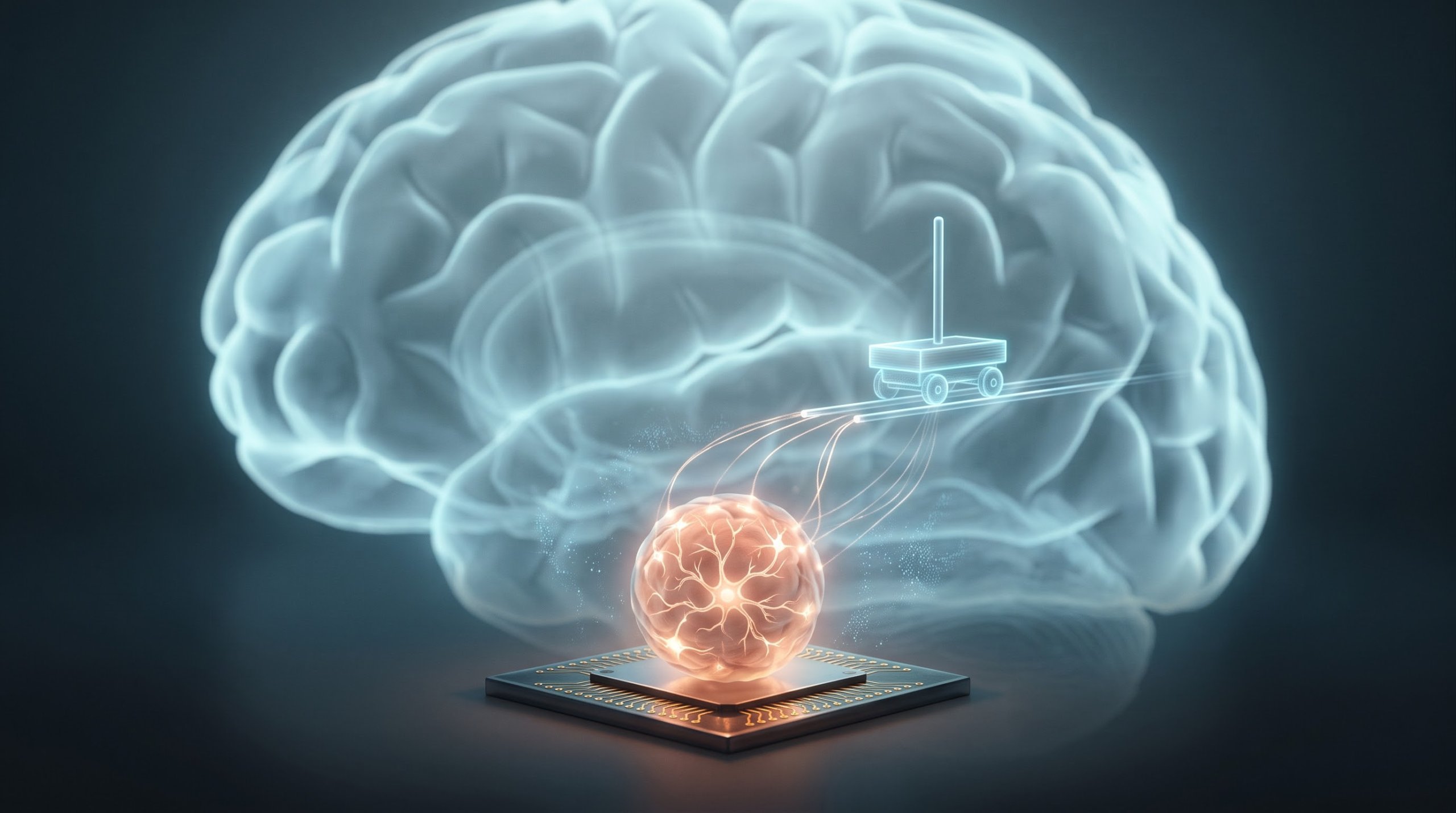
At a meeting in Silicon Valley, a team from UC Santa Cruz showed how cultured human brain tissue learns a classic control task: keeping a pole upright on a cart. An AI algorithm acts as the coach. A volunteer with a keyboard could barely keep up with the tissue.