Nederlands
Physicist lets AI swap calculation methods between fields: 36 papers in three months
Harvard physicist Matthew Schwartz had the AI model Claude apply calculation tricks from one field in another. With 19 colleagues, that produced 36 scientific papers in three months, from sunspots with a life expectancy to a rainforest that changes faster than expected.
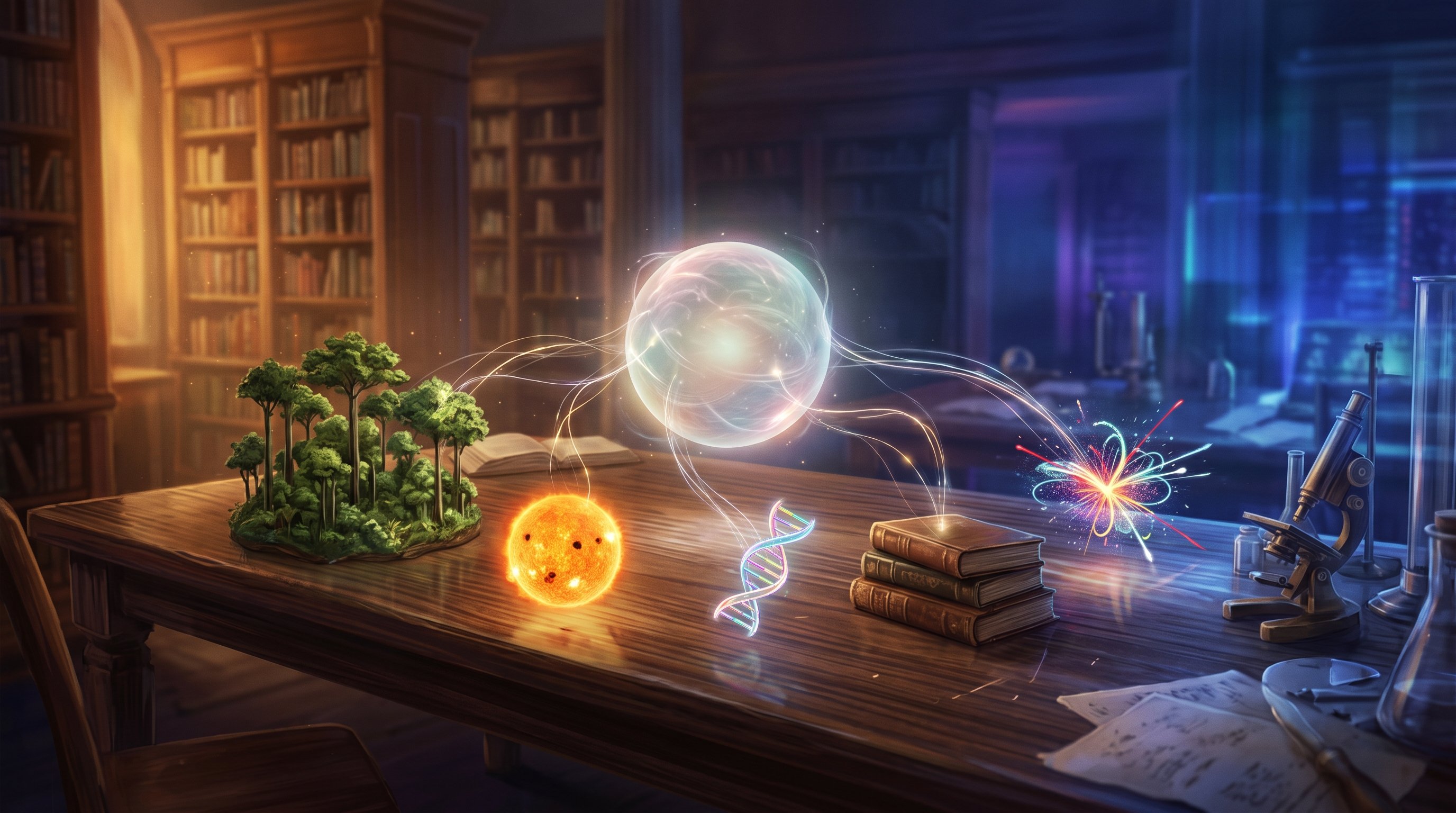
An astronomer who studies sunspots does not read journals on population research. A forest ecologist does not delve into particle physics. Yet such fields sometimes use exactly the same mathematics. A calculation trick that has been routine in one field for years can solve a stuck question in another. Only almost nobody sees it, because nobody knows all fields at once.
An AI model, however, has read the specialist literature of all those fields. The American physicist Matthew Schwartz of Harvard wanted to know whether AI can build bridges between fields in this way. He worked for a while as a visiting researcher at the AI company Anthropic and described the results on 1 October 2026. Together with 19 colleagues and the AI model Claude, he worked on 36 scientific papers in three months, spread over 18 fields.
Problems tailored to the AI
Schwartz first tried to use Claude as a kind of research assistant. That worked moderately: the model kept needing to be steered. So he turned it around. He looked for problems that suit what AI is already strong at: a great deal of specialist knowledge, good programming and reading papers and data at lightning speed. He calls such problems "Claude-shaped problems".
He started in his own field, particle physics. There, physicists calculate what happens when particles collide, as in CERN's particle accelerator near Geneva. The calculation methods for this were scattered across many papers and programs. Claude combined them into a single toolkit. With it, the model worked out 30 such calculations completely. Half of them had never been calculated by anyone before.
Then Claude noticed something: the same kind of sums also turns up in fields that have nothing to do with particles. From some 400 possible problems, Schwartz and subject experts chose the most interesting. Five examples show how such a leap works.
Sunspots with a life expectancy
Demographers calculate how long people live on average and how the chance of dying changes with age. Insurers and pension funds use that method every day. The team applied it to something completely different: all the sunspots recorded since 1874.
Sunspots are dark patches on the Sun that last from days to weeks. Using the demographers' method, it turned out that they have a kind of old age: the longer a spot exists, the greater the chance that it will disappear the next day. The team extended the approach to spots on other stars. That is useful for astronomers looking for planets around other stars, because such starspots can disturb that search.
A rainforest that changes faster than chance explains
On Barro Colorado, an island in the Panama Canal, ecologists have been counting all the trees in a patch of rainforest for decades. A well-known theory says that the mix of tree species changes mainly by chance: which tree falls over and which seed comes up in that spot. Since 2005 there had been a formula to test this precisely, but it could not be calculated for a large forest.
Claude recognised in that formula the same kind of sum as in particle physics, and calculated it with the toolkit. The outcome: the species mix changes 4.5 times faster than chance can explain. So more is going on. At the suggestion of an ecologist, the team looked at that difference. It built a model in which tree species each have their own strategy: tough survivors, fast growers and species that mainly produce a lot of fruit. That model is now being tested in other forests.
An overlooked copying process in our DNA
Our DNA comes in pairs of chromosomes: one from your mother, one from your father. Sometimes a cell copies a piece of one copy over onto the other, a bit like copy and paste. This is called gene conversion. Almost all analyses of heredity leave it out.
A formula from population genetics that describes how natural selection shapes rare mutations had not been solved in a usable form for thirty years. Claude solved it with mathematics from physics. The team then searched 5.7 billion pairs of small DNA differences from a large international DNA database. In them they found signs of gene conversion, the process that is missing from many calculations.
Stress rules of more than six thousand languages
Not every project was a leap between fields; sometimes it was about a great deal of reading. Languages differ in where the stress falls. In Finnish it is always on the first syllable, in Polish usually on the second-to-last. Linguists had collected such rules by hand for a few hundred languages.
Claude searched all freely available linguistic literature. Together with three linguists, this produced a database with the stress rules of 6,072 languages. For almost every language, the passage from the source where the rule comes from is included, so that anyone can check it.
Are the figures in economic studies right?
Economics journals ask researchers to supply their calculation files, so that others can reproduce the results. Whether that really works is checked by almost nobody: it is a lot of manual work. The team built an AI tool that re-ran the files behind 4,452 papers from five leading journals, about 30,000 programs. It converted them from expensive commercial software to free software, and compared almost every number with the tables in the published papers.
Caveats and next steps
Schwartz is open about the limitations. Many connections that Claude found were technically correct, but only became interesting after an expert in that field had sharpened the question. In the case of the rainforest, the ecologist expected his colleagues to shrug at the bare outcome; only the follow-up question made it new.
Claude also tends to say too quickly that something is finished. According to Schwartz, "done, with one caveat" often means that it is not finished at all. So he kept having the model explain its results until he believed them himself. In fields he knows less well, he brought in experts.
The 36 papers are preprints: they still have to be reviewed by other scientists, and some of the results are being checked further.
The next step is for other researchers to apply the tools to their own questions. That is possible: the toolkit is called BootLoops and is free to use and to extend. It also works with AI models from other companies.
What does this mean for the road to the singularity?
This project shows where AI can already speed up science: not by replacing the scientist, but by bringing knowledge from one field to another. Georgia Channing of the AI company Hugging Face told the journal Science that physicists rarely spend months reading, say, linguistics to take methods from it. An AI model has already done that reading, and so sees that a sunspot and a human life can be described with the same sum. Critics sometimes call that 'just combining', but combining can also push back the limits of knowledge.
WATTBA showed earlier that AI agents can independently do heavy calculations from theoretical physics. Schwartz's work takes the next step: using that calculation work across the boundaries of fields. The human chooses which questions matter; the AI finds the tools to go with them. If that cooperation grows, discoveries that used to be chance could become routine.
What is the technological singularity? Read the explanation →