Nederlands
Lab-grown human brain tissue learns to balance a virtual pole with an AI coach
At a meeting in Silicon Valley, a team from UC Santa Cruz showed how cultured human brain tissue learns a classic control task: keeping a pole upright on a cart. An AI algorithm acts as the coach. A volunteer with a keyboard could barely keep up with the tissue.
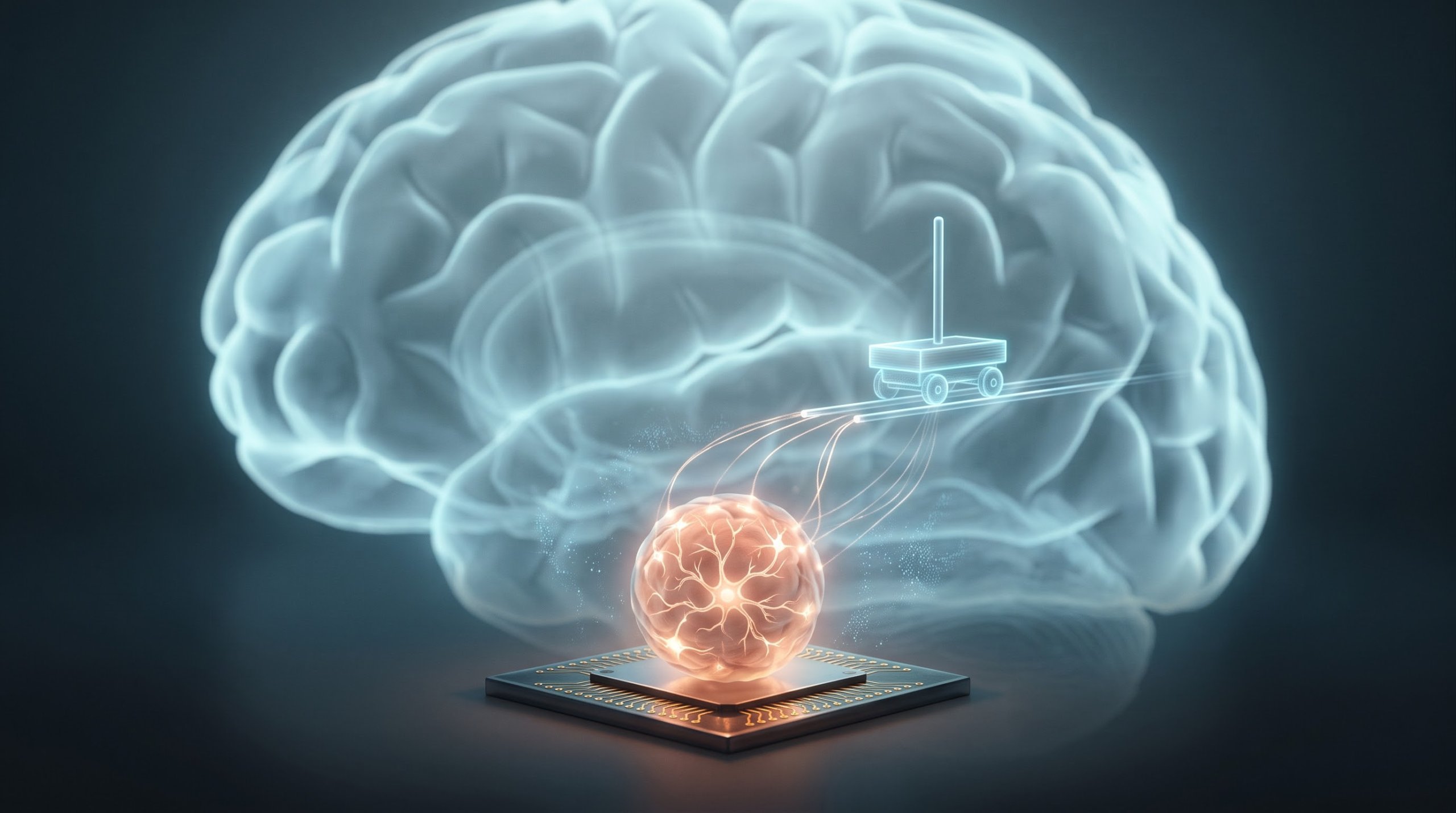
Try keeping a ruler upright on the palm of your hand. You have to keep making small corrections, or it falls over. Engineers know this as the 'cart-pole' problem: a pole stands on a hinge on a cart and only stays upright if the cart moves back and forth in time. It is a well-known test for robots, control engineering and AI.
At a meeting in Menlo Park, in Silicon Valley, the Braingeneers research group of the University of California, Santa Cruz showed that cultured human brain tissue can learn this task. Visitors watched live as a small piece of tissue in the lab in Santa Cruz, connected to a virtual cart for about half an hour, got better and better at balancing. Researcher Ash Robbins then handed a keyboard to a volunteer from the audience to play the same game. The volunteer could barely keep up with the tissue, to the amusement of the room. According to Robbins, this shows how difficult the task is: the tissue does not do well by accident.
A computer game for brain tissue
The tissue is a brain organoid: a small piece of brain tissue grown in the lab from stem cells. Such an organoid is smaller than a peppercorn, but can still contain millions of nerve cells. It lies on a chip full of electrodes. With these, the researchers can see which nerve cells fire, and they can stimulate cells themselves.
The pole and the cart exist only in the computer. With stronger or weaker electrical pulses, the computer tells the tissue how far the pole is tilted and to which side. The tissue's electrical response is translated into a push to the left or right. In this way the organoid plays a computer game, as it were: keep the pole upright as long as possible. If it falls over, a new attempt begins.
An AI coach that steers
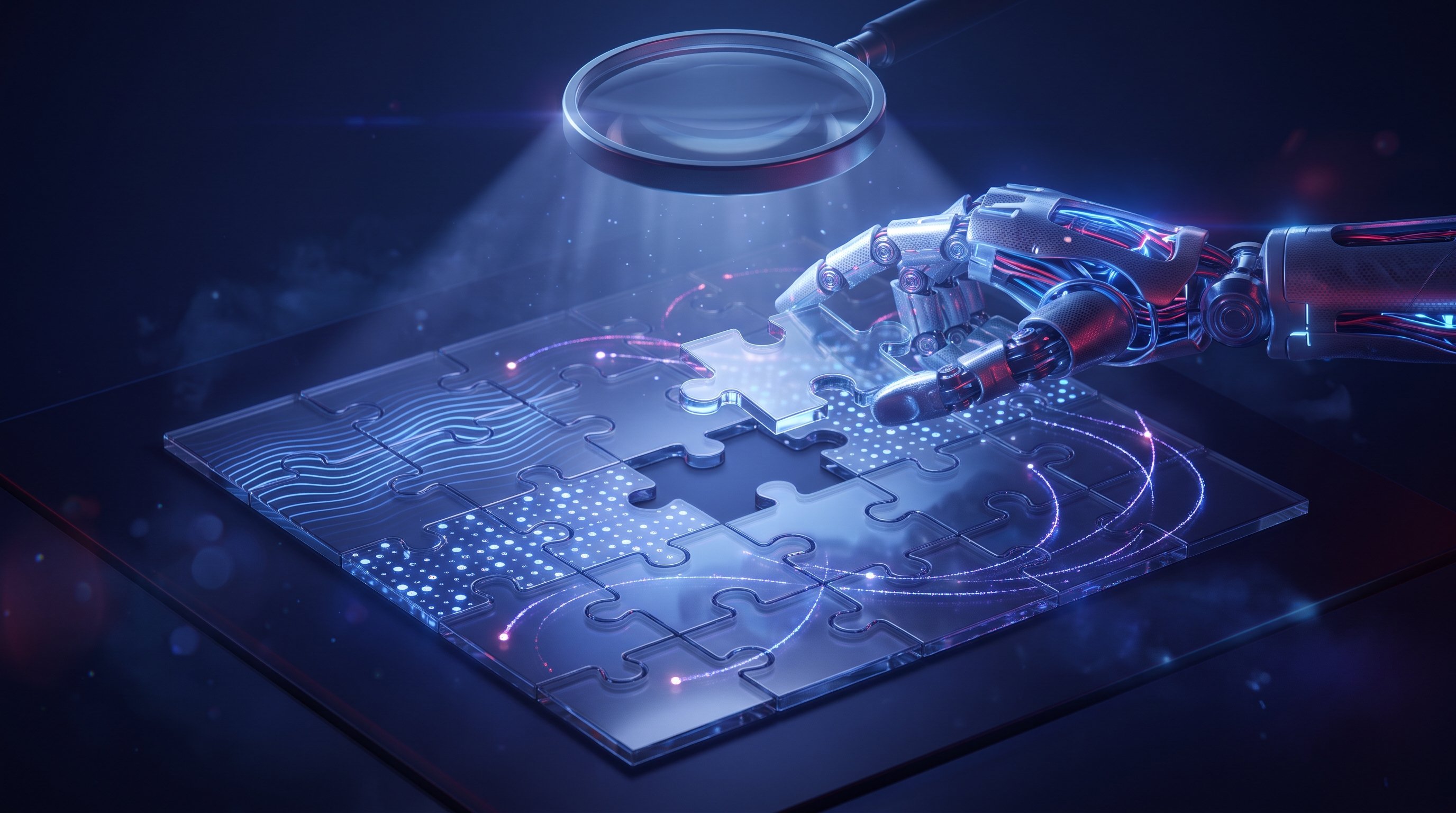
While balancing, the tissue gets no help. After every five attempts, the computer checks whether the organoid is doing better than in the twenty attempts before. If it is doing better, nothing happens. If not, the tissue receives a training signal: a short pattern of electrical pulses on a few selected nerve cells. Which cells these are is decided by an AI algorithm that learns by trial and error, a technique called reinforcement learning. Robbins compares it to an artificial coach that says it has to be done differently, and how.
The team showed earlier in 2026, with mouse brain tissue, that this approach works. The results appeared in February in the scientific journal Cell Reports. The researchers set a strict standard in advance: the organoid had to keep the pole upright for a minimum time to 'win'. When the organoids received training signals in random places, they managed this in 4.5 per cent of the training rounds. With the smart AI coach, that rose to 46 per cent. When the researchers blocked communication between the nerve cells with medicines, the learning effect disappeared. So the tissue really adjusts its own connections. According to the researchers, it was the first thorough scientific demonstration that brain organoids can learn in a goal-directed way. With human tissue, the team is now taking the next step.
Keith Hengen, a biologist at Washington University in St. Louis who was not involved in the mouse research, called those results telling. These are very simple networks of nerve cells, without a body, senses or the reward substance dopamine. Yet this tissue can be steered with targeted stimuli towards the solution of a real control problem. According to him, the ability to adapt therefore lies in the brain tissue itself.
From short memory to longer learning
What has been learned does not stay for long yet. In the mouse organoids, the tissue started again at the old level after three quarters of an hour of rest. David Haussler, scientific director of the Genomics Institute at UC Santa Cruz, expects that more complex organoids are needed for lasting learning, for example tissue with several brain regions that together handle learning in animals. The team is working on this.
Robbins also wrote free, open software, BrainDance. With it, other labs can set up such learning experiments in a short time, without having to program a game, the control of the equipment or a training environment themselves.
AI and brain tissue together
The demonstration was part of a meeting where researchers, funders and ethicists discussed the next step. The Braingeneers want to build a platform on which thousands of organoids grow at the same time and are studied for months. For this they are working with Stanford researcher Jure Leskovec, who builds AI foundation models that learn the 'language' of cells, just as language models learn human language. Together this should show how brain circuits form, respond to medicines and go wrong in disease.
According to the researchers, the goal is not to replace computers or robot control with brain tissue. They want to understand how nerve cells learn, so that they can study how conditions such as Alzheimer's, Parkinson's, autism or schizophrenia affect that ability. Working with learning human brain tissue also raises ethical questions. Haussler therefore had the participants talk with each other in a circle about what happens if this research succeeds, with a contribution from the Stanford ethicist Hank Greely. Those present agreed that ethical rules must keep pace with the science.
What does this mean for the road to the singularity?
In this research, two forms of learning work together: an AI algorithm that learns how best to coach living tissue, and human brain tissue that adapts as a result. This produces a new kind of tool for studying learning in the brain, at the level of individual nerve cells and while it is happening. That knowledge can in turn inspire more efficient and smarter AI. If this can be scaled up to thousands of organoids at once, a detailed picture of how brain circuits form, learn and go wrong comes within reach: a step towards better treatments for brain diseases and towards a deeper understanding of what intelligence actually is.
What is the technological singularity? Read the explanation →
Sources
- Cell Reports: Goal-directed learning in cortical organoids (Robbins et al., 2026)
- UC Santa Cruz: Brain organoids can be trained to solve a goal-directed task
- UC Santa Cruz: The frontier of brain science: AI and organoid research takes center stage in Silicon Valley
- SingularityHub: These Mini Brains Just Learned to Solve a Classic Engineering Problem
- ScienceAlert: Scientists grew mini brains, then trained them to solve an engineering problem