Nederlands
All computers on the ARPANET switch to TCP/IP at once on 1 January
On 1 January 1983 the ARPANET switches in one go to new rules for sending messages. From now on, networks of different kinds can talk to each other.
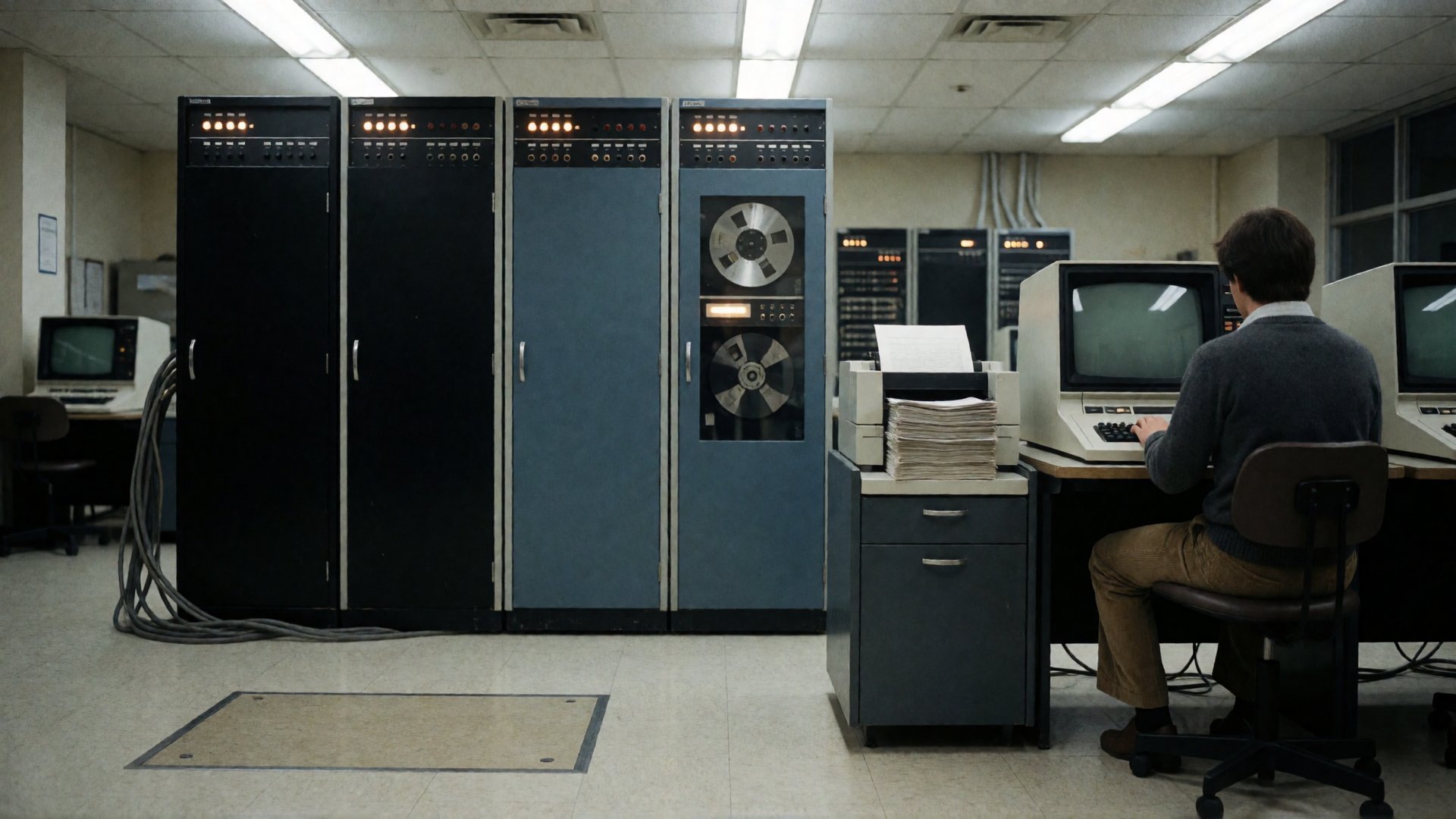
LOS ANGELES, JANUARY 1983 - On 1 January the ARPANET, the computer network of American research institutions, switched in one go to new rules for sending messages. They are called TCP/IP. All connected computers had to switch at the same time. Any computer that had not done so could only talk to the rest through workarounds. The switch was prepared over several years and has gone smoothly so far.
Rules for a conversation between machines
A protocol is an agreement on how computers send each other messages: what a message looks like, how the receiver confirms that it has arrived and what happens when something goes wrong. Without the same agreement, two computers cannot understand each other. Until now, the computers on the ARPANET talked using NCP, the Network Control Protocol. NCP was made for that one network. It turned out to be unsuitable for the packet radio networks and satellite networks that came later, networks that behave differently from the fixed lines of the ARPANET.
A network of networks
TCP/IP was devised by Vint Cerf and Bob Kahn, who published a design for it in 1974. The idea: each network may work differently inside, and a shared agreement hides those differences. That agreement has two layers.
The lower layer is IP, the Internet Protocol. IP gives every computer an address and sends small packets to their destination, through relay stations called gateways. A gateway passes packets on from one network to another. IP does not promise that a packet will arrive. It does its best.
The upper layer is TCP, the Transmission Control Protocol. TCP makes sure things still go right. It numbers the pieces of a message, puts them back in the right order at the receiving end, throws away duplicates and sends lost pieces again. This work is done by the computers at the start and the end, not by the network in between.
It is like posting a long letter in numbered envelopes. IP is the address on each envelope and the post office that forwards it, even when other carriers handle it along the way, not just the local postman. TCP is the number on the envelope: the receiver sees which one is missing and asks for it again. In 1978 the network designer Jon Postel split the original design, which was one program, into these two parts.
Why everything on one day
The switch is a 'flag day': a fixed day on which everything changes at once. There is no other way. Computers that still speak NCP and computers that speak TCP/IP cannot understand each other. So all computers had to switch at the same time, and there was no going back.
Postel wrote down the schedule in November 1981. Every institution with a computer on the network had to start preparing in 1982. Until the switch, relay stations made sure that computers that only spoke NCP could still talk to computers that only spoke TCP/IP. New computers got only TCP/IP. The schedule assumed about 200 computers at the start of 1982 and about 250 at the end of that year. In March 1982 the US Department of Defense declared TCP/IP the standard for all military computer networking.
The switch opens up new possibilities. The ARPANET can soon be split into a part for military use, MILNET, and a part for research, and both will stay connected to each other.
Looking back from 2026
TCP/IP is still the basis of the internet. The article about the first message on the ARPANET in 1969 describes how a single network worked with packets, through small relay stations that each passed a packet on. The step of 1983 is the next one: not one network, but a shared language that lets networks of all kinds be linked together. That allowed the network to grow without anyone having to rebuild everything.
For AI, this meant that a worldwide network appeared, full of text, images and sound from billions of people. Language and image models learn from that material. Without a shared language between networks, the networks would have stayed separate, and that material would never have come together in one place.