Nederlands
Radio waves drive current in the heart of a fusion plasma: a step towards a power plant that runs non-stop
Researchers at the US fusion reactor DIII-D have clearly shown for the first time that helicon waves, a kind of radio wave, can drive current in the heart of a fusion plasma. This is a step towards fusion power plants that run continuously instead of in short pulses.
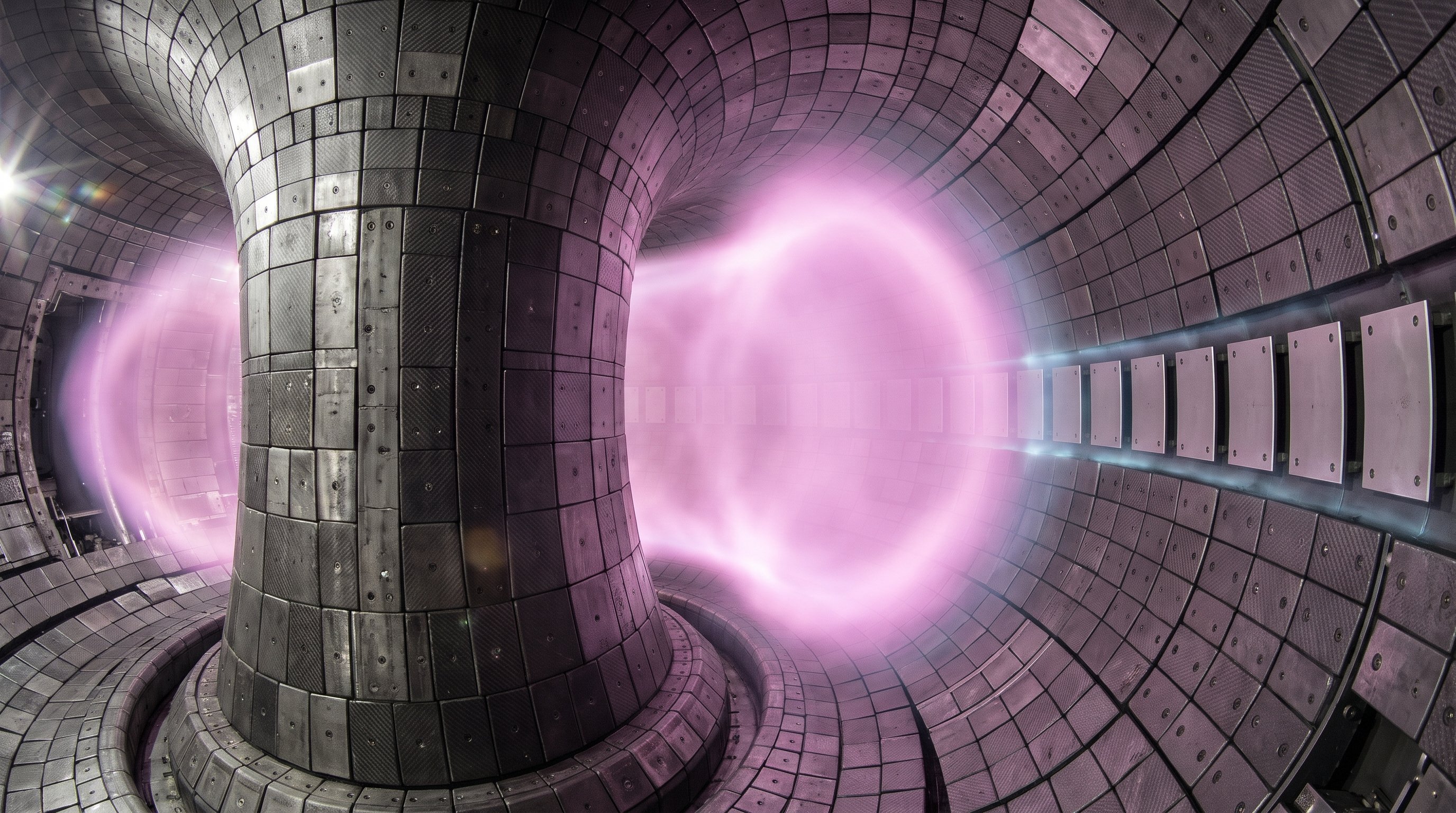
Researchers at the DIII-D fusion reactor in San Diego have clearly shown for the first time that a particular kind of radio wave, called helicon waves, can drive an electric current deep inside a fusion plasma. They describe the result in the journal Physical Review Letters. DIII-D is a research reactor run by the US company General Atomics. The work was led by Jeff Lestz, Bob Pinsker and Bart Van Compernolle of General Atomics.
That may sound technical, but it touches a big problem of this type of fusion reactor: for now, they can only work in short pulses.
Why fusion reactors now work in pulses
A tokamak is a fusion reactor shaped like a doughnut. Inside is plasma: a gas so hot that atomic nuclei can fuse together and release energy. Strong magnets keep the hot plasma away from the wall. This also requires a large electric current that flows around inside the plasma itself.
Today this current usually comes from a large coil in the middle of the doughnut, which works like a transformer. A transformer only produces current while the magnetic field of the coil keeps changing, and that cannot go on for ever. When the coil reaches the end of its range, the reactor has to stop and start again. At DIII-D, one such pulse lasts about ten seconds. At ITER, the much larger test reactor being built in France, normal operation is planned to last less than about a thousand seconds, roughly a quarter of an hour.
A power plant would rather run day and night. For that, the current in the plasma has to be kept going in another way.
Radio waves as a drive
One way is to drive the current with radio waves. The waves travel around the doughnut in one direction. The plasma absorbs them, and in doing so they push electrons mainly in that direction. This creates extra current.
Such methods already exist. But in the large, hot plasmas of a real power plant, some waves are already absorbed at the edge, before they reach the middle. Helicon waves are absorbed less quickly by the electrons, so they can reach deeper.
At DIII-D, the researchers used a helicon system with a power of about one megawatt. The waves come from a special antenna built by General Atomics: a row of transmitting elements along the doughnut, each vibrating just a little later than its neighbour. This works like a wave in a stadium: because everyone stands up just after their neighbour, the wave moves in one direction.
What the measurements show
The waves gave up their energy in the heart of the plasma, as the calculations predicted. To see whether they also produced current, the researchers compared experiments with helicon waves to experiments in which they used a similar amount of ordinary heating with microwaves. With the helicon waves, the magnetic field in the plasma changed clearly faster. According to the researchers, this is a strong sign of extra current, and the first convincing evidence that helicon waves can drive current.
According to Pinsker, attempts at similar experiments go back to the mid-1980s. The calculations of that time predicted a very weak effect. The idea stayed alive partly thanks to the Russian physicist Victor Vdovin of the Kurchatov Institute, who was a strong supporter of it.
The next steps
The experiments were done at modest power. The plasma was in an operating mode that holds its heat less well than the mode a power plant would use. The next step is to work with stronger transmitters and to test other operating modes. It also has to become clear how efficient the method is.
Other projects choose other waves. The UK prototype power plant STEP, for example, plans to use almost two hundred microwave sources: simpler to build in, but with a low efficiency for now. Pinsker thinks it possible that helicon waves will eventually become the chosen approach, but finds it too early to say for sure.
What does this mean for the road to the singularity?
Fusion energy promises a lot of electricity without CO2 emissions. For that, a power plant must be able to run continuously. This result shows for the first time that helicon waves can help with this, because they produce current exactly where it is needed: in the heart of the plasma. There is still a lot of work to do, but every step towards a fusion power plant that runs day and night brings a large, clean source of energy closer. And energy is exactly what data centres and new technology need more and more.
What is the technological singularity? Read the explanation →